Many years back when I covered Warren I made a post of my favorite Warren stories; now the time has come to do the same for Skywald. For Warren it was fairly easy to determine my top stories, as there were quite a number that really stood out to me just from memory. For Skywald it was a bit harder. Very few stories were as striking to me, especially from an intellectual level. Not that I didn't enjoy going through the Skywald library; I absolutely did, but it unfortunately never hit the heights for me that Warren did. That said, I've spent the time going back over my prior posts and synopsis and have come up with my list of what I considered the highlight of Skywald. While my picks were primarily based on the writing, I will admit that the art at times also came into play, and many of the stories were concentrated from a few artists. Hewetson was the writer for all but one of those included in my top 10 list.
This list is specifically one-time stories; all ongoing series have been excluded. This wouldn't have had that major an impact on the list aside from a few stories that come to mind including one of the stories in the Shoggoths series, one of the stories in the Autobiography of a Vampire series and the Saga of the Victims series as a whole. I'm not sure if all 3 would have made my top 10, but they'd at least rank among my honorable mentions, which I have included below:
Time Stop - Nightmare #2
Gruesome Crewcut - Psycho #3
Slime World - Nightmare #5
Broken Sparrow - Nightmare #6
Horror Has 1 Thousand Faces - Psycho #7
Alone - Nightmare 1972 Special
The Transplant - Psycho #10
The Comics Macabre - Scream #1
What the Hell is Dracula Doing Alive and Well in 1974?! - Nightmare #19
A Tale of Horror -Nightmare #20
I Never Heard of a Ghost Actually Killing Anyone! - Scream #9
Kill, Kill, Kill, and Kill Again - Nightmare #22
My Top 10 Skywald Stories
10. "Whether Man or Scarecrow" - Nightmare 1973 Winter Special; story by Al Hewetson, art by Felipe Dela Rosa
This one is a fun combination of a Pinocchio-type story (with a scarecrow coming to life instead of a puppet) and the concept of having wishes. A scarecrow named Perry is approached by an old man one day who claims he can grand him three wishes. In a traditional tale, Perry would take advantage of this to become human and be with his crush, the farmer's daughter, Judy. And well, while he certainly tries for that, things go spectacularly bad for him in every way possible. Like many stories on this top 10 ranking, Hewetson takes things really over the top here, and its a blast.
9. "...Suffer the Little Children" - Psycho #9; story by Al Hewetson, art by Xavier Villanova
A governess arrives at a mansion to take care of two young children, Flora and Miles, only to find that things are totally not what they seem. Both children are mentally disturbed, impacted by the recent death of their brother. From here the story takes a lot of twists and turns, bringing the reader on an exciting ride up to its surprising ending.
8. "A Plot of Dirt" - Psycho #9; story by Doug Moench, art by Felipe Dela Rosa
Like EC comics, Skywald did a number of stories featuring corpses returning from the dead; this story was one of the best. It features Philip, a corpse summoned from the grave by the evil Craig, who was responsible for his death due to jealousy over a woman. Largely told from Philip's perspective, we have a sympathetic protagonist, despite being a corpse and hope he will be able to come out of Craig's spell and get his revenge.
7. "The Old Vampire Lady" - Psycho #16; story by Al Hewetson, art by Jesus Duran
Every once and a while Hewetson would eschew the typical type of plot and instead provide us a story that acted more as a historical account or biography. This is one of such stories. A young photographer comes across the titular vampire lady, who tells him her horrifying life from her childhood to now. Jesus Duran was one of my favorite Skywald artists and he does an effective job providing a scary atmosphere throughout.
6. "Now... Another Maniac!" - Psycho #18; story by Al Hewetson, art by Maelo Cintron
This story was a rare one drawn by Maelo Cintron that did not feature the human gargoyles characters. It also is unique for a Skywald story in that it has no supernatural element to it. Our protagonist plans to kill a man. While he is able to successfully pull it off, a bike he ran over comes back to haunt him in a big way. The story also is memorable for me as the first Skywald story I ever read, due to coming across it in a collection of horror comic stories years ago.
5. "The Artist's Other Hand" - Psycho #14; story by Al Hewetson, art by Jesus Suso Rego
One of the really fun things about Skywald was their willingness to break the fourth wall, and this story is a perfect example of that. It stars the story's artist, Suso, who gets sick of the ridiculous story his editor, Hewetson, writes for him. The two get into a big conflict over how to improve the story, and neither can come to an agreement resulting in a fist fight between the two. Hewetson loved to put himself in his stories (off the top of my head I think this happened at least 10 times, if not more) and this is the best such example.
4. "Limb from Limb from Death" - Nightmare 1972 Special; story by Al Hewetson, art by Pablo Marcos
One of Skywald's most gory and over the top stories. A trio of men are trapped in the Sahara desert. One of them, a doctor, convinces the other two that the only way they have to survive is to eat each other. Each of the other two men gives up an arm for this, under the promise from the doctor that if they are saved he will have his own arm sawed off. Well, they are saved before that happens, so the big question is whether the doctor will actually go through with it?
3. "Diary of an Absolute Lunatic" - Nightmare #14; story by Al Hewetson, art by Felipe Dela Rosa
A man named Munro appears in the 1920s in an insane asylum, claiming to be a time traveler. Coming from 70 years from the future, he tells of how a madman threatens to destroy the Earth if his demands are not met. Munro makes his way through time, including witnessing the Earth blow up! Is he telling the truth? While we don't know with absolute certainty, the ending to the tale provides a pretty strong indication. Beyond being a fun story to read, this story also boasts some strong artwork from Dela Rosa, particularly during the time travel sequence.
2. "The Day That Satan Died" - Psycho #13; story by Al Hewetson, art by Felipe Dela Rosa
This story proves that Hewetson could turn out a great story even if the ending is literally spoiled in the title. A young woman hijacks a small plane and then purposely causes it to crash into a snowy mountain. Its all part of a plot on her part to get one of the other passengers to sacrifice their soul so she can satisfy a deal with Satan to preserve her youth. Only she soon learns to her dismay that her fellow passengers include the abominable snowman, a vampire and Satan himself! The sheer ridiculousness of this story makes it quite a fun one to read and Dela Rosa's artwork serves the story quite well.
1. "The 13 Dead Things" - Psycho #15; story by Al Hewetson, art by Jesus Duran
An imprisoned count in the 17th century sits in a cell in a tower, and comes up with an idea about how to fake his death so he can escape and take revenge. For pages on end we see our protagonist imagining himself going on a rampage and brutally killing those who have wronged him. When he realizes a possible flaw in his escape plan this doesn't stop him from continuing to plot his revenge, and we see him once again slaying those who have wronged him, but this time as a corpse! The story is topped off by a hilarious, but very fitting ending. This story is so ridiculously over the top it needs to be seen to be believed. Just when you think it can't get any more absurd after seeing our protagonist kill so many people in horrifying ways, we get it repeated with him doing it as a rotting corpse.
Showing posts with label dela rosa. Show all posts
Showing posts with label dela rosa. Show all posts
Saturday, May 9, 2020

Sunday, January 12, 2020
Psycho #18
 Xavier Villanova provides the cover for this issue, cover dated May 1974. An interesting concept, in the form of a jigsaw puzzle!
First is "The Macabre" by Al Hewetson (story) and Ricardo Villamonte (art). Movie actor Basil's agent comes up with an idea for him to hype up his role as vampires by having him pretend to be a vampire in real life, carrying around a coffin with him. But this leads to a real vampire encountering him, and when he discovers it is all a gag, the vampire bites him, turning him into a vampire for real! Basil flees from society, living on an island and only succumbing to his urges to bite someone occasionally. He eventually comes up with a cure for vampirism and drinks it, turning himself back into a regular human. Unfortunately for him at that very moment a mob of villagers have come to the village and slay him with an ax! Villamonte's art as often is the case leaves a lot to be desired, but this was a fairly strong story with a hilarious ending.
Next is a one page pin up of Lady Satan as drawn by Pablo Marcos. I'm not sure why we are featuring her in Psycho when she usually appears in Scream.
 |
| "The Rats' |
Fourth is "A Descent into the Maelstrom", an adaption of the Edgar Allen Poe story by Al Hewetson, with Cesar Lopez providing the art. Two men look into the sea at a maelstrom, aka a whirlpool far off. The older of the two tells of how he was caught up in one a while ago. His ship was blast into pieces, with only him and his brother left alive. He eventually realized that in order to survive he had to be as light as possible and tied himself to a barrel. Meanwhile his brother refused to leave the much larger remains of the ship and was sucked into the whirlpool while he survived. As the story ends we realize that despite looking old with his white hair, he is a young man and looks that way due to his experience. A rather unconventional Poe story, that isn't macabre as usual and is more of an adventure tale.
 |
| "Now... Another Maniac!" |
Next is "Uncle Ed's Grave" by Al Hewetson (story) and Alphonso Font (art). The titular Uncle Ed speaks to his nephew Ralph, admitting that he is a vampire. Ralph does not believe him, but Ed claims that most fantastical things related to vampires aren't real and he is nonetheless one. He speaks of how his own uncle made him a vampire when he was a child and once a year he drinks someone's blood, but otherwise lives a normal life. Ed tries to attack Ralph, but he throws him to the ground and he appears dead of a heart attack. We find that Ralph came here to seize his uncle's jewels, but with him now dead he needs to dispose of the body. He plans to bury him in the local graveyard. He talks of how Ed wasn't ever discussed as part of the family and his apparent insanity was the reason why. Yet when about to mark a gravestone for him, Ralph realizes that Ed was born in 1822 and is 150 years old, which explains why he was never spoke of. Suddenly Ed's arms break out of the ground and grab a hold of Ralph. It is here where the story ends, quite abruptly. I wonder if we'll get a second part as this seems like an odd place to end it.
 |
| "Uncle Ed's Grave" |
Last is "Monster, Monster, Watch Them Die" by Augustine Funnell (story) and Ricardo Villamonte (art). The story begins with our werewolf protagonist going on yet another rampage. Then we see Dominik, prince of the gypsies shoot Kirsten and we find that the veiled woman from the previous story has seized the amulet and restored her beauty. She leaves Nola to Dominik, who takes her at gunpoint and we later find has killed her. Our protagonist, discovering this, becomes enraged, turns back into a werewolf and kills Dominik, then cries over Nola's death. The gypsy storyline finally resolved, this would be the perfect place to end this very mediocre series, but alas, the ending states we will get more chapters...
Tuesday, December 24, 2019
Psycho #17

We begin with "The Death Pit", a one page frontispiece by Al Hewetson (story) and Domingo Gomez (art). Featuring a band of the dead, this reminds me of the story "Phantom of the Rock Era" all the way back in Nightmare #4.
The first full length story is "The Black Sculpture of the Pharaohs" by Al Hewetson (story) and Ricardo Villamonte (art). A pharaoh obsesses over a cat statue he claims took him 20 years to find. He gets into an argument with his queen and stabs her to death, claiming it was an accident. She is buried in a tomb as a mummy, but soon after the pharaoh realizes the cat statue is gone, as is his wife's mummy! It is shown that this is a plot of his high priest, who seized the statue and the mummy to make it look like the dead queen did it. However the dead queen's mummy is indeed alive and kills the priest, then tosses his body where the pharaoh and others can see it. The pharaoh now knows the high priest was behind things and orders his men to search for his henchmen for the statue. He doesn't realize that the statue is in the tomb with the mummy of his dead queen. A rather weak start to the issue, with all that trouble about a statue and some weak art from Villamonte.
 |
| "The Death Pit" |
Next is "This is Your Life, Sam Hammer, This is Your Death!" by Al Hewetson (story) and Jose Cardona (art). Police officer Sam Hammer is criticized by his boss for not making enough arrests and to catch some criminals in the act. Through information from a bum, Sam and his partner confront a crew of criminals making fake license plates. While trying to arrest them Sam is forced to kill one of them and his partner is killed in a machine. Suddenly, crazy things start happening. His sandwich is alive! He finds a corpse in the bathroom. The time clock punches him. And so on. He eventually wakes up at his own funeral! He is told that he is on a TV show, This is Your Life, This is Your Death. His partner and everyone else was in on it. They get prizes for their participation, while Sam gets punished by being killed! Quite a ridiculous story, and its a good thing they revealed the big action from the license plate criminals as being an act, as multiple people dying over fake license plates is considerably absurd.
 |
| "This is Your Life< Sam Hammer, This is Your Death!" |
Fourth is "These Are the Things That Are Dead" by Al Hewetson (story, credited to Howie Anderson) and Felipe Dela Rosa (art). A group of guys in Manhattan decide to steal a subway train. They jump inside, knock out the conductors and cause a big crash, jumping out of it mere seconds in advance. They then grab a car and go on a driving spree, hitting a parked car. When the policy arrive and find the car empty, we realize that the three of them have been dead all this time. Some okay art from Dela Rosa here, but the ending to this story I could see from miles away.
 |
| "The Narrative of Skut" |
Next is "The Lunatic Class of '64" by Jane Lynch (story) and Emilio Bernardo (art). Walter Lyman says goodbye to his wife and kids, planning on going to his high school reunion. As he heads there we flashback to Walter being a loser in high school. The girl he liked rejected him due to his pimples. No one would sign his yearbook, he even has a girl who refuses to cheat from his notes when he offers. Walter arrives but surprisingly is treated well by his old classmates. Thinking everyone is in on a secret plot to make fun of him, he knocks over some candles, causing the entire place to burn down. In our final panel we see a classroom filled with skeletons! Lynch does a decent job in her Skywald debut, although I'm not really sure where she was going with the final panel.
Seventh is "The Narrative of Skut" by Al Hewetson (story) and Luis Collado (art). Some mobsters arrive at a local boarding house and shoot up the old lady who runs it. The small sized Skut runs errands for the mobsters including dragging out the body, getting them food and other errands. He decides to rat out the mobsters, revealing their location to another mob who shoot them up. Not wanting to be seen with the bodies, Skut brings them to the basement where the old woman appears, alive, despite the bullets already in her and the more Skut fires into her. She grabs a hold of him and drags him into the grave he dug, trapping him there until he starves to death. Collado's art is very strong here, including a number of very detailed, highly realistic looking panels.
We conclude with "Monster, Monster, Heed Death's Call" by Augustine Funnell (story) and Ricardo Villamonte (art). Our werewolf protagonist, now back to a human, the gypsy Kirsten and her daughter Nola travel, fleeing from the group of gypsies after them seeking an amulet Kirsten has. Kirsten decides to leave the werewolf behind but then the other gypsies arrive and attack her. the werewolf, now back in said form, goes on a rampage, slaughtering all of them except a veiled woman who has stayed back and at story's end removes her veil and swears the amulets will be hers. This series continues to be rather mediocre, with a rather dull, repeated plot and often inconsistent or poor art from Villamonte.
Monday, December 16, 2019
Psycho #16
 Domingo Gomez provides the cover for this issue of Psycho, cover dated January 1974.
First is "The Old Vampire Lady" by Al Hewetson (story) and Jesus Duran (art). A young photographer comes to interview the wretched old vampire lady. She tells him of her past, starting from her childhood and how her headmistress was a vampire. At 10 years old she was bitten and changed into a vampire herself and she would bite classmates and boys. Eventually a man named Baron Meinster who is a vampire comes to see them and they live with him, and our protagonist, now grown up, turns on the headmaster along with Meinster. She and him kill many victims but Meinster is eventually found and killed. Returning home, she finds her mother has died, of a broken heart after finding what came of her daughter. She eventually finds a man who falls in love with and marries her, but upon finding out she is a vampire, his strong religious beliefs cause him to commit suicide by stabbing himself. We return to the present, finding out that the old vampire lady is 175 years old and she brings the photographer to a tomb where she still posses the now rotted body of her husband. Some excellent, macabre art by Duran here and it was a fairly interesting story too, telling us the various events of the titular character's life rather than being focused on just one plot.
 |
| "The Old Vampire Lady" |
Third is "They Lived in Darkkos Manse!", the latest in the Darkkos Manse series, by Al Hewetson (story, credited to Joe Dentyn) and Maro Nava (art). A fugitive named Paul Muni flees from the authorities into the swamp and comes across Darkkos mansion. He climbs to the top of it as his pursuers arrive and sees a humanoid monster who kills his pursuers and dogs, but then climbs the mansion towards him! Paul jumps off, but into the quicksand, which he sinks into. The monster pulls him out and he is now another monster guarding the swamp. Nava's style comes off a bit cartoonish here, but it overall works for this story.
 |
| "The Thing With the Red Ribbon in its Hair" |
Fifth is "The Thing in the Box" by Al Hewetson (story, credited to Harvy Lazarus) and Fernando Rubio (art). A rather odd approach in this story in that only the final panel has any dialogue in it. An old man's wife falls asleep while they are on the porch, and he takes the opportunity to kiss another old woman who stops by. His wife wakes up, sees it and goes to the shed where she grabs a box. She leaves it at her rival's front door, who opens it and some tentacles come out and she dies. The old woman then puts it back in the shed. That's about it, a pretty simple story.
Sixth is "Hunger of the Slaughter-Sludge Beasts!" by Doug Moench (story) and Jesus Suso Rego (art). Detectives Harry and Frank investigate some weird occurrences where bodies are found, reduced to mere skeletons in areas with water or drains such as a bathtub or swimming pool. Meanwhile the wealthy Clinton owns a company that dumps chemicals into the river. Naturally, these chemicals have led to some sludge like creature forming and it is soon revealed that it can take the form of inanimate objects. It turns into a garbage can and then kills a homeless man that goes through it. We then see it traveling through drains and killing various people in their homes and a woman at a laundromat. Harry and Frank discover what is happening when they see the sludge at the lake, but it ends up killing them by taking the form of their car. At the end of the story we see that it even can take the form of a plane and a human being as a man returns home to his wife, who is actually the sludge. A pretty good story here, both horrifying and funny at times and Suso provides his usually strong art performance.
 |
| "Hunger of the Slaughter Sludge Beasts" |
The issue concludes with "Greed" by Al Hewetson (story, credited to Edward Farthing) and Ricardo Villamonte (art). A little girl's parents don't believe her when she tells them of a fish monster. We see that the monster, who is humanoid in form is real and he kidnaps her, telling her he will kill her before their eyes to teach humanity a lesson. He brings her to a cliff and prepares to throw her off in front of the large crowd that gathers to rescue her. The father is able to climb up the cliff and knock the monster off, but in its last moments he shows mercy and tosses the girl onto a cliff so she doesn't die with him. But unfortunately no one sees or hears her, so she dies. Quite a depressing ending here!
Thursday, December 5, 2019
Psycho #15

The frontispiece for this issue is "How to Make a Mummy" by Al Hewetson (story) and Maelo Cintron (art). It features what else, but directions on how to make a Mummy.
We kick the issue off with "The 13 Dead Things" by Al Hewetson (story) and Jesus Duran (art). This story was originally intended for issue 13, and was the cover feature for that issue, but due to a delay in the artwork wasn't published until now. It was certainly worth the wait! This is the most over the top, hilarious Skywald story yet. In the 1600s, the Count of Monte Godo lays chained in the black cells of an asylum, with rats for company. When an old man in the fellow cell dies, our protagonist gets an idea, about how he can fake his death and escape the asylum when they toss a sack with his "dead" body into the moat outside. He imagines how he will get his revenge on the 13 who wronged him. We are treated to panel after panel, for three full pages of our protagonist brutally murdering people one after another. He strangles his wife and her lover. He stabs people through the chest, he cuts their heads off. He bashes a banker's head in, he shoves a knife through the head of his lawyer, he smashes a judge in the face with an ax, on and on, and collects everyone's heads to feed to the rats in the cells. Our protagonist then realizes the downside of his plan, what if the sack is tied too tight, and he drowns? He swears that won't stop him though, and we once again are treated to panel after panel, page after page as our protagonist, now a rotting corpse, brutally slaughters the 13 people all over again. Back in reality, our protagonist decides to set his plan in motion and play dead. But when he realizes he can't move, he discovers that most of his body has been consumed by the rats! This story is such a perfect representation of the Skywald style. There's not much of a plot to this story, but wow, across 12 pages we are treated to about as much over the top mayhem one can possibly get in a short story. Just when you think page after page of our protagonist brutally murdering people is as ridiculous as you can get, we go through it all over again, even more ridiculously as his corpse does it! This was such a blast to read, the best Skywald story thus far.
 |
| "The 13 Dead Things" |
Second is "When the Bad Moon Rises... I Am a Ghoul!" by Rodion Eis (story) and Maro Nava (story). Got no idea who Rodion Eis is; it wouldn't surprise me if its one of Skywald's usual authors under a pseudonym. This story features a couple of newlyweds, Peter and Tina who are on their honeymoon. When Peter gets asked by his employer to take photos of the Andes for a travel feature, they decide to go ahead with it and hire a bush pilot, Stein. Stein is a drunk and due to the plane's battery being dead they are forced to touch down in the Andes, then travel through them, making their way into the mountains where they are attacked by ghoul bats. Eventually Stein is killed and Tina reveals that she is a ghoul herself, desiring to eat his body. Nava's style here is drastically different than that which he used in his prior story, where he looked a lot like Jerry Grandenetti. None of that here. Also the art style is really grimy and dark throughout, at times making it hard to read.
Third is "The Ghoul" by Al Hewetson (story) and Ferran Sostres (art). The passenger ship S.S. Captain Cook makes a trip across the Atlantic. One of its passengers is killed by a beastly ghoul. The passengers of the ship start questioning the captain, even offering their own thoughts on what it could be (a werewolf, a homicidal maniac, a vampire, etc...). The captain is hesitant to believe any of them and soon there are more victims. Because they can't find the killer, the captain believes it must be one of them doing it and orders everyone to stay in their cabins. Eventually though we realize why they couldn't find the killer, the ghouls have actually been coming aboard through nearby icebergs! Soon a group of them jump on board and kill everyone on the ship.
 |
| "When the Bad Moon Rises... I Am a Ghoul!" |
 |
| "The House of Demons" |
Sixth is "The Town That Crumbled" by Al Hewetson (story) and Jesus Suso Rego (art). This one pager talks about corrupt, dead places on Earth, such as a ghost corpse in the wild west and a corpse in Atlantis, underneath the ocean depths.
Seventh is "I Laugh the Laugh of the Graceful Dead!" by Al Hewetson (story) and Felipe Dela Rosa (art). Suzette is a ballerina dancer, jealous of her rival Monique who gets all the accolades. She kills Monique by stabbing her with a knife then hides her body in a coffin. When Monique fails to show for a dance, Suzette is able to take her place as she had hoped. Yet suddenly Monique appears on the stage with her and gets everyone's applause. After it is over Suzette chases after Monique, finding her in the coffin where she left her. Monique rises from the coffin and strangles her, telling her she can't kill someone who is already dead. I'm not used to seeing a Dela Rosa story with predominantly female characters. There's no indication that Monique is a ghoul, she just as easily could be a vampire or a body risen from the dead.
 |
| "I Laugh the Laugh of the Graceful Dead!" |
The issue concludes with a one page advertisement for Scream, featuring some strong art from Zesar Lopez.
Tuesday, December 3, 2019
Scream #2
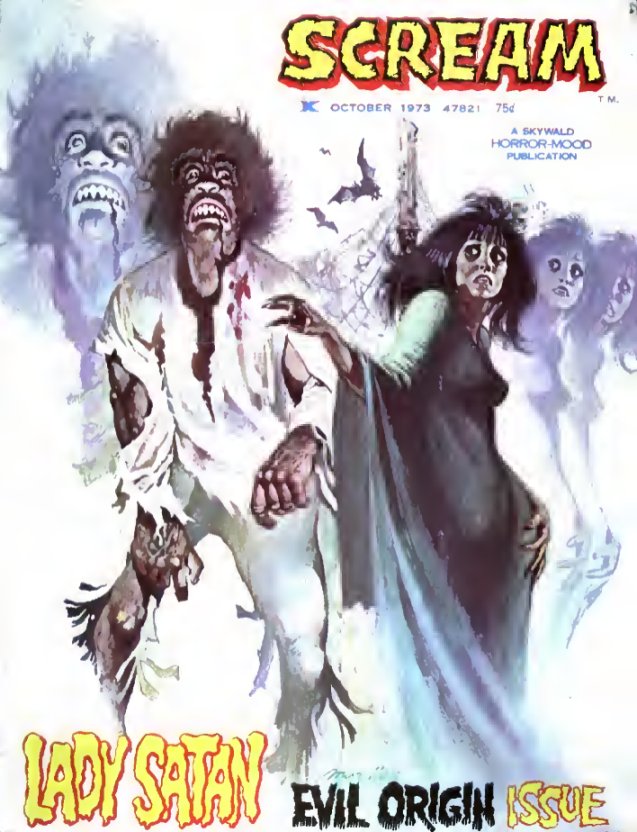 Jose Miralles provides the cover for this issue of Scream, featuring the character Lady Satan. It is cover dated October 1973.
First is Lady Satan in "The Macabre Beginning" by Al Hewetson (story) and Ricardo Villamonte (art). A young woman, Anne Jason, is brought by friends to a tourist attraction in Salem, but is then grabbed by some Satanists, who claim she's the Black Queen of Salem Witches, returned from the dead. Anne shocks them by revealing that she is in possessed by her. The Satanists reveal it was all an act, but she considers things real and calls forth for Satan, to marry him. Around this time Anne is able to repossess her body and not wanting to be married to Satan, flees and jumps off a cliff to her death. This is a bit of a confusing origin story, and VIllamonte's art is rather mediocre
Next is "I Was a Vampire for Hire" by Al Hewetson (story) and Felipe Dela Rosa (art). A man named Watson comes across an advertisement for Stanley, a pretend vampire for hire! Watson hires him to dress up as a vampire and smash through a window at an upcoming party he is holding. Stanley does as he was hired, but it has horrendous results as people freak out and Watson's father in law dies of a heart attack! Stanley finds out that it was all a plot schemed by Watson though, as he is set to inherit money due to his father in law's death. Stanley decides to get revenge, putting on a mask of the father in law and pretending to be him at the funeral, then reveals himself to be alive during it. This causes Watson to blab out that this was all a scheme both he and his father in law cooked up to enable them to easily transfer some holdings. Watson and the others demand to know where the father in law is, as he was only unconscious. Stanley reveals that he hid him in a frozen body compartment in the morgue, and he's now dead for real. Some pretty good twists in this story, A rare Skywald story that ends up not having any actual supernatural element to it.
 |
| "I Was a Vampire for Hire" |
Fourth is an Edgar Allen Poe adaption, "The Pit and the Pendulum" with adaption by Al Hewetson and art by Ricardo Villamonte. This classic Poe story features a man who is sentenced to death and is jailed in a cell which contains a large pit in the middle. He avoids the pit, but drinks a drugged cup and later awakens bound on a board, with a pendulum swinging above him and slowly lowering. Our protagonist is able to escape by rubbing food on the ropes binding him, causing rats to bite at them until he is loose. Our protagonist is once again faced with the pit, but now the walls are moving in, forcing him closer and closer to it. But suddenly he hears voices and is freed by a friend. This is a fairly decent story, but I'll admit that Villamonte can't really hold a candle to Jose Ortiz, who also drew an adaption of this story for Warren.
 |
| A "Gothic Fairy Tale" |
Next is the one page "The Vampire Hunters" by Al Hewetson (story) and Domingo Gomez (art). It features, what else, but some vampire hunters, who come across a crypt with 8 open coffins and stake all the bodies within.
Seventh is "The Vampire Letters" by Al Hewetson (story) and Emilio Bernardo (art). An editor as a newspaper (Howie Anderson, a pseudonym for Al Hewetson, for whom the character is modeled after) publishes a classified ad from a vampiress wanting to meet up with a male vampire. Some bizarre vampire photos start coming into the paper and after he publishes them some actual vampire killings start occurring. Howie investigates and finds the source of the ad, and meets up with the vampiress, the beautiful Anne, who claims it was all a joke. As they embrace and start to kiss he realizes he really is a vampire though. Anne is in love with Howie for real, but he leaves. She chases after him, outside, and the sunlight starts immediately decaying her body. Howie changes his mind, turns around, bites her on the neck and changes into a vampire himself... then instantly dies as well. A somewhat decent story, its always fun to see Hewetson involved in the story in some fashion. Bernardo's art is just okay, but he at least provides a rather gruesome final page.
Another one pager is next, "The Thing That Left No Fingerprints" by Al Hewetson (story) and Ferran Sostres (art). This story features a rabid dog that was shot by its owner come back to life and kill him!
Ninth is "The Fetid Belle of the Mississippi" by Al Hewetson (story) and Jesus Suso Rego (art). This story is told in interesting fashion; the caption show lines from a screenplay while the word balloons include narration. A steamboat, the Robert E. Lee travels down the Mississippi river in Tennessee. Things are initially calm, but then chaos ensues. The body of a woman is found in the wheel of the boat. Then another boat, occupied by corpses bears down on the Robert E. Lee, crashing into it. Then a giant Loch Ness Monster type beats rises from the sea and attacks! It is here where the captain of the Robert E. Lee loses it, shouting out that the script is all wrong. He beats the monster into submission, then grabs an ax and starts chopping away at the captions and says he will rewrite the screenplay. Another one of those crazy, break the fourth wall Skywald stories, which helps what may have otherwise been a rather dull story.
 |
| "The Vampire Letters" |
The issue concludes with the one page "A Gothic Fairy Tale: A Tale of 2 Macabre Snakes" by Al Hewetson (story) and Felipe Dela Rosa (art). Despite being credited to Dela Rosa, this doesn't really look like his artwork. This is a very simple feature, two snakes attack and eat each other.
Wednesday, November 27, 2019
Psycho #14

The frontispiece for this issue features art by Maelo Cintron of a skeleton, and is more akin to the text stories Skywald used to include, with it taking up approximately half the page. It is titled "The Dead..."
First regular story is "The Classic Creeps" by Al Hewetson (story) and Francisco Cueto (art). the story begins telling us our protagonist is a lunatic, and we watch him watch a Dracula movie. He then decides to bring it to real life, dresses like Dracula and bites the neck of a woman in the park! He is able to escape from the police and the woman lives. He then starts watching other horror movies such as Dr. Phibes, The Mummy and Phantom of the Opera, taking on that guise for another attack, which is successful this time. He then takes on the role of the hunchback of Notre Dame, and then Frankenstein's monster, trying to grab a little girl and drown her but the police are able to kill him, saving her. As the story ends we find that our protagonist had a kid's show on TV where he dressed up as various monsters but it got cancelled. Cueto's art is a bit improved here than some of his past jobs, and although the story is a bit longer than it needed to be, it is pretty good.
 |
| "The Classic Creeps" |
Third is "The Artist's Other Hand" by Al Hewetson (story) and Jesus Suso Rego (art). This story is a blast, and is another one of those Skywald stories that kind of breaks the fourth wall. Our unnamed artist, who is visually modeled after artist Suso works on drawing a horror story about an artist who has a third arm growing out of his chest, is knocked out by a woman when the arm attacks her, but she chops it off him, and he thanks her for releasing him from its control. The artist brings the story to his editor, who is modeled after Al Hewetson, but he hates it! The two of them go through varying scenarios under which the artist can change the story to improve, but the editor hates them all, pointing out The Heap as more legitimate horror (kind of ironic since Hewetson reportedly hated The Heap). Eventually this leads to the editor punching out the artist and in the final panel we see some artists focusing on a new story with some scarier monsters. Much like The Comics Macabre, which just appeared in Scream, it was a lot of fun getting to see actual members of Skywald appear in a horror story.
 |
| Skywald staffers star in "The Artist's Other Hand" |
Fifth is "A Man Who Dare Not Sleep!" by Ed Fedory (story) and Felipe Dela Rosa (art). This story features a ship captain tied to the helm of the ship, dozing off. He fears a vampire on board the ship and has put crosses around him only for the vampire to toss them aside. The captain hopes for the clouds to part, for the sun to shine through and kill the vampire, and that's exactly what happens. At least as far as I can tell. On the final page the captain shouts out that it is the Southern Cross in the sky, a constellation, but you'd figure that can only be seen at night, so how did the vampire die?
Sixth is "Cassandra... Sorceress of the Seventh Wind" by Marv Wolfman (story) and Don Heck/Mike Esposito (art). I'm assuming this story is an inventory one as none of the men involved in creating it had put out a new Skywald story in a while. This story is also a stark contrast to Hewetson's style and is more the type of story we'd see in an early Skywald issue. It features the titular Cassandra, who asks a minstrel to join her on a quest to battle the evil wizard Morlock. Many pages go by, monsters are fought and Cassandra and the Minstrel finally reach Morlock. There's a body swap temporarily and in the end we find out that Morlock pursued the minstrel because he is the man who sunk Atlantis. I really don't care for these more sword & sorcery type stories unless we're getting some strong art of it and that isn't really the case here.
 |
| Nava's Skywald debut looks a lot like Jerry Grandenetti |
We wrap up with "I Battle the Vicious Vampire Bats of Transylvania and I Lived to Tell About It" by Al Hewetson (story) and Maro Nava (art). This story is Nava's Skywald debut. A British man comes to Transylvania and speaks of the descendant of Dracula, having talked about it to a man in another town. He is told by a bartender that Dracula's castle is nearby. Soon another man, wearing a cape comes in. He claims to be an American and offers to bring him to Dracula's castle. When they arrive, the American reveals that he is in fact Dracula's son and attacks, but our protagonist turns the tables on him. It seems like the American is a phony Dracula's descendant, but our protagonist is the real thing and kills him, being a vampire himself. Nava's art here is extremely similar to that of Jerry Grandenetti, enough so that in many panels one could easily think Grandenetti drew this.
Saturday, November 23, 2019
Scream #1

First is "I, Slime" by Al Hewetson (story) and Jose Gual (art). An old man whose legs were shot off in the war works as a mailman, delivering mail to various places in the town including the local lunatic asylum. One day when he heads there he finds the woman who usually tends to him hanging upside down from the ceiling, with her throat ripped out. The lunatics have taken over and they grab a hold of him. They bring him to the top of a tower in the Asylum and drop him, and he splatters on the ground, dead. His remains are gathered and buried. But soon his remains, now just slime, make their way up out of the ground and to the Asylum, sealing the doors until the lunatics starve to death. This was a pretty good story including some real life photos used in the artwork. Although there is an easy work around for the ending, they could have simply knocked the doors down.
Second is "Weird Count, Black Vampire Bats and Lunatic Horrors" by Al Hewetson (story). Richard Arndt's "Horror Comics in Black and White" claims this story is drawn by Felipe Dela Rosa, but it looks much more like Fernando Rubio to me. This isn't a traditional story, but rather gets into superstitions, myths and realities about vampires, getting into facts about Transylvania, Vlad the Impaler and other matters.
 |
| Craziness in the premiere of the "Nosferatu" series |
Fourth is "...Hickory Dickory Dock..." by Al Hewetson (story) and Ferran Sostres (art). Anthony Capelli is a young man who has lived in a mental institution since stabbing his Satan worshiping mother as a young boy. The day has finally come for the doctors to let him go. Anthony eventually comes across a screening of Dracula starring Bela Lugosi and becomes enraptured upon seeing a scene where Dracula proclaims himself unable to be harmed by fire. Incidentally enough the movie theater burns down, but Anthony makes it out okay. He makes his way to a costume shop and dresses up as Dracula, then bites the neck of the woman tending to him! He flees, making his way to a funeral home and continuing to think he is Dracula, lies down in a coffin. But the coffin is for a man slated to be cremated. As the story ends we can clearly see that Anthony is not Dracula as he is burned alive! This was a pretty good story with some good art and a hilarious ending. It is clear that the doctors never should have let him out of the asylum!
Next is the two page "Dracula" by Al Hewetson (story) and Domingo Gomez (art). This appears to be another part of the Scream Scene series and is a brief scene from Dracula.
 |
| "The Comics Macabre" |
Sixth is "The Tale of the Perfect Crime" by Al Hewetson (story). Again, Richard Arndt credits in his book appear off this as he has this being drawn by Fernando Rubio but it is clearly Felipe Dela Rosa (perhaps he mistakenly swapped stories in his book). A man plots to kill his annoying wife. One night he grabs her and forces her to consume poison until she dies. He then puts her in his bathtub and pours acid over her until her body dissolves. He laughs maniacally as the story ends and the narrator tells us someone has pulled the plug on his brain. An example of a story without much of a plot but is rather focused more so on concept and mood.
 |
| The one page "Scream" closer |
Eight is "The Strange Painting of Jay Crumb" by Al Hewetson (story) and Zesar Lopez (art). A group of critics decide upon the award for Best Illustrator. One such man is hesitant to give it to Jay Crumb, the one favored by the others and leaves. On the way back home he actually stops by Crumb's home and calling him a phony, decides to head inside. There he finds many horrific and monstrous paintings from Crumb, who start coming to life! As the story ends Crumb shows off his new painting, featuring said events. This story features references to artist Dela Rosa and well as Josep Toutain (called Jerry here), the head of Seleccionnes Illustrada.
The issue concludes with the one page "Scream" as drawn by Zesar Lopez and features what else, but a woman screaming.
Tuesday, November 19, 2019
Nightmare #14

This issue's frontispiece is "The Easter Island Things!" by Al Hewetson (story) and Maelo Cintron (artist). It features the statues of Easter Island, going on a rampage!
First story is "The Diary of an Absolute Lunatic" by Al Hewetson (story) and Felipe Dela Rosa (art). In the 1920s a madman is brought to a lunatic asylum. The doctor of the asylum starts reading some papers that was along with the man. In them, the madman, whose name is Munro, tells of how he is a time traveler. In the year 1999 the Presidents of Earth gathered to celebrate. One such President however, named Tuckle starts making demands for money and special privileges; if not provided he will blow up the Earth. People ignore his mad ravings and start proceeding to impeach him. Meanwhile Munro starts traveling through time and by doing so sees the Earth explode! He goes back in time, seeing the birth of nature, of humanity, but eventually his craft crashes, leaving him stranded in this time. The doctor decides to burn all the paperwork, considering it the ravings of a madman. When his assistant talks to the doctor about how its funny that the crazy President Tuckle shares the same name as him, he strangles her and blames Munro, as the story ends. A fairly strong effort, my favorite story of the issue. Dela Rosa also provides some pretty strong artwork as we get to the later part of the story and Munro starts traveling through time.
 |
| Time traveling in "Diary of an Absolute Madman" |
Third is "Death of the 80th Victim!" by Doug Moench (story) and Ricardo Villamonte (art). A serial killer is stalking and killing East Indian women, and chopping off their hand. It is investigated by Inspector James Reston and his assistant Rahib. After Rahib's wife is killed he and Reston head out at night where Reston reveals that he is the killer. As a boy when his father was stationed in India, he was kidnapped and tortured, with his hand being cut off. Despising Indians, he purposely made sure to kill them and cut off a hand. After killing Rahib, Reston returns home, revealing a chest full of hands and writes a suicide note, chopping off his other hand and dying.
Fourth is the one page "...Werewolf..." by Ed Fedory (story) and Juez Xirinius (art). This brief feature is about the werewolf of Le Geaudan, which terrorized France.
Fifth is "...And the Corrupt Shall Dine!" by Ed Fedory (story) and Fernando Rubio (art). This is an incredibly confusing mess of a story and it is quite difficult to identify what is going on. Two men dine, one being the guest of the other. Flashbacks show that the host was a vampire, yet the guest either purposely led away a mob someplace else, or to another vampire who looks the exact same and gets killed, with the host leading the attack. The guest, enjoying the meal, ask for the recipe of what they are eating. The host reveals it was blood sucking leeches, then reveals he is a vampire and kills his guest.
 |
| "Starchild" |
Sixth is "Charles Laughton: Scream Screen Scenes" by Al Hewetson (story) and Domingo Gomez (art). This two page feature is the second part of the Scream Scene series that we just saw premiere in Psycho. It is about Charles Laughton, the silent movie director/actor. We see scenes from movies such as the Hunchback of Notre Dame, The Island of Lost Souls and Les Miserable. Similar to last time the brief scenes included aren't word for word adaptions to avoid copyright issues.
Seventh is "Starchild" by Bruce Jones (story and art). This is an inventory story held onto for a couple of years when Skywald's planned sci-fi magazine never happened. The robot Cyx travels through space with the titular Starchild, a girl who has grown up floating through space and is now 17 years old. Her parents were on board the ship Dori Ann, which was destroyed in a cosmic storm, but Cyx found her, still alive in her mother's womb and has kept her alive all this time. Finding a planet capable of life, she and Cyx go down there where she encounters various forms of wildlife, including a dinosaur! A spaceship eventually arrives and a man comes out. Starchild goes to be with him, leaving Cyx behind and the ship takes off. Jones' art is fairly good here, although a little lower quality than some of the other stories he had provided for Skywald. It was surprising to see a story with a happy ending! Not used to that for Skywald, or Jones personally for that matter.
Eighth is "The Creature from the Black Lagoon" by Al Hewetson (story) and Ricardo Villamonte (art). Although it isn't under the Scream Scene title, this story appears to be another in the series, being only two pages in length and featuring a short scene from said movie.
 |
| "The Butchered at Earth's Core" |
We wrap up with the latest story in the Gargoyles series, "And they Did Battle with the Thing from Underneath" from Al Hewetson (story) and Maelo Cintron (art). Edward gets a job with a Mr. Roanoke who works on a tug boat, the Andy Jackson. He and Mina go through some difficulty and discrimination as they try to find an apartment for themselves. For the fourth time, some Satanists get involved, beating up Roanoke due to his employ of Edward. Suddenly a tentacled monster attacks Edward, who battles and kills it. His fight ends up being front page news in a newspaper! Edward decides that he and his family must leave Manhattan, at least for now and as the story ends they start hitchhiking. While Cintron's art is pretty decent, I'll admit to getting bored with the Gargoyles series at this point. The Gargoyles face discrimination for being gargoyles. Edward battles some monster summoned by or used by the Satanists. Over and over again. Yawn.
Thursday, November 14, 2019
Psycho #13

This issue's frontispiece is "Prologue to Horror" by Al Hewetson (story) and Domingo Gomez (art).
First up is "The Day That Satan Died" by Al Hewetson (story) and Felipe Dela Rosa (art). On a small plane traveling towards Calcutta, captain Jack Boivon goes back to speak to his passengers, the large Bob, photographer Herbert and a young woman named Patti who is quickly revealed to be a radical communist and hijacks the plane. When Jack's co-pilot refuses to purposely crash the plane like she demands, she shoots him in the head and the plane promptly crashes into a mountain. Amazingly enough, all four survive. Patti reveals that she made a deal with Satan for her youth and beauty to last hundreds of years in exchange for her soul, but she's running low on time until the deal is up and needs someone else to give up their soul to retain it. She figures her fellow passengers have no choice but to agree to it or freeze to death. But this soon blows up in her face as Bob reveals he's the abominable snowman, Herbert reveals he's a vampire, and Jack reveals he's Satan himself! Patti's body immediately rots away, but Bob and Herbert, angry at having to live as monsters promptly stomp and tear Satan to shreds! I love this story, in fact may consider it my favorite Skywald story so far. Its the perfect representation of Skywald's drastically different style from Warren, where Hewetson is willing to go so over the top, enough so that one doesn't mind at all that the ending is spoiled by the title. Dela Rosa's characters often come off as quite ugly looking but that is in service to a story filled with monsters and villains like this one. The character Herbert makes a reference to working for Pilote magazine, a real magazine based out of France which would feature work from Selecciones Illustrada artists like Luis Garcia.
 |
| "The Day That Satan Died" |
Third is "Let's All Drink to the Death of a Clown" by Doug Moench (story) and Fernando Rubio (art). A man, Mr. Cade, is pursued by a knife wielding... clown! Flashbacks reveal Cade, owner of a circus, pursuing one of his employees, a young woman named Beth, who is engaged to the clown, Bob. Bob punches out Cade when he continues to go after her, but thinks he and Beth have a secure spot in the circus and Cade won't get rid of them. Cade eventually does kill Bob, then fires all the other clowns in the circus as well. As we return to the present, he continues to flee, pursued by the killer clown, and is eventually confronted by many of them and is stabbed to death... or is he? We find as the story ends that it was actually a novelty knife, so I'm assuming he died of fright? Clowns were always scary to me as a kid, so they fit being used in a horror story such as this.
 |
| A werewolf... killing himself? |
Fifth is the two page "A Taste of Human Flesh..." by Ed Fedory (story) and Ferran Sostres (art). Three men are lost at sea and start getting extremely hungry. They soon arrive at an island, only to discover it is full of cannibals! Two of the men are promptly cooked, but the last manages to escape, killing a native on his canoe and paddling away. Soon the hunger returns. When the man is eventually found, he has become a cannibal himself!
Sixth is "The Horror Within and Without" by Rich Buckler/Chuck McNaughton (story) and Mike Kaluta (art). This story was originally intended for the sci-fi magazine that Skywald cancelled, explaining why we're seeing a few collaborators we haven't seen in a Skywald magazine in a while. A man named J-1001011 (I'll just call him J the rest of the way) awakens in space, ordered to take part in an upcoming attack. J communicates with his ship's computer, which is ordering him to attack a city on a nearby planet. J also questions if there's any news of his parents but doesn't receive any response. J takes part of the attack and is able to successfully destroy the city as ordered, killing its inhabitants. When J returns he is told that his parents were killed in his attack! As the story ends his memory is wiped and he returns to sleep. A rather depressing tale, and I kinda knew from early on what the big twist would be.
 |
| The conclusion to "The Heap" |
Seventh is the two page feature "The Raven" by Al Hewetson (story, credited to Jessica Vogel) and Manuel (art). Even Richard Arndt's Horror Comics in Black and White book doesn't fully identify who "Manuel" is and if that's his first name or last name. This brief story features a man who comes across a raven on a tree branch who can speak! The raven asks him to kiss him and that it is a beautiful woman, transformed by a witch. Once he does so, she actually transforms into a beautiful woman, but he reveals he is a vampire and bites her! She has one last twist though, she has rabies, causing him to die from being unable to breathe. Yet another story in this issue that hammers home twist after twist, this was a pretty good, short feature.
Eighth is "The Taste of Carrion" by Ed Fedory (story) and Pablo Marcos (art). At a funeral, a man bemoans the death of his daughter, Greta, and blames some nearby demons for her death, and the death of other children. When another body is found, a mob gathers, convinced that they will find the monster responsible if they check the local mausoleum and castle. Upon going inside the mausoleum they find millions of flies, which are revealed to be the monster. The townsfolk are soon all killed by them. This story didn't make the most sense to me (It is really hard to follow at times) and also drags on a bit too much towards the end.
We wrap up with "Scream Screen Scene: The Mummy" by Al Hewetson (story) and Maelo Cintron (art). This is the start of a recurring feature in Skywald where they show a brief scene from a famous horror movie, but due to copyright don't exactly adapt the scene but rather use a similar one. In this case its the Mummy and features some archaeologists excavating a mummy, which immediately comes alive and attacks them.
Subscribe to:
Posts (Atom)