Showing posts with label nava. Show all posts

Friday, January 3, 2020

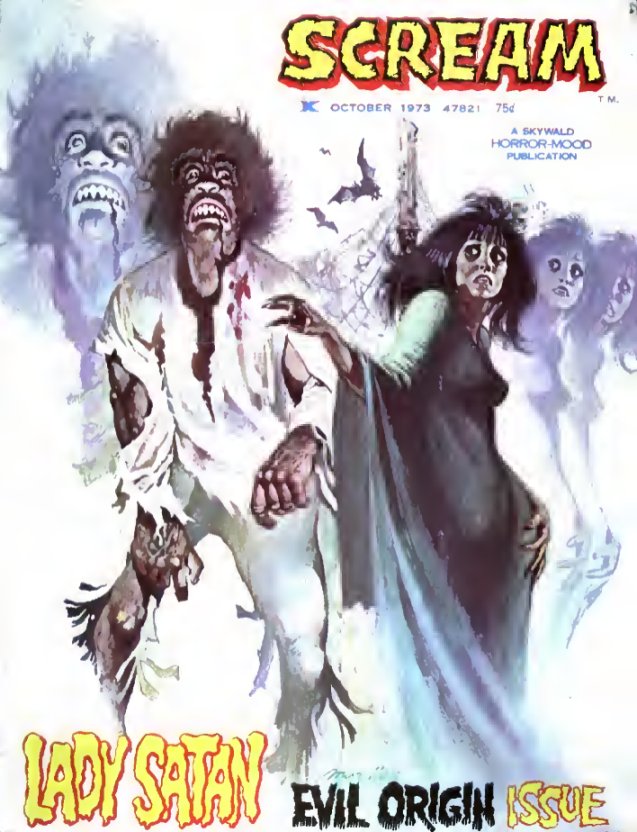
Scream #5

Fernando Fernandez provides a particularly scary looking cover for this issue of Scream, cover dated April 1974.

First is the second chapter in "The Autobiography of a Vampire", by Al Hewetson (story) and Ricardo Villamonte (art). Our titular vampire (called Judas in the prior story) continues his tale. Now a young man, he travels to Barcelona where he meets many women, but falls for one, Maria, he finds swimming in a nearby river. Unfortunately when Judas tells Maria's father he has no money or prospects, he throws him out. Judas asks Maria to elope but she too rejects him, so he bites her neck and kills her. These many years later he still regrets it. This is another one of those stories where Villamonte's art is quite inconsistent. On some pages it is really strong, at the quality of someone like Esteban Maroto, while in other pages it looks quite rushed.

Next is another story in the Darkkos Manse story, "Get Up and Die Again" by Al Hewetson (story,credited to Howie Anderson) and Alphonso Font (art). A man who bears a resemblance to Frankenstein's monster is seized and hung. A Dr. Ingels wants his body, but the sheriff will only provide it to him if he agrees to murder his wife for him. Ingels does it; poisoning her. He takes the man's body and is able to successfully resurrect it, a real life Frankenstein's monster. The monster is horrified at being brought to life and demands Ingels create him a mate, so he raises the sheriff's wife back to life. But she knows it is he who murdered her. The monster kills her, then turns on Ingels and kills him, then heads to the swamp. Font did very little work for Warren (only one story if I remember correctly) but will get several stories here at Skywald, with this being his debut. He does quite a good job and I look forward to seeing more from him. A fairly decent story too. Ingels' name has got to be a reference to EC's Ghastly Graham Ingels.
"The Autobiography of a Vampire"


Third is "The Cask of Amontillado" an adaption of the Edgar Allen Poe story, with adaption by Al Hewetson and art by Maro Nava. This classic Poe tale tells the story of a man who seeks to end the life of a colleague named Fortunato who is a wine connoisseur. Our protagonist claims he has a bottle of the wine Amontillado and Fortunato comes with him down to a vault where he is chained to the wall and then walled up behind some bricks. The overall plot of this story is fairly simple (and this is at least the fourth comics adaption I've read of this story). Nava's artwork this time bears some resemblance to Rafael Auraleon.

Fourth is "The Black Orchids and the Tale of Anne" by Al Hewetson (story) and Jose Cardona (art). A young woman named Anne is cared for in an asylum. When she is let outside to look at some orchids she grows angry and destroys them. One of the doctors tells Anne's history. She had caught her husband walking with another woman and murdered them both. Further flashbacks shows that the woman was Anne's sister! Anne was quite beautiful while her sister Mary was not. Once Anne married her husband, he spent some time with Mary, who grew in love with him and he cared for her inner beauty. Anne caught them together and killed them. It is explained that Anne hates beautiful things and they can't let her see herself or she'd try to destroy herself. Unfortunately she isn't guarded very well, walks past a mirror and reacts by swinging an axe into her face! This is a fairly strong story, with a good ending and Cardona does a very good job on the art. His style is very reminiscent of Jose Gonzalez at many points in the story.

"The Black Orchids and the Tale of Anne"
Fifth is "The Conqueror Worm and the Haunted Palace" another Poe adaption, by Al Hewetson, with art by Domingo Gomez. This two page feature combines the two Poe poems, The Conqueror Worm and The Haunted Palace. Gomez's art as usual is quite good.

Sixth is "Are You Dead Yet?" by Al Hewetson (story) and Ricardo Villamonte (art). A man named Simon Toubin tells of how a group of four individuals come to visit his asylum. He initially shows them a few patients, but soon they find one of them dead and that there is a killer on the loose. Chaos ensues, more people die and we find that Simon has let many of the inmates run wild! Eventually it is revealed that one of the guests is the killer and he is thrown in an asylum himself. This story is rather confusing with it hard to tell characters apart at times (and part of me wonders if some pages are out of order). Ultimately results in an overall weak effort.

Seventh is "Shift: Vampire" by Augustine Funnell (art) and Emilio Bernardo (art). As with many Skyald stories this one is a bit hard to comprehend. It identifies two vampires, one in 1973 and another in 2073 (at least I think that is the case, when I first read it I thought they were the same character) who have a time machine that can send them back in time or forward in time by 100 years. Both end up getting pursued by people, so they jump in the time machine. Because they both do so at the same time though, they get trapped in some sort of eternal shift and get stuck in time as a result. At least that's the way I interpret how this rather confusing story ends.

"The Picture of Dorian Gray"
We conclude with an adaption of Oscar Wilde's "The Picture of Dorian Gray", with adaption by Al Hewetson and art by Zesar Lopez. The beautiful young man Dorian Gray acts as model for a portrait by his friend Basil. When the art purchaser Henry Wotton arrives to look at it, he becomes fascinated with Dorian's face. Dorian states that he wishes he could stay young and attractive like he does now forever and that the painting would age in his place. Through the influence of Henry, Dorian starts living a life of hedonism, constantly partying, drinking and sleeping with various women. He notices a change in the painting, with a grimace appearing on his face and decides to hide it in the attic. As time goes by the painting continues to change, with the painting looking meaner, uglier and more decrepit while in reality Dorian remains exactly the way he is. Dorian becomes quite disgusted with the painting, which is showing his true self. Over 30 years goes by and he is visited by Basil, who is shocked to see Dorian still looks the same and grows quite angry when he sees the horrifying state the painting is in. He attacks Dorian, who ends up stabbing him with a sword. Dorian, disgusted by his actions attacks the painting with the sword. His servants find the scene later, with Basil dead, Dorian also dead, now aged and quite horrifying looking and the painting has returned to its original state. Having read the original book I can say that this adaption is quite abbreviated, but does a good job hitting at the high points of what is a pretty well known tale. Zesar's art is quite strong as usual and he is effective at the contrast between Dorian's face and the painting.

Tuesday, December 24, 2019

Psycho #17

Salvador Faba provides the cover for this issue of Psycho, cover dated March 1974.

We begin with "The Death Pit", a one page frontispiece by Al Hewetson (story) and Domingo Gomez (art). Featuring a band of the dead, this reminds me of the story "Phantom of the Rock Era" all the way back in Nightmare #4.

The first full length story is "The Black Sculpture of the Pharaohs" by Al Hewetson (story) and Ricardo Villamonte (art). A pharaoh obsesses over a cat statue he claims took him 20 years to find. He gets into an argument with his queen and stabs her to death, claiming it was an accident. She is buried in a tomb as a mummy, but soon after the pharaoh realizes the cat statue is gone, as is his wife's mummy! It is shown that this is a plot of his high priest, who seized the statue and the mummy to make it look like the dead queen did it. However the dead queen's mummy is indeed alive and kills the priest, then tosses his body where the pharaoh and others can see it. The pharaoh now knows the high priest was behind things and orders his men to search for his henchmen for the statue. He doesn't realize that the statue is in the tomb with the mummy of his dead queen. A rather weak start to the issue, with all that trouble about a statue and some weak art from Villamonte.
"The Death Pit"

Next is "This is Your Life, Sam Hammer, This is Your Death!" by Al Hewetson (story) and Jose Cardona (art). Police officer Sam Hammer is criticized by his boss for not making enough arrests and to catch some criminals in the act. Through information from a bum, Sam and his partner confront a crew of criminals making fake license plates. While trying to arrest them Sam is forced to kill one of them and his partner is killed in a machine. Suddenly, crazy things start happening. His sandwich is alive! He finds a corpse in the bathroom. The time clock punches him. And so on. He eventually wakes up at his own funeral! He is told that he is on a TV show, This is Your Life, This is Your Death. His partner and everyone else was in on it. They get prizes for their participation, while Sam gets punished by being killed! Quite a ridiculous story, and its a good thing they revealed the big action from the license plate criminals as being an act, as multiple people dying over fake license plates is considerably absurd.

"This is Your Life< Sam Hammer, This is Your Death!"
Third is "This is the Vault of the Living Dead!" by Al Hewetson (story, credited to Harvey Lazarus) and Maro Nava (art). A group of drunks in a bar attack a group of mysterious, peaceful hippies that come in and sleep during the day, and go out at night. The drunks try to push them around with no luck, then suspect they are vampires and bring them out in the daylight, but nothing happens to them. The drunks then go even further, murdering all the hippies. The drunks leave, but then the hippies get up and go find them, attacking them. It turns out they are indeed vampires, and that brief exposure to sunlight doesn't kill them after all. They are generally peaceful but the behavior of the drunks have caused them to satiate their hunger and attack them, sucking their blood. A rather weak story with some really over the top action by the characters and some particularly dreadful art by Nava.

Fourth is "These Are the Things That Are Dead" by Al Hewetson (story, credited to Howie Anderson) and Felipe Dela Rosa (art). A group of guys in Manhattan decide to steal a subway train. They jump inside, knock out the conductors and cause a big crash, jumping out of it mere seconds in advance. They then grab a car and go on a driving spree, hitting a parked car. When the policy arrive and find the car empty, we realize that the three of them have been dead all this time. Some okay art from Dela Rosa here, but the ending to this story I could see from miles away.

"The Narrative of Skut"
Fifth is "The Crime in Satan's Crypt!" by Ed Fedory (story) and Antonio Borrell (art). A man takes out a contract hit on a young woman in an alley. Dressed in robes, he hides from the police then finds his hiding place leads to a tom, which he heads into, finding solid gold and a casket with a dead body in it that makes him think it is alive. Soon a group of robed men, led by a naked woman show up, commanding the body, Lothodeus to rise and help guide them for the coming of Satan. The killer tries to flee, with the gold but is seen and chased. As he makes his way out the ceiling of the tomb starts collapsing. He makes it out just in time, only for a statue in the graveyard to fall on and kill him. A rather lame ending, but some good art from Borrell at least.

Next is "The Lunatic Class of '64" by Jane Lynch (story) and Emilio Bernardo (art). Walter Lyman says goodbye to his wife and kids, planning on going to his high school reunion. As he heads there we flashback to Walter being a loser in high school. The girl he liked rejected him due to his pimples. No one would sign his yearbook, he even has a girl who refuses to cheat from his notes when he offers. Walter arrives but surprisingly is treated well by his old classmates. Thinking everyone is in on a secret plot to make fun of him, he knocks over some candles, causing the entire place to burn down. In our final panel we see a classroom filled with skeletons! Lynch does a decent job in her Skywald debut, although I'm not really sure where she was going with the final panel.

Seventh is "The Narrative of Skut" by Al Hewetson (story) and Luis Collado (art). Some mobsters arrive at a local boarding house and shoot up the old lady who runs it. The small sized Skut runs errands for the mobsters including dragging out the body, getting them food and other errands. He decides to rat out the mobsters, revealing their location to another mob who shoot them up. Not wanting to be seen with the bodies, Skut brings them to the basement where the old woman appears, alive, despite the bullets already in her and the more Skut fires into her. She grabs a hold of him and drags him into the grave he dug, trapping him there until he starves to death. Collado's art is very strong here, including a number of very detailed, highly realistic looking panels.

We conclude with "Monster, Monster, Heed Death's Call" by Augustine Funnell (story) and Ricardo Villamonte (art). Our werewolf protagonist, now back to a human, the gypsy Kirsten and her daughter Nola travel, fleeing from the group of gypsies after them seeking an amulet Kirsten has. Kirsten decides to leave the werewolf behind but then the other gypsies arrive and attack her. the werewolf, now back in said form, goes on a rampage, slaughtering all of them except a veiled woman who has stayed back and at story's end removes her veil and swears the amulets will be hers. This series continues to be rather mediocre, with a rather dull, repeated plot and often inconsistent or poor art from Villamonte.

Sunday, December 22, 2019

Scream #4

Xavier Villanova provides the cover for this issue of Scream, cover dated February 1974.

First is the latest Lady Satan story in "Satan Wants a Child" by Al Hewetson (story, credited to Howie Anderson) and Ricardo Villamonte (art). Lady Satan is brought before a demon who reveals that Satan has not yet forgiven her and seeks something else from her, a child. She is to wait in a bed for him, but awakens with Anne back in control of her body. She departs, heading back to the town of Salem and figures the only way to stop things from happening is to stab herself. It fails to kill her however and Lady Satan returns to having control of her body. She travels to be with Satan, they embrace and when Anne resumes control of her body she learns to her horror she is with Satan's child. This series continues to be rather lackluster for me, and the act of Anne and Lady Satan exchanging control of Anne's body is getting old.

"The Skull of the Ghoul"
Next is an adaption of Edgar Allen Poe's "The Oblong Box" with adaption by Al Hewetson and art by Maro Nava. This story tells of how our protagonist, traveling on a boat at sea sees his friend Wyatt also come on board with several servants, his wife and a large oblong box that he believes includes a painting. Wyatt's wife is quite vulgar and grotesque and Wyatt seems fit to rage and pass out. Eventually a large storm hits the ship and as it is destroyed, Wyatt chains himself to the box and sinks into the depths of the ocean. As the story concludes the captain reveals all. Wyatt's wife was in fact his servant, his real wife was dead, included in the box which was filled with salt. Our protagonist considers with horror what must have been going on with Wyatt and the box in his room at night. A pretty good Poe story; Nava's aping of Jerry Grandenetti continues including an extremely obvious swipe of a character from the story "The Adventure of the German Student" from Creepy #15.

Third is "The Skull of the Ghoul" by Al Hewetson (story) and Ferran Sostres (art). Traveling in a carriage across Barcelona is a carriage manned by a guard who is keeping a hold of a woman prisoner. When the driver of the carriage collapses dead, the woman takes the opportunity to break from her bonds and kill her guard. Feigning that she needs help, she travels into the town and is greeted by a Countess Sostres to brings her to her manse. There the countess shows our protagonist around, including showing her the skull of Dracula. Our protagonist plans to steal it and flee yet that night as she is about to do so she hears talking. It is the countess, talking to the skull! Our protagonist is taken a hold by Sostres' servants and she reveals she is a vampiress; she killed the driver of the carriage and will now drink her blood as well. Rather standard vampire fare, but Sostres' art is quite strong. For some odd reason this story is split into two parts, although the first part is a mere three pages long.
"The Lunatic Mummy"

Fourth is "The Legend of the Cannibal Werewolf" by Ed Fedory (story) and Ricardo Villamonte (art). A hunter named Sir Percy shows off the stuffed werewolf he hunted in Africa. He is asked to describe how he hunted it and we see him traveling through the jungle, and being attacked by the werewolf. Returning to the present, he reveals that the werewolf wasn't seeking to kill him, but find a mate and he transforms into a werewolf himself, along with his mate slaying everyone there. We will see another werewolves in love type story a bit later on which I consider quite a bit better than this rather "eh" story.

Fifth is "The Lunatic Mummy" by Al Hewetson (story, credited to Howie Anderson) and Cesar Lopez (art). This story is Lopez's Skywald debut. A man named Emmanuel Humphrey travels through the desert, stopping to rest at an oasis. While sleeping a group of religious fanatics capture him, planning on sacrificing him. They bury him up to his head, about to let a snake kill him, but then change their mind, dig him back up and mummify his body, then bury him again. The authorities arrive and kill all the fanatics, but upon digging up Emmanual find that his body completely deteriorates. The plot of this story makes me wonder if it inspired a sequence from the first Creepshow movie where people are buried in sand up to their heads. Stephen King was reportedly a Skywald fan, so it is a possibility.

Sixth is "The Vampire Kingdom" by Al Hewetson (story) and Domingo Gomez (art). A pair of newspaper reporters search Peru, finding a half buried city, occupied by the man-bats, half man, half vampire creatures. The design of the man bats seem quite similar to a one page feature of them done all the way back in Nightmare #11.

"When the Dusk Falls... So Does Death"
The issue concludes with the latest in the Nosferatu series, "When the Dusk Falls... So Does Death" by Al Hewetson (story) and Zesar Lopez (art). Nosferatu ask another of his dinner guests to tell his tale, this time one with a werewolf mask. The man removes his mask, only to reveal another, iron mask underneath. The man says his name was Fernando Doma and he lived in Madrid. An eligible bachelor, he pursued a woman, Anastasia Rubio, causing her to break up with her current suitor. At the first full moon we discover that Anastasia is in fact a werewolf and upon biting Fernando turns him into one too. They pursue many victims but eventually Anastasia is killed by a cross dropped by her former suitor. Fernando transforms into a werewolf and kills him, but is taken in by the authorities who put him in an asylum and strap an iron mask around his head such that when he transforms into a werewolf, the growth of his head will crush it. As we return to the present, Fernando removes his mask revealing his mutilated crushed head. As often is the case, the Nosferatu story is the peak of the issue, with great art from Zesar. I must say though Anastasia just isn't that beautiful with her short hair, and most notably very dark circles around her eyes.

Monday, December 16, 2019

Psycho #16

Domingo Gomez provides the cover for this issue of Psycho, cover dated January 1974.

First is "The Old Vampire Lady" by Al Hewetson (story) and Jesus Duran (art). A young photographer comes to interview the wretched old vampire lady. She tells him of her past, starting from her childhood and how her headmistress was a vampire. At 10 years old she was bitten and changed into a vampire herself and she would bite classmates and boys. Eventually a man named Baron Meinster who is a vampire comes to see them and they live with him, and our protagonist, now grown up, turns on the headmaster along with Meinster. She and him kill many victims but Meinster is eventually found and killed. Returning home, she finds her mother has died, of a broken heart after finding what came of her daughter. She eventually finds a man who falls in love with and marries her, but upon finding out she is a vampire, his strong religious beliefs cause him to commit suicide by stabbing himself. We return to the present, finding out that the old vampire lady is 175 years old and she brings the photographer to a tomb where she still posses the now rotted body of her husband. Some excellent, macabre art by Duran here and it was a fairly interesting story too, telling us the various events of the titular character's life rather than being focused on just one plot.

"The Old Vampire Lady"
Next is "Monster, Monster Rise from Thy Crypt" by Augustine Funnell (story) and Ricardo Villamonte (art). Where we last left this series, our protagonist, a werewolf had shot himself in the head. But it seems like he hasn't died, as it was not a silver bullet. The bullet is still lodged in his head however. An old gypsy woman, Kirsten, finds him and wondering if he is her son brings him out with her while he is unconscious. Soon her daughter Nola approaches, being chased by a man named Dominik. She demands Dominik leave and she, Nola and our protagonist, now in his human form, travel in a wagon to the gypsy village where Dominik declares (without her consent) that Nola is marrying him. Back in his werewolf form, our protagonist attacks Dominik, but the bullet lodged in his head weakens him and he, Kirsten and Nola flee when a plank is thrown at him (quite lame, I know) and Dominik swears revenge as the story ends. This series had an interesting enough start, but now its starting to get dragged out (and now involving gypsies after seeming to be a urban story earlier is odd).

Third is "They Lived in Darkkos Manse!", the latest in the Darkkos Manse series, by Al Hewetson (story, credited to Joe Dentyn) and Maro Nava (art). A fugitive named Paul Muni flees from the authorities into the swamp and comes across Darkkos mansion. He climbs to the top of it as his pursuers arrive and sees a humanoid monster who kills his pursuers and dogs, but then climbs the mansion towards him! Paul jumps off, but into the quicksand, which he sinks into. The monster pulls him out and he is now another monster guarding the swamp. Nava's style comes off a bit cartoonish here, but it overall works for this story.

"The Thing With the Red Ribbon in its Hair"
Fourth is "The Thing with the Red Ribbon in Its Hair", a one page feature by Al Hewetson (story) and Domingo Gomez (art). Tom marries a woman named Clarice for her money then kills her, revealing to her that he is in it for the money. But she either returns from the dead or doesn't die at all (the narrative is rather confusing) and forces him to live out his life with her. Some okay art by Gomez but a rather confusing story.

Fifth is "The Thing in the Box" by Al Hewetson (story, credited to Harvy Lazarus) and Fernando Rubio (art). A rather odd approach in this story in that only the final panel has any dialogue in it. An old man's wife falls asleep while they are on the porch, and he takes the opportunity to kiss another old woman who stops by. His wife wakes up, sees it and goes to the shed where she grabs a box. She leaves it at her rival's front door, who opens it and some tentacles come out and she dies. The old woman then puts it back in the shed. That's about it, a pretty simple story.

Sixth is "Hunger of the Slaughter-Sludge Beasts!" by Doug Moench (story) and Jesus Suso Rego (art). Detectives Harry and Frank investigate some weird occurrences where bodies are found, reduced to mere skeletons in areas with water or drains such as a bathtub or swimming pool. Meanwhile the wealthy Clinton owns a company that dumps chemicals into the river. Naturally, these chemicals have led to some sludge like creature forming and it is soon revealed that it can take the form of inanimate objects. It turns into a garbage can and then kills a homeless man that goes through it. We then see it traveling through drains and killing various people in their homes and a woman at a laundromat. Harry and Frank discover what is happening when they see the sludge at the lake, but it ends up killing them by taking the form of their car. At the end of the story we see that it even can take the form of a plane and a human being as a man returns home to his wife, who is actually the sludge. A pretty good story here, both horrifying and funny at times and Suso provides his usually strong art performance.

"Hunger of the Slaughter Sludge Beasts"
Seventh is "A Tale in Old Egypt: The Premature Burial" by Al Hewetson (story) and Felipe Dela Rosa (art). This brief two-page feature displays via hieroglyphics someone being mummified, waking up in a tomb and trying to get out but finding themselves locked in.

The issue concludes with "Greed" by Al Hewetson (story, credited to Edward Farthing) and Ricardo Villamonte (art). A little girl's parents don't believe her when she tells them of a fish monster. We see that the monster, who is humanoid in form is real and he kidnaps her, telling her he will kill her before their eyes to teach humanity a lesson. He brings her to a cliff and prepares to throw her off in front of the large crowd that gathers to rescue her. The father is able to climb up the cliff and knock the monster off, but in its last moments he shows mercy and tosses the girl onto a cliff so she doesn't die with him. But unfortunately no one sees or hears her, so she dies. Quite a depressing ending here!

Sunday, December 8, 2019

Nightmare #16

Today I'm covering issue 16 of Nightmare, cover dated December 1973. Jose Antonio Domingo provides the cover for this issue, featuring the interior story "The Voodoo Dead".

"The Voodoo Dead" kicks off the issue, with story by Al Hewetson (credited to Joe Denryn) and art by Ricardo Villamonte. A vampire decides to escape to the Caribbean. There he comes across a priestess leading a ceremony with several demons. She orders her demons to destroy the vampire, but soon regrets it as he has the qualities she romantically desires. She soon finds he is alive after all, but he attacks her, biting her on the neck then is killed for good by the demons. She continues to regret the loss of him and now is a vampire herself. An average story to kick off the issue; Villamonte's art is good on some pages, but rather mediocre on others.

"Dragnet: Werewolf"
We next get two chapters in "The Werewolf Macabre" series, the first titled "The Birth of a Beast" as written by Al Hewetson and drawn by Fernando Rubio. Chapter two is "Dragnet: Werewolf" also written by Hewetson and drawn by Jesus Suso Rego. The first story introduces us to Ted Williams, police commissioner of Chicago, who unknown to him, is actually a werewolf! He slays someone while a wolf and then investigates while human, not believing those who speculate a werewolf is behind it. A trip to a gypsy causes him to reconsider though. In flashbacks we find out that his father had a fling with a witch while his mother was pregnant with him and when he ended it, the witch cursed him into becoming a werewolf, a fate that Ted now suffers from as well. As the first chapter concludes, Ted determines he is a werewolf, then bursts out in werewolf form while in the police headquarters. This continues into the second chapter, where Ted attacks many while in werewolf form. Meanwhile in a special jail cell a woman also becomes a werewolf and bursts her way out. Ted flees into the streets, as does the woman, as the police pursue. In flashbacks we find out about the woman; her father was a werewolf and her mother a bearded lady. She comes across Ted in an alley. They kiss, but the policy come upon them and shoot them with silver bullets. This ended more abruptly than I thought it would, so I guess instead of a new series its just this two part story. Interesting choice to have two different artists draw it. Suso as usual is one of Skywald's best artists and does a terrific job, especially when the woman becomes a werewolf.

"The Roots of Evil"
Fourth story is "When the Devil Sent Us Death!" by Augustine Funnell (story) and Maro Nava (art). A mysterious man comes to a town to stay at a hotel. Soon afterwards a murder occurs, then another. People suspect it has something to do with the stranger and confront him in his hotel room. He claims to have been in the room the entire time and to not be involved. One of the men heads to the hotel room and the stranger leaves the next day. The man decides to use his hotel room and somehow he determines that the stranger works for Satan and brings hardship wherever he goes. The man is now going to continue in his footsteps. This is another story where Nava's art looks extremely like Jerry Grandenetti's. The story itself is only so-so, with not much of a point to it.

Fifth is "The Roots of Evil" by Al Hewetson (story, credited to Howie Anderson) and Antonio Borrell (art). A ship returns from China, much of its crew infected by the black plague. The captain orders the dead launched off the ship into a nearby town, which causes many in the town to become infected and the black plague rages its way through Europe. The story focuses on the ship's captain, whose crew mutiny and put him on a small boat with a few of his men and a corpse. After drifting for a while, one of his fellow men shoots himself, but before any others do so they spot the ship returning towards them, everyone on board now dead. It crashes through the boat, killing the remaining men with him but the captain makes his way on board. The ship starts rotting before his eyes and he is absorbed into it, proclaiming the ship has become the root of evil. An interesting story here (I wasn't aware this is how the black plague started) and Borrell provides some strong art. I've read that this story was originally intended as the cover story for Scream #1.

"The Vampyre"
Sixth is "The Vampyre!" by Ed Fedory (story) and Pablo Marcos (art). This story was originally advertised as appearing in Psycho #13, but for some reason was held off until this issue. This story introduces us to a vampire, going into hiding in his coffin. We find that he has killed four children in the span of only a single week. The local doctor claims his own son can be used to slay the vampire. His son, suffering from some sort of disease will be used as a sacrifice. Knowing he will die from it one day the boy is willing to act in this role. The vampire arrives and bites the boy as expected, and is repeatedly shot by several men with rifles, to no effect. The vampire returns to his cave but finds himself extremely weak and finds that his body is bleeding everywhere he was shot. As he dies, we go back to the doctor, who reveals his son had a disease that prevented his blood from clotting. Marcos' art is only so-so here, but that certainly was a unique way to slay a vampire.

Seventh is "Hell Hath No Face" by Al Hewetson (story, credited to Harvey Lazarus) and Ricardo Villamonte (art). This story surrounds the ship Ambergris. Heading back with whale meat (blubber), it is suddenly attacked by a giant octopus, after the whale meat! The octopus makes its way into the hold where the meat is being stored and they are forced to wait until it is finished. When it departs, the men head there to see what is left of the whale meat and are horrified to find numerous baby octopi! This story is essentially just a variant of "The Monstrosity Strikes!" from Psycho #14, with an extremely obvious ending and is even drawn by the same artist. An extremely mediocre way to close out the issue.

Thursday, December 5, 2019

Psycho #15

Vicente Segrelles provides the cover for this issue of Psycho, cover dated November 1973.The cover identifies this as an all ghoul issue, although the cover is a man turning into a werewolf! In fact, not all stories are ghoul related, although most are.

The frontispiece for this issue is "How to Make a Mummy" by Al Hewetson (story) and Maelo Cintron (art). It features what else, but directions on how to make a Mummy.

We kick the issue off with "The 13 Dead Things" by Al Hewetson (story) and Jesus Duran (art). This story was originally intended for issue 13, and was the cover feature for that issue, but due to a delay in the artwork wasn't published until now. It was certainly worth the wait! This is the most over the top, hilarious Skywald story yet. In the 1600s, the Count of Monte Godo lays chained in the black cells of an asylum, with rats for company. When an old man in the fellow cell dies, our protagonist gets an idea, about how he can fake his death and escape the asylum when they toss a sack with his "dead" body into the moat outside. He imagines how he will get his revenge on the 13 who wronged him. We are treated to panel after panel, for three full pages of our protagonist brutally murdering people one after another. He strangles his wife and her lover. He stabs people through the chest, he cuts their heads off. He bashes a banker's head in, he shoves a knife through the head of his lawyer, he smashes a judge in the face with an ax, on and on, and collects everyone's heads to feed to the rats in the cells. Our protagonist then realizes the downside of his plan, what if the sack is tied too tight, and he drowns? He swears that won't stop him though, and we once again are treated to panel after panel, page after page as our protagonist, now a rotting corpse, brutally slaughters the 13 people all over again. Back in reality, our protagonist decides to set his plan in motion and play dead. But when he realizes he can't move, he discovers that most of his body has been consumed by the rats! This story is such a perfect representation of the Skywald style. There's not much of a plot to this story, but wow, across 12 pages we are treated to about as much over the top mayhem one can possibly get in a short story. Just when you think page after page of our protagonist brutally murdering people is as ridiculous as you can get, we go through it all over again, even more ridiculously as his corpse does it! This was such a blast to read, the best Skywald story thus far.
"The 13 Dead Things"

Second is "When the Bad Moon Rises... I Am a Ghoul!" by Rodion Eis (story) and Maro Nava (story). Got no idea who Rodion Eis is; it wouldn't surprise me if its one of Skywald's usual authors under a pseudonym. This story features a couple of newlyweds, Peter and Tina who are on their honeymoon. When Peter gets asked by his employer to take photos of the Andes for a travel feature, they decide to go ahead with it and hire a bush pilot, Stein. Stein is a drunk and due to the plane's battery being dead they are forced to touch down in the Andes, then travel through them, making their way into the mountains where they are attacked by ghoul bats. Eventually Stein is killed and Tina reveals that she is a ghoul herself, desiring to eat his body. Nava's style here is drastically different than that which he used in his prior story, where he looked a lot like Jerry Grandenetti. None of that here. Also the art style is really grimy and dark throughout, at times making it hard to read.

Third is "The Ghoul" by Al Hewetson (story) and Ferran Sostres (art). The passenger ship S.S. Captain Cook makes a trip across the Atlantic. One of its passengers is killed by a beastly ghoul. The passengers of the ship start questioning the captain, even offering their own thoughts on what it could be (a werewolf, a homicidal maniac, a vampire, etc...). The captain is hesitant to believe any of them and soon there are more victims. Because they can't find the killer, the captain believes it must be one of them doing it and orders everyone to stay in their cabins. Eventually though we realize why they couldn't find the killer, the ghouls have actually been coming aboard through nearby icebergs! Soon a group of them jump on board and kill everyone on the ship.

"When the Bad Moon Rises... I Am a Ghoul!"
Fourth is "The House of Demons" by Chic Stone (story) and Amador Garcia (art). Vincent and his wife Melanie go to visit his dying uncle Sinclair. There they meet his nurse, Christine and she leads them up to him. Sinclair tells off Vincent, saying he knows he is here because he is dying and has been foolhardy since his parents died. He nonetheless lets them stay the night. Behind closed doors Vincent and Melanie fight with one another. Meanwhile a stranger watches them, then Christine, as she goes to the basement to feast on something. A scream emits out, waking Vincent, who heads downstairs and starts coming onto Christine. She tells him of a ghoul, a being with a rare disease which eats away at its cells unless it consumes new flesh, which will in turn make it younger and more powerful. Just then we realize that both Sinclair and Christine are ghouls, and Sinclair has been able to restore his youth by eating a local visitor. Vince is killed, but Melanie and the stranger come upon them. The stranger says by shattering the reflection of a ghoul he can kill them and he does so, causing both Sinclair and Christine to age to death. The stranger reveals himself to be Sinclair's son, but then reveals that he is a ghoul as well and strangles Melanie. This story is a bit over complicated and it is hard to tell the male characters apart because they look so much alike (granted, they are related).

"The House of Demons"
Fifth is "Ghouls Walk Among Us" by Augustine Funnell (story) and Ferran Sostres (art). A trio of ghouls kills a man in a graveyard. The next day the police, Bill and Carl, find the body. They report to the police chief who refuses to believe anything supernatural is going on and thinks it is just a clever insane man. The ghouls continue to find victims, including Bill and Carl. As the story ends we find that the police chief was one of the ghouls and has been wearing a mask. Sostres' art is fairly strong here, helping make up for a story which is only so-so.

Sixth is "The Town That Crumbled" by Al Hewetson (story) and Jesus Suso Rego (art). This one pager talks about corrupt, dead places on Earth, such as a ghost corpse in the wild west and a corpse in Atlantis, underneath the ocean depths.

Seventh is "I Laugh the Laugh of the Graceful Dead!" by Al Hewetson (story) and Felipe Dela Rosa (art). Suzette is a ballerina dancer, jealous of her rival Monique who gets all the accolades. She kills Monique by stabbing her with a knife then hides her body in a coffin. When Monique fails to show for a dance, Suzette is able to take her place as she had hoped. Yet suddenly Monique appears on the stage with her and gets everyone's applause. After it is over Suzette chases after Monique, finding her in the coffin where she left her. Monique rises from the coffin and strangles her, telling her she can't kill someone who is already dead. I'm not used to seeing a Dela Rosa story with predominantly female characters. There's no indication that Monique is a ghoul, she just as easily could be a vampire or a body risen from the dead.
"I Laugh the Laugh of the Graceful Dead!"

The issue concludes with a one page advertisement for Scream, featuring some strong art from Zesar Lopez.

Tuesday, December 3, 2019

Scream #2

Jose Miralles provides the cover for this issue of Scream, featuring the character Lady Satan. It is cover dated October 1973.

First is Lady Satan in "The Macabre Beginning" by Al Hewetson (story) and Ricardo Villamonte (art). A young woman, Anne Jason, is brought by friends to a tourist attraction in Salem, but is then grabbed by some Satanists, who claim she's the Black Queen of Salem Witches, returned from the dead. Anne shocks them by revealing that she is in possessed by her. The Satanists reveal it was all an act, but she considers things real and calls forth for Satan, to marry him. Around this time Anne is able to repossess her body and not wanting to be married to Satan, flees and jumps off a cliff to her death. This is a bit of a confusing origin story, and VIllamonte's art is rather mediocre

Next is "I Was a Vampire for Hire" by Al Hewetson (story) and Felipe Dela Rosa (art). A man named Watson comes across an advertisement for Stanley, a pretend vampire for hire! Watson hires him to dress up as a vampire and smash through a window at an upcoming party he is holding. Stanley does as he was hired, but it has horrendous results as people freak out and Watson's father in law dies of a heart attack! Stanley finds out that it was all a plot schemed by Watson though, as he is set to inherit money due to his father in law's death. Stanley decides to get revenge, putting on a mask of the father in law and pretending to be him at the funeral, then reveals himself to be alive during it. This causes Watson to blab out that this was all a scheme both he and his father in law cooked up to enable them to easily transfer some holdings. Watson and the others demand to know where the father in law is, as he was only unconscious. Stanley reveals that he hid him in a frozen body compartment in the morgue, and he's now dead for real. Some pretty good twists in this story, A rare Skywald story that ends up not having any actual supernatural element to it.

"I Was a Vampire for Hire"
Next is "Gothic Fairy Tales: The Thing in the Black Dress" by Al Hewetson (story) and Jesus Suso Rego (art). This may be the first in a series, perhaps modeled after EC Comic's Grim Fairy Tales? We get another brief feature in this series at the end of the issue. In this story, an aging woman, angry that she can no longer compete with younger women decides to move to the village of Garg in Transylvania, hoping there she can regain a powerful position in society. She gets a bit of attention, but not as much as another, far younger and more attractive woman. Our protagonist decides she wants to get rid of her and starts telling everyone her rival is a vampire, including showing everyone a dead body with bite marks. A mob forms, and grabs the rival, then pulls her outside, where our protagonist is shocked to find the rival is in fact a vampire and is killed due to exposure to sunlight. Upon her death she calls out our protagonist as a witch. The mob quickly changes their focus, believing it, and our protagonist ends the story bound in a public stock in the middle of town. How volatile the mob was in this story was pretty ridiculous, but Suso's art is quite strong.

Fourth is an Edgar Allen Poe adaption, "The Pit and the Pendulum" with adaption by Al Hewetson and art by Ricardo Villamonte. This classic Poe story features a man who is sentenced to death and is jailed in a cell which contains a large pit in the middle. He avoids the pit, but drinks a drugged cup and later awakens bound on a board, with a pendulum swinging above him and slowly lowering. Our protagonist is able to escape by rubbing food on the ropes binding him, causing rats to bite at them until he is loose. Our protagonist is once again faced with the pit, but now the walls are moving in, forcing him closer and closer to it. But suddenly he hears voices and is freed by a friend. This is a fairly decent story, but I'll admit that Villamonte can't really hold a candle to Jose Ortiz, who also drew an adaption of this story for Warren.

A "Gothic Fairy Tale"
Fifth is "The Phantom of the Opera", a two page feature from Al Hewetson (story) and Maro Nava (art). The first page of this features us seeing how Lon Chaney put on his makeup for the titular role. The second page features a short scene from the movie, of his unmasking. Makes me wonder if this was originally intended for the "Scream Scene" feature we recently saw in some other Skywald issues.

Next is the one page "The Vampire Hunters" by Al Hewetson (story) and Domingo Gomez (art). It features, what else, but some vampire hunters, who come across a crypt with 8 open coffins and stake all the bodies within.

Seventh is "The Vampire Letters" by Al Hewetson (story) and Emilio Bernardo (art). An editor as a newspaper (Howie Anderson, a pseudonym for Al Hewetson, for whom the character is modeled after) publishes a classified ad from a vampiress wanting to meet up with a male vampire. Some bizarre vampire photos start coming into the paper and after he publishes them some actual vampire killings start occurring. Howie investigates and finds the source of the ad, and meets up with the vampiress, the beautiful Anne, who claims it was all a joke. As they embrace and start to kiss he realizes he really is a vampire though. Anne is in love with Howie for real, but he leaves. She chases after him, outside, and the sunlight starts immediately decaying her body. Howie changes his mind, turns around, bites her on the neck and changes into a vampire himself... then instantly dies as well. A somewhat decent story, its always fun to see Hewetson involved in the story in some fashion. Bernardo's art is just okay, but he at least provides a rather gruesome final page.

Another one pager is next, "The Thing That Left No Fingerprints" by Al Hewetson (story) and Ferran Sostres (art). This story features a rabid dog that was shot by its owner come back to life and kill him!

Ninth is "The Fetid Belle of the Mississippi" by Al Hewetson (story) and Jesus Suso Rego (art). This story is told in interesting fashion; the caption show lines from a screenplay while the word balloons include narration. A steamboat, the Robert E. Lee travels down the Mississippi river in Tennessee. Things are initially calm, but then chaos ensues. The body of a woman is found in the wheel of the boat. Then another boat, occupied by corpses bears down on the Robert E. Lee, crashing into it. Then a giant Loch Ness Monster type beats rises from the sea and attacks! It is here where the captain of the Robert E. Lee loses it, shouting out that the script is all wrong. He beats the monster into submission, then grabs an ax and starts chopping away at the captions and says he will rewrite the screenplay. Another one of those crazy, break the fourth wall Skywald stories, which helps what may have otherwise been a rather dull story.

"The Vampire Letters"
Tenth is another entry in the Nosferatu series, "The Name is Sinner Cane... And the Name Means Evil!" by Al Hewetson (story) and Zesar Lopez (art). Similar in fashion to the prior story in this series, the titular Nosferatu has summoned various hooded fiends to eat dinner with him. He calls upon one of them, Sinner Cane, who was a voodoo priest in Haiti. We flash back to his conflict with a man named Papa General, and how he would curse him with unexplained pain. The general starts having Cane's followers murdered, but Cane rises them up as zombies and comes to the General's home. The general is revealed to be holding a doll through which he is able to control Cane's actions, and causes him to burn and mutilate his own body. Cane eventually jumps out of a window and the general causes him to shoot himself in the head. We return to the present and Cane removes his hood, revealing his mutilated corpse body. Zesar's art and atmosphere is quite strong, helping hold up an only slightly better than average story.

The issue concludes with the one page "A Gothic Fairy Tale: A Tale of 2 Macabre Snakes" by Al Hewetson (story) and Felipe Dela Rosa (art). Despite being credited to Dela Rosa, this doesn't really look like his artwork. This is a very simple feature, two snakes attack and eat each other.

Wednesday, November 27, 2019

Psycho #14

This issue of Psycho features a cover by Ken Kelly, including various monster faces like Frankenstein's Monster, the Phantom of the Opera, a vampire and more! It is cover dated September 1973.

The frontispiece for this issue features art by Maelo Cintron of a skeleton, and is more akin to the text stories Skywald used to include, with it taking up approximately half the page. It is titled "The Dead..."

First regular story is "The Classic Creeps" by Al Hewetson (story) and Francisco Cueto (art). the story begins telling us our protagonist is a lunatic, and we watch him watch a Dracula movie. He then decides to bring it to real life, dresses like Dracula and bites the neck of a woman in the park! He is able to escape from the police and the woman lives. He then starts watching other horror movies such as Dr. Phibes, The Mummy and Phantom of the Opera, taking on that guise for another attack, which is successful this time. He then takes on the role of the hunchback of Notre Dame, and then Frankenstein's monster, trying to grab a little girl and drown her but the police are able to kill him, saving her. As the story ends we find that our protagonist had a kid's show on TV where he dressed up as various monsters but it got cancelled. Cueto's art is a bit improved here than some of his past jobs, and although the story is a bit longer than it needed to be, it is pretty good.

"The Classic Creeps"
Second is "The Monstrosity... Strikes!" by Augustine Funnell (story) and Ricardo Villamonte (art). This story begins with a man walking down an alley when suddenly a blob like creature with two glowing eyes rises up and attacks him! The monster completely consumes the man's body then slithers back into hiding, waiting for its next victim. The next night a cop passes by but is able to avoid getting consumed and shoots the monster repeatedly until it dies. In the final panel we realize that the creature had several children who are still alive! A cliche ending drags this story down a bit, making it overall average at best.

Third is "The Artist's Other Hand" by Al Hewetson (story) and Jesus Suso Rego (art). This story is a blast, and is another one of those Skywald stories that kind of breaks the fourth wall. Our unnamed artist, who is visually modeled after artist Suso works on drawing a horror story about an artist who has a third arm growing out of his chest, is knocked out by a woman when the arm attacks her, but she chops it off him, and he thanks her for releasing him from its control. The artist brings the story to his editor, who is modeled after Al Hewetson, but he hates it! The two of them go through varying scenarios under which the artist can change the story to improve, but the editor hates them all, pointing out The Heap as more legitimate horror (kind of ironic since Hewetson reportedly hated The Heap). Eventually this leads to the editor punching out the artist and in the final panel we see some artists focusing on a new story with some scarier monsters. Much like The Comics Macabre, which just appeared in Scream, it was a lot of fun getting to see actual members of Skywald appear in a horror story.

Skywald staffers star in "The Artist's Other Hand"
Fourth is "The Horror That's Not All It Seems" by Al Hewetson (story) and Antonio Borrell (art). At a mere one page, this is a brief historical telling of how scalping, viewed as something Native Americans would do to colonists and settlers, was actually something the white man was doing first, with Native Americans adopting it only as vengeance. This is something I hadn't even realized was the case, so this was an educational read.

Fifth is "A Man Who Dare Not Sleep!" by Ed Fedory (story) and Felipe Dela Rosa (art). This story features a ship captain tied to the helm of the ship, dozing off. He fears a vampire on board the ship and has put crosses around him only for the vampire to toss them aside. The captain hopes for the clouds to part, for the sun to shine through and kill the vampire, and that's exactly what happens. At least as far as I can tell. On the final page the captain shouts out that it is the Southern Cross in the sky, a constellation, but you'd figure that can only be seen at night, so how did the vampire die?

Sixth is "Cassandra... Sorceress of the Seventh Wind" by Marv Wolfman (story) and Don Heck/Mike Esposito (art). I'm assuming this story is an inventory one as none of the men involved in creating it had put out a new Skywald story in a while. This story is also a stark contrast to Hewetson's style and is more the type of story we'd see in an early Skywald issue. It features the titular Cassandra, who asks a minstrel to join her on a quest to battle the evil wizard Morlock. Many pages go by, monsters are fought and Cassandra and the Minstrel finally reach Morlock. There's a body swap temporarily and in the end we find out that Morlock pursued the minstrel because he is the man who sunk Atlantis. I really don't care for these more sword & sorcery type stories unless we're getting some strong art of it and that isn't really the case here.

Nava's Skywald debut looks a lot like Jerry Grandenetti
Seventh is "The Hippy-Critters Are Comin'" by Al Hewetson (story) and Fernando Rubio (art). In this story we see a couple of odd men watching as a couple park their car and go into a restaurant in a small town in Arkansas. The woman in the couple ask the man if it was wise to bring "Peter" with them. A few more scoundrels gather outside and they grab a hold of the couple. But we then realize that Peter is their car, its alive and it starts eating them! This rather brief story has quite the hilarious ending and the man eating car is a sight to see.

We wrap up with "I Battle the Vicious Vampire Bats of Transylvania and I Lived to Tell About It" by Al Hewetson (story) and Maro Nava (art). This story is Nava's Skywald debut. A British man comes to Transylvania and speaks of the descendant of Dracula, having talked about it to a man in another town. He is told by a bartender that Dracula's castle is nearby. Soon another man, wearing a cape comes in. He claims to be an American and offers to bring him to Dracula's castle. When they arrive, the American reveals that he is in fact Dracula's son and attacks, but our protagonist turns the tables on him. It seems like the American is a phony Dracula's descendant, but our protagonist is the real thing and kills him, being a vampire himself. Nava's art here is extremely similar to that of Jerry Grandenetti, enough so that in many panels one could easily think Grandenetti drew this.