Showing posts with label bernardo. Show all posts

Friday, February 28, 2020

NIghtmare #20

Sebastian Boada provides the cover for this issue of Nightmare, cover dated August 1974.

We start with the one page "Horror Fragments: The Demon Whale" by Al Hewetson (story) and Ferran Sostres (art). It discusses Moby Dick, and Captain Ahab's obsession and eventual defeat to the giant white whale.

Next is the latest in the Shoggoths series, "The Scream and the Nightmare" by Al Hewetson (story) and Jose Cardona (art). Much like with prior stories, we have Al Hewetson and Jose Cardona themselves star in the story. Upon seeing a report of a Shoggoth, they go to a library where the librarian, Suzette, brings them the Necronomicon. Suddenly a Shoggoth appears and grabs the book. Finding a secret passageway through a bookshelf, they head down an underground passage and find a library of the Shoggoths, who attack and knock out our heroes. Waking up, they find themselves in the center of the Earth. Brought along by the Shoggoths to an ancient city, they are eventually able to escape, keeping the Shoggoths away by collapsing a bridge. They then find themselves in an Egyptian tomb where a mummy wakes up, but they slay it. As the story ends the various characters ask the reader if they would like to join them on an expedition to discover Shoggoths. Like previous stories in the series, Hewetson does a good job of aping the Lovecraft style, although this story is a bit long (a whopping 20 pages) and too familiar with previous entries.

"The Scream and the Nightmare"
Third is "Wanted: ...More Dead Than Alive..." by Al Hewetson (story) and Emilio Bernardo (art). A creature rises from a swamp and we flash back to see what led to its death. A man named Ingels comes across a wanted poster for a man named Ortega and is told he is up on a nearby hill. Ingels is caught on the way up there and Ortega shoots him in the leg, although leaves him alive. We see how in the present, the monster has arrived at and attacks a camp. Ingels pursues Ortega again, this time getting shot in the head. Meanwhile a gypsy woman turns into a werewolf and bites Ingels, turning him into one. He attacks and kills Ortega. At the end we realize that Ortega is the swamp creature, seeking revenge against Ingels. A so-so story with a decent end twist, but the narrative at times is a bit confusing.

Fourth is "A Tale of Horror" by Al Hewetson (story) and Luis Collado (art). In the later days of World War II we focus on a reluctant German soldier, stationed in a destroyed Berlin. The soldier, a former farmer, desires to return back to his family. He is come upon by a superior who tells him that Hitler himself requires a messenger. The soldier is brought to an underground bunker and instructed by the officer to deliver the message to the front lines. Hitler himself meets with the soldier, telling him its an important to an underground group. The soldier departs and hiding from the Americans, opens the letter and reads it. Despondent, he tosses the letter away and says to hell with the war, deciding to head back to his family. We then see a panel of those he was to deliver the message to, deciding that without receiving word from Hitler, they are to go into hiding. In the final panel we read Hitler's message, that he was recruiting werewolves! A really funny ending to this story, which is most notable in my eyes for the amazing art done by Luis Collado. While the quality isn't there throughout every panel of the story, much of it is quite beautiful.

"A Tale of Horror"
Next is "The Black Cat", an Edgar Allen Poe adaption with Al Hewetson doing the story and Ricardo Villamonte doing the art. Our protagonist, Edgar, has a black cat he loves, Pluto, but in an argument with his wife attacks it, cutting out its eye, then he decides later to hang it. A fire ruins Edgar, and he is reduced to poverty, feeling that the murder of Pluto caused this. He eventually finds another black cat, with white marks around its neck and blinded in one eye. He takes it home with him, but then decides to kill the cat. When his wife tries to stop him, he kills her instead. He takes his wife to the basement and puts her behind a brick wall that he lays all the bricks in. He soon discovers that the cat has disappeared. Upon hearing some screams, the cops arrive and they find them coming from behind the wall. It is broken down and there they find his wife's corpse and the cat. This is a fairly good adaption of a story that I've also seen adapted by EC Comics and Warren.

Next is "The Castle" by Al Hewetson (story) and John Byrne/Duffy Vohland (art). In this two page story, some construction workers work on demolishing a castle that is in the way of a new highway. One of the workers feels shame and ominous about doing it, but they go ahead and do so, blowing it up with dynamite. Only then do they discover the castle was some kind of prison for a giant monster! The closing caption explains that somehow the castle is rebuilt and the highway is made to go around it. A mere two pages, but the story does mark the professional debut of Byrne.

"The Black Cat"
We wrap up with "I, Gargoyle", the latest story in the Gargoyles series by Al Hewetson (story) and Maelo Cintron (art). Edward is released from jail by Judge Wallace who says he doesn't want to see him in this courtroom again. Upon leaving, Edward along with his wife Mina and son Andrew discover that Edward's autobiography, I, Gargoyle, has been published and is a best seller. Money is rolling in from the book and Edward's agent/ghost writer Paul Hawkins has gotten him spots of TV shows. During one such one, another gargoyle appears, sent by Satan, claiming Edward is an impostor and fights him. Edward is able to defeat him, and realizes that with this happening on TV Edward now has millions of witnesses who have seen that he is not evil but defending himself against Satan. As the story ends, Edward and Mina come upon a castle he has bought, not knowing that Satan has forces waiting here. This series continues to get more and more dreadful. The notion that Paul could have written Edward's biography in mere days and that it would become such a big hit is quite absurd. As we approach the end of Skywald's run I hope we get as few of these Gargoyles stories as possible.

Friday, January 31, 2020

Psycho #19

Sebastia Boada provides the cover for this issue of Psycho, cover dated July 1974.

The frontispiece is "Old Horrors" by Al Hewetson (story) and Domingo Gomez (art). It features a young woman being pursued from a man coming out of a coffin.

First story is Lady Satan in "The Son of Lord Lucifer" by Al Hewetson (story, credited to Edward Farthing) and Pablo Marcos (art). Marcos makes his first appearance for a new story in a while. Lady Satan is now with Satan's child. She knows that once Anne retakes control of her body, she will try to destroy it and has herself bound to a bed. Anne wakes back up and knows that the only way to kill Satan's child is to kill herself. Later Anne awakens again while not bound and tries to kill herself, first by jumping off a cliff, then stabbing herself to no luck. She is able to throw herself into a fire, horrifically burning herself and killing the baby. This part of the series ends here, and this would end up being the final part, either dropped by Skywald or perhaps a victim of the entire line's cancellation that happens later. I never particularly cared for this series, with the same gimmick of Lady Satan and Anne taking control of the same body getting old a long time ago.

"Old Horrors"
Next is "Like a Bat Outta Hell" by Al Hewetson (story, credited to Howie Anderson) and Ricardo Villamonte (story). Our protagonist is an older man who has always been interested in inventing things. Unfortunately for him, his devices often stop working or malfunction in key moments, causing him to be shunned. He decides to move to Europe, buy a castle and turn it into an amusement park. One of his inventions though, a giant mechanical bird runs amok and kills a girl. The townsfolk gather, wanting to kill him and take revenge. Upon coming to the castle much of his devices such as robot alligators and knights also run amok, killing many. They finally come up on him and our protagonist says he's had enough. He chops up his own body with an ax, revealing he was a robot! A crazy ending to a rather crazy story!

Third is "The Yeti" by Al Hewetson (story) and Alphonso Font (art). A town in Switzerland is ravaged by the titular Yeti, who is quite strong but not intelligent. It kills person after person, all those standing in its way. A man covered in shadows claims he is the only one who can stop it. He heads into the town and successfully strangles the Yeti, then leaves. The man returns to his home where we discover he's Frankenstein's monster! A rather simple story with a funny and unexpected ending.

"Ligeia"
Fourth is "Ligeia", an adaption of the Edgar Allen Poe story by Al Hewetson, with art by Jesus Duran. This is a fairly basic story, plot-wise. The protagonist falls in love with the tall brunette Ligeia, but she dies of an illness. He drowns in his sorrows by taking opium, but eventually marries another woman, the blonde haired Rowena, whom he does not love. Then she falls sick and dies too. While at her side all he can think of is Ligeia. Rowena's body rises, but removing its veil reveals it is the corpse of Ligeia instead. He kisses her then rots away himself. The ending is somewhat changed from the original story; while Ligeia is resurrected my recollection was it was not as a corpse, nor does the protagonist rot away himself.

Fifth is "Hell is on Earth!" the second story in the Revenge of Dracula series by Al Hewetson (story) and Emilio Bernardo (art). When we last left this storyline, Vlad had fakes his own death but now finds he must hide out. He finds a shack where he rests, and there lives an old woman who worships Lucifer. She tells him she seeks to give great power and embraces him. We find she is a vampire and she bites him, turning him into the first male vampire. He then heads out, turning into a bat and comes before some people, revealing he has power over them, including convincing a woman to stab herself. Bernardo turns in a really strong first page of artwork here, after that it reverts to his usual level of work.

"And in this Land... A Monster"
We wrap up with the Monster, Monster series with "And in this Land... A Monster" by Augustine Funnell (story) and Ricardo Villamonte (art). Our werewolf protagonist, in his human form, has come to America, under the name Vincent Crayne, seeking to find the American woman who took the amulet in the prior stories. While walking down an alley, he is mugged, but changes into a werewolf and slaughters his muggers. He realizes someone saw him and chases him, only to discover another werewolf! He knocks the other werewolf out, lets a hippie who saw it go, and then turns back into human. Realizing what he's done, he brings him to the room he is staying in, waiting for him to wake up. The setting for this series changes and this is at least a little more interesting than the last few parts, but I'd much rather see this series put to rest so we could get something new.

Friday, January 3, 2020

Scream #5

Fernando Fernandez provides a particularly scary looking cover for this issue of Scream, cover dated April 1974.

First is the second chapter in "The Autobiography of a Vampire", by Al Hewetson (story) and Ricardo Villamonte (art). Our titular vampire (called Judas in the prior story) continues his tale. Now a young man, he travels to Barcelona where he meets many women, but falls for one, Maria, he finds swimming in a nearby river. Unfortunately when Judas tells Maria's father he has no money or prospects, he throws him out. Judas asks Maria to elope but she too rejects him, so he bites her neck and kills her. These many years later he still regrets it. This is another one of those stories where Villamonte's art is quite inconsistent. On some pages it is really strong, at the quality of someone like Esteban Maroto, while in other pages it looks quite rushed.

Next is another story in the Darkkos Manse story, "Get Up and Die Again" by Al Hewetson (story,credited to Howie Anderson) and Alphonso Font (art). A man who bears a resemblance to Frankenstein's monster is seized and hung. A Dr. Ingels wants his body, but the sheriff will only provide it to him if he agrees to murder his wife for him. Ingels does it; poisoning her. He takes the man's body and is able to successfully resurrect it, a real life Frankenstein's monster. The monster is horrified at being brought to life and demands Ingels create him a mate, so he raises the sheriff's wife back to life. But she knows it is he who murdered her. The monster kills her, then turns on Ingels and kills him, then heads to the swamp. Font did very little work for Warren (only one story if I remember correctly) but will get several stories here at Skywald, with this being his debut. He does quite a good job and I look forward to seeing more from him. A fairly decent story too. Ingels' name has got to be a reference to EC's Ghastly Graham Ingels.
"The Autobiography of a Vampire"


Third is "The Cask of Amontillado" an adaption of the Edgar Allen Poe story, with adaption by Al Hewetson and art by Maro Nava. This classic Poe tale tells the story of a man who seeks to end the life of a colleague named Fortunato who is a wine connoisseur. Our protagonist claims he has a bottle of the wine Amontillado and Fortunato comes with him down to a vault where he is chained to the wall and then walled up behind some bricks. The overall plot of this story is fairly simple (and this is at least the fourth comics adaption I've read of this story). Nava's artwork this time bears some resemblance to Rafael Auraleon.

Fourth is "The Black Orchids and the Tale of Anne" by Al Hewetson (story) and Jose Cardona (art). A young woman named Anne is cared for in an asylum. When she is let outside to look at some orchids she grows angry and destroys them. One of the doctors tells Anne's history. She had caught her husband walking with another woman and murdered them both. Further flashbacks shows that the woman was Anne's sister! Anne was quite beautiful while her sister Mary was not. Once Anne married her husband, he spent some time with Mary, who grew in love with him and he cared for her inner beauty. Anne caught them together and killed them. It is explained that Anne hates beautiful things and they can't let her see herself or she'd try to destroy herself. Unfortunately she isn't guarded very well, walks past a mirror and reacts by swinging an axe into her face! This is a fairly strong story, with a good ending and Cardona does a very good job on the art. His style is very reminiscent of Jose Gonzalez at many points in the story.

"The Black Orchids and the Tale of Anne"
Fifth is "The Conqueror Worm and the Haunted Palace" another Poe adaption, by Al Hewetson, with art by Domingo Gomez. This two page feature combines the two Poe poems, The Conqueror Worm and The Haunted Palace. Gomez's art as usual is quite good.

Sixth is "Are You Dead Yet?" by Al Hewetson (story) and Ricardo Villamonte (art). A man named Simon Toubin tells of how a group of four individuals come to visit his asylum. He initially shows them a few patients, but soon they find one of them dead and that there is a killer on the loose. Chaos ensues, more people die and we find that Simon has let many of the inmates run wild! Eventually it is revealed that one of the guests is the killer and he is thrown in an asylum himself. This story is rather confusing with it hard to tell characters apart at times (and part of me wonders if some pages are out of order). Ultimately results in an overall weak effort.

Seventh is "Shift: Vampire" by Augustine Funnell (art) and Emilio Bernardo (art). As with many Skyald stories this one is a bit hard to comprehend. It identifies two vampires, one in 1973 and another in 2073 (at least I think that is the case, when I first read it I thought they were the same character) who have a time machine that can send them back in time or forward in time by 100 years. Both end up getting pursued by people, so they jump in the time machine. Because they both do so at the same time though, they get trapped in some sort of eternal shift and get stuck in time as a result. At least that's the way I interpret how this rather confusing story ends.

"The Picture of Dorian Gray"
We conclude with an adaption of Oscar Wilde's "The Picture of Dorian Gray", with adaption by Al Hewetson and art by Zesar Lopez. The beautiful young man Dorian Gray acts as model for a portrait by his friend Basil. When the art purchaser Henry Wotton arrives to look at it, he becomes fascinated with Dorian's face. Dorian states that he wishes he could stay young and attractive like he does now forever and that the painting would age in his place. Through the influence of Henry, Dorian starts living a life of hedonism, constantly partying, drinking and sleeping with various women. He notices a change in the painting, with a grimace appearing on his face and decides to hide it in the attic. As time goes by the painting continues to change, with the painting looking meaner, uglier and more decrepit while in reality Dorian remains exactly the way he is. Dorian becomes quite disgusted with the painting, which is showing his true self. Over 30 years goes by and he is visited by Basil, who is shocked to see Dorian still looks the same and grows quite angry when he sees the horrifying state the painting is in. He attacks Dorian, who ends up stabbing him with a sword. Dorian, disgusted by his actions attacks the painting with the sword. His servants find the scene later, with Basil dead, Dorian also dead, now aged and quite horrifying looking and the painting has returned to its original state. Having read the original book I can say that this adaption is quite abbreviated, but does a good job hitting at the high points of what is a pretty well known tale. Zesar's art is quite strong as usual and he is effective at the contrast between Dorian's face and the painting.

Saturday, December 28, 2019

Nightmare #18

Jose Antonio Domingo provides the cover for this issue of Nightmare, cover dated April 1974.


This issue's stories are identified as the 7 Tales of the Man-Macabre. Zesar Lopez provides us with an introduction page featuring editor Al Hewetson.

First is "The Vampire" by Al Hewetson (story, credited to Howie Anderson) and Zesar Lopez (art, miscredited to Cesar Lopez). This isn't so much a story, but rather a display of four different possible endings to a scenario where a woman, Anne, has been seized and bitten by a vampire and her father and lover come to rescue her. In the first ending, Anne tricks the vampire into staking himself by laying in his coffin where she has placed it. In the second ending there are suddenly several other female vampires and Anne pulls open a curtain, causing the sun to kill her and the other vampires. In the third ending the vampire bites the lover but Anne kills the vampire with the cross and she and her lover remain as vampires themselves. In the fourth ending the vampire holds Anne hostage but she stakes herself and him at the same time, killing them both. Zesar's art is the highlight here; I do at least appreciate they didn't waste our time by dragging out all these different endings across 4 different stories.

"The Werewolf"
Second is "The Werewolf" by Al Hewetson (story) and Jesus Suso Rego (art). A Dr. Wescott comes to an asylum to meet Dr. Mann. Just after arriving, one of the patients, Elton, escape and changes into a werewolf with the full moon. Mann shows Wescott around, revealing that their 56 inmates are all some sort of abnormal creatures. He shows him a were-vampire and even a were-lizard! As the story ends we realize how they are able to keep a hold of these monstrous prisoners and the doctors at the asylum, including Wescott are werewolves themselves! I enjoyed how ridiculous this story is and Suso provides his usual strong art.

Third is "The Creep" by Al Hewetson (story) and Jesus Duran (art). The ugly, short, hunchback Clarence, has been picked on his whole life and is known to the townsfolk as the Creep. He is only able to find work at the local graveyard burying the dead. Soon a man named Craw arrives with his young wife, asking Clarence to bury his brother. Craw reveals that he is from out of town and we soon find out why as he kills his wife once the grave is dug, claiming she and his brother were having an affair and he wanted to take care of things far away. In exchange for him staying quiet, Craw pays Clarence some money, but Clarence poisons him and buries him with his brother and wife. Clarence has had enough of what Craw had and threw away or flaunted such as his brother, wife and money and decides that it is time for him to live up to his nickname. Another pretty strong effort both from Duran and Hewetson here.

"The Creep"
Fourth is "The Dead Things" by Al Hewetson (story, credited to Stuart Williams) and Ricardo Villamonte (art). This is a brief story at only two pages long. A man buries his wife, but we soon find that he has a girlfriend and even brought her with him. Once everyone else leaves, hands erupt from the ground and pull both him and the girlfriend below the dirt.

Fifth is "The Vulture" by Al Hewetson (story, credited to Joe Dentyn) and Jose Cardona (art). Simon Walker is stranded in the desert after his jeep breaks down and comes across some vultures, including a newborn. He is soon rescued and brings the newborn with him, making it his pet. The vulture grows up, but we find that he has raised it with the purpose of it killing his business partner. When he shoots at the vulture it flees, eventually being found by a young boy who wants it as a pet. The boy's father refuses to let him have it though and the vulture kills him when he attacks it with an ax. The vulture makes its way to Germany where it is bound and put in a cage. A man comes and frees the vulture and bring it with him to his mansion, wanting him as a pet and revealing himself to be a vampire. But the vulture has had enough of humans and kills him, returning to the desert.

"The Thing in the Space"
Sixth is "The Ancient One" by Al Hewetson (story, credited to Howie Anderson) and Ricardo Villamonte (art). Jack Daniels, a reporter is the oldest man alive, 150 years old. One day a couple of men visit him claiming they are investigating a possible vampire outbreak and asking him about a prior report he made on the subject. Years before Daniels had come across a beautiful vampire and staked her to death, but no one believed him. When the men leave, Daniels goes to his basement where we realize that he didn't actually kill her. She has lived with him many years and is now old like him. The two argue, leading to Daniels staking her! As she is dying he feels bad, leans into her, and she stakes him too! Hearing the screams, the two men rush back, but is too late, Daniels and his companion have died.

We wrap up with "The Thing in the Space" by Al Hewetson (story, credited to Harvey Lazarus) and Emilio Bernardo (art). This story's host appears to be the Slither Slime Man from Psycho #9 (or at least looks like him) and calls himself the Man Macabre and speaks of how the themes of the prior six stories all make up who he is. This seventh story appears to be a take on Alice and Wonderland. Our main character (I will call her Alice to make it easier) follows a rabbit into a hole in the ground, bringing her into all sorts of adventures. She eats a cake that causes her to grow to great heights, she meets the Cheshire cat, nearly drowns in a flash flood, meets a caterpillar-like man constantly attacked by large demons, meets the mad hatter, the queen of hearts and nearly has her head chopped off, then wakes up, revealing it to all be a dream. Or was it? Many of the charters stand in her yard with axes ready. This story was all over the place, but then when you think about it, wasn't Alice in Wonderland that way?

Tuesday, December 24, 2019

Psycho #17

Salvador Faba provides the cover for this issue of Psycho, cover dated March 1974.

We begin with "The Death Pit", a one page frontispiece by Al Hewetson (story) and Domingo Gomez (art). Featuring a band of the dead, this reminds me of the story "Phantom of the Rock Era" all the way back in Nightmare #4.

The first full length story is "The Black Sculpture of the Pharaohs" by Al Hewetson (story) and Ricardo Villamonte (art). A pharaoh obsesses over a cat statue he claims took him 20 years to find. He gets into an argument with his queen and stabs her to death, claiming it was an accident. She is buried in a tomb as a mummy, but soon after the pharaoh realizes the cat statue is gone, as is his wife's mummy! It is shown that this is a plot of his high priest, who seized the statue and the mummy to make it look like the dead queen did it. However the dead queen's mummy is indeed alive and kills the priest, then tosses his body where the pharaoh and others can see it. The pharaoh now knows the high priest was behind things and orders his men to search for his henchmen for the statue. He doesn't realize that the statue is in the tomb with the mummy of his dead queen. A rather weak start to the issue, with all that trouble about a statue and some weak art from Villamonte.
"The Death Pit"

Next is "This is Your Life, Sam Hammer, This is Your Death!" by Al Hewetson (story) and Jose Cardona (art). Police officer Sam Hammer is criticized by his boss for not making enough arrests and to catch some criminals in the act. Through information from a bum, Sam and his partner confront a crew of criminals making fake license plates. While trying to arrest them Sam is forced to kill one of them and his partner is killed in a machine. Suddenly, crazy things start happening. His sandwich is alive! He finds a corpse in the bathroom. The time clock punches him. And so on. He eventually wakes up at his own funeral! He is told that he is on a TV show, This is Your Life, This is Your Death. His partner and everyone else was in on it. They get prizes for their participation, while Sam gets punished by being killed! Quite a ridiculous story, and its a good thing they revealed the big action from the license plate criminals as being an act, as multiple people dying over fake license plates is considerably absurd.

"This is Your Life< Sam Hammer, This is Your Death!"
Third is "This is the Vault of the Living Dead!" by Al Hewetson (story, credited to Harvey Lazarus) and Maro Nava (art). A group of drunks in a bar attack a group of mysterious, peaceful hippies that come in and sleep during the day, and go out at night. The drunks try to push them around with no luck, then suspect they are vampires and bring them out in the daylight, but nothing happens to them. The drunks then go even further, murdering all the hippies. The drunks leave, but then the hippies get up and go find them, attacking them. It turns out they are indeed vampires, and that brief exposure to sunlight doesn't kill them after all. They are generally peaceful but the behavior of the drunks have caused them to satiate their hunger and attack them, sucking their blood. A rather weak story with some really over the top action by the characters and some particularly dreadful art by Nava.

Fourth is "These Are the Things That Are Dead" by Al Hewetson (story, credited to Howie Anderson) and Felipe Dela Rosa (art). A group of guys in Manhattan decide to steal a subway train. They jump inside, knock out the conductors and cause a big crash, jumping out of it mere seconds in advance. They then grab a car and go on a driving spree, hitting a parked car. When the policy arrive and find the car empty, we realize that the three of them have been dead all this time. Some okay art from Dela Rosa here, but the ending to this story I could see from miles away.

"The Narrative of Skut"
Fifth is "The Crime in Satan's Crypt!" by Ed Fedory (story) and Antonio Borrell (art). A man takes out a contract hit on a young woman in an alley. Dressed in robes, he hides from the police then finds his hiding place leads to a tom, which he heads into, finding solid gold and a casket with a dead body in it that makes him think it is alive. Soon a group of robed men, led by a naked woman show up, commanding the body, Lothodeus to rise and help guide them for the coming of Satan. The killer tries to flee, with the gold but is seen and chased. As he makes his way out the ceiling of the tomb starts collapsing. He makes it out just in time, only for a statue in the graveyard to fall on and kill him. A rather lame ending, but some good art from Borrell at least.

Next is "The Lunatic Class of '64" by Jane Lynch (story) and Emilio Bernardo (art). Walter Lyman says goodbye to his wife and kids, planning on going to his high school reunion. As he heads there we flashback to Walter being a loser in high school. The girl he liked rejected him due to his pimples. No one would sign his yearbook, he even has a girl who refuses to cheat from his notes when he offers. Walter arrives but surprisingly is treated well by his old classmates. Thinking everyone is in on a secret plot to make fun of him, he knocks over some candles, causing the entire place to burn down. In our final panel we see a classroom filled with skeletons! Lynch does a decent job in her Skywald debut, although I'm not really sure where she was going with the final panel.

Seventh is "The Narrative of Skut" by Al Hewetson (story) and Luis Collado (art). Some mobsters arrive at a local boarding house and shoot up the old lady who runs it. The small sized Skut runs errands for the mobsters including dragging out the body, getting them food and other errands. He decides to rat out the mobsters, revealing their location to another mob who shoot them up. Not wanting to be seen with the bodies, Skut brings them to the basement where the old woman appears, alive, despite the bullets already in her and the more Skut fires into her. She grabs a hold of him and drags him into the grave he dug, trapping him there until he starves to death. Collado's art is very strong here, including a number of very detailed, highly realistic looking panels.

We conclude with "Monster, Monster, Heed Death's Call" by Augustine Funnell (story) and Ricardo Villamonte (art). Our werewolf protagonist, now back to a human, the gypsy Kirsten and her daughter Nola travel, fleeing from the group of gypsies after them seeking an amulet Kirsten has. Kirsten decides to leave the werewolf behind but then the other gypsies arrive and attack her. the werewolf, now back in said form, goes on a rampage, slaughtering all of them except a veiled woman who has stayed back and at story's end removes her veil and swears the amulets will be hers. This series continues to be rather mediocre, with a rather dull, repeated plot and often inconsistent or poor art from Villamonte.

Tuesday, December 3, 2019

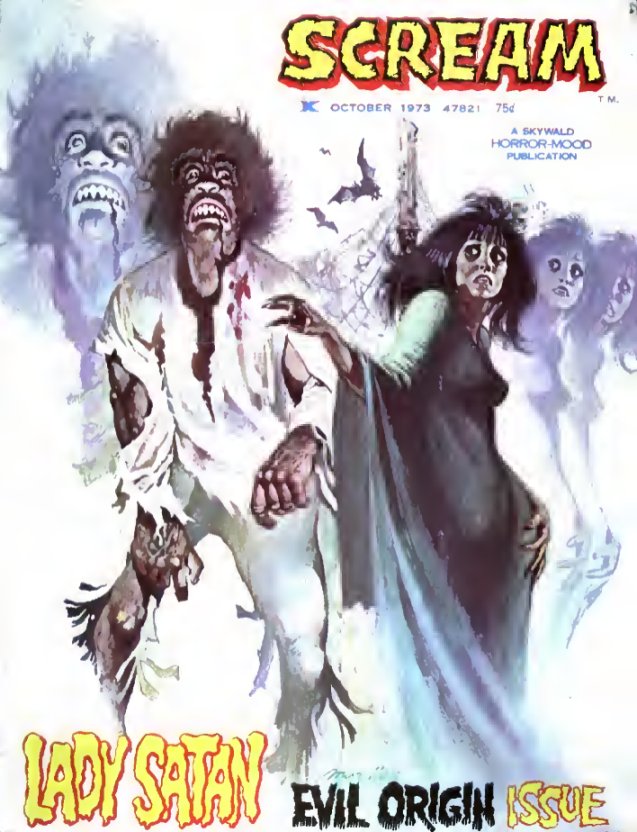
Scream #2

Jose Miralles provides the cover for this issue of Scream, featuring the character Lady Satan. It is cover dated October 1973.

First is Lady Satan in "The Macabre Beginning" by Al Hewetson (story) and Ricardo Villamonte (art). A young woman, Anne Jason, is brought by friends to a tourist attraction in Salem, but is then grabbed by some Satanists, who claim she's the Black Queen of Salem Witches, returned from the dead. Anne shocks them by revealing that she is in possessed by her. The Satanists reveal it was all an act, but she considers things real and calls forth for Satan, to marry him. Around this time Anne is able to repossess her body and not wanting to be married to Satan, flees and jumps off a cliff to her death. This is a bit of a confusing origin story, and VIllamonte's art is rather mediocre

Next is "I Was a Vampire for Hire" by Al Hewetson (story) and Felipe Dela Rosa (art). A man named Watson comes across an advertisement for Stanley, a pretend vampire for hire! Watson hires him to dress up as a vampire and smash through a window at an upcoming party he is holding. Stanley does as he was hired, but it has horrendous results as people freak out and Watson's father in law dies of a heart attack! Stanley finds out that it was all a plot schemed by Watson though, as he is set to inherit money due to his father in law's death. Stanley decides to get revenge, putting on a mask of the father in law and pretending to be him at the funeral, then reveals himself to be alive during it. This causes Watson to blab out that this was all a scheme both he and his father in law cooked up to enable them to easily transfer some holdings. Watson and the others demand to know where the father in law is, as he was only unconscious. Stanley reveals that he hid him in a frozen body compartment in the morgue, and he's now dead for real. Some pretty good twists in this story, A rare Skywald story that ends up not having any actual supernatural element to it.

"I Was a Vampire for Hire"
Next is "Gothic Fairy Tales: The Thing in the Black Dress" by Al Hewetson (story) and Jesus Suso Rego (art). This may be the first in a series, perhaps modeled after EC Comic's Grim Fairy Tales? We get another brief feature in this series at the end of the issue. In this story, an aging woman, angry that she can no longer compete with younger women decides to move to the village of Garg in Transylvania, hoping there she can regain a powerful position in society. She gets a bit of attention, but not as much as another, far younger and more attractive woman. Our protagonist decides she wants to get rid of her and starts telling everyone her rival is a vampire, including showing everyone a dead body with bite marks. A mob forms, and grabs the rival, then pulls her outside, where our protagonist is shocked to find the rival is in fact a vampire and is killed due to exposure to sunlight. Upon her death she calls out our protagonist as a witch. The mob quickly changes their focus, believing it, and our protagonist ends the story bound in a public stock in the middle of town. How volatile the mob was in this story was pretty ridiculous, but Suso's art is quite strong.

Fourth is an Edgar Allen Poe adaption, "The Pit and the Pendulum" with adaption by Al Hewetson and art by Ricardo Villamonte. This classic Poe story features a man who is sentenced to death and is jailed in a cell which contains a large pit in the middle. He avoids the pit, but drinks a drugged cup and later awakens bound on a board, with a pendulum swinging above him and slowly lowering. Our protagonist is able to escape by rubbing food on the ropes binding him, causing rats to bite at them until he is loose. Our protagonist is once again faced with the pit, but now the walls are moving in, forcing him closer and closer to it. But suddenly he hears voices and is freed by a friend. This is a fairly decent story, but I'll admit that Villamonte can't really hold a candle to Jose Ortiz, who also drew an adaption of this story for Warren.

A "Gothic Fairy Tale"
Fifth is "The Phantom of the Opera", a two page feature from Al Hewetson (story) and Maro Nava (art). The first page of this features us seeing how Lon Chaney put on his makeup for the titular role. The second page features a short scene from the movie, of his unmasking. Makes me wonder if this was originally intended for the "Scream Scene" feature we recently saw in some other Skywald issues.

Next is the one page "The Vampire Hunters" by Al Hewetson (story) and Domingo Gomez (art). It features, what else, but some vampire hunters, who come across a crypt with 8 open coffins and stake all the bodies within.

Seventh is "The Vampire Letters" by Al Hewetson (story) and Emilio Bernardo (art). An editor as a newspaper (Howie Anderson, a pseudonym for Al Hewetson, for whom the character is modeled after) publishes a classified ad from a vampiress wanting to meet up with a male vampire. Some bizarre vampire photos start coming into the paper and after he publishes them some actual vampire killings start occurring. Howie investigates and finds the source of the ad, and meets up with the vampiress, the beautiful Anne, who claims it was all a joke. As they embrace and start to kiss he realizes he really is a vampire though. Anne is in love with Howie for real, but he leaves. She chases after him, outside, and the sunlight starts immediately decaying her body. Howie changes his mind, turns around, bites her on the neck and changes into a vampire himself... then instantly dies as well. A somewhat decent story, its always fun to see Hewetson involved in the story in some fashion. Bernardo's art is just okay, but he at least provides a rather gruesome final page.

Another one pager is next, "The Thing That Left No Fingerprints" by Al Hewetson (story) and Ferran Sostres (art). This story features a rabid dog that was shot by its owner come back to life and kill him!

Ninth is "The Fetid Belle of the Mississippi" by Al Hewetson (story) and Jesus Suso Rego (art). This story is told in interesting fashion; the caption show lines from a screenplay while the word balloons include narration. A steamboat, the Robert E. Lee travels down the Mississippi river in Tennessee. Things are initially calm, but then chaos ensues. The body of a woman is found in the wheel of the boat. Then another boat, occupied by corpses bears down on the Robert E. Lee, crashing into it. Then a giant Loch Ness Monster type beats rises from the sea and attacks! It is here where the captain of the Robert E. Lee loses it, shouting out that the script is all wrong. He beats the monster into submission, then grabs an ax and starts chopping away at the captions and says he will rewrite the screenplay. Another one of those crazy, break the fourth wall Skywald stories, which helps what may have otherwise been a rather dull story.

"The Vampire Letters"
Tenth is another entry in the Nosferatu series, "The Name is Sinner Cane... And the Name Means Evil!" by Al Hewetson (story) and Zesar Lopez (art). Similar in fashion to the prior story in this series, the titular Nosferatu has summoned various hooded fiends to eat dinner with him. He calls upon one of them, Sinner Cane, who was a voodoo priest in Haiti. We flash back to his conflict with a man named Papa General, and how he would curse him with unexplained pain. The general starts having Cane's followers murdered, but Cane rises them up as zombies and comes to the General's home. The general is revealed to be holding a doll through which he is able to control Cane's actions, and causes him to burn and mutilate his own body. Cane eventually jumps out of a window and the general causes him to shoot himself in the head. We return to the present and Cane removes his hood, revealing his mutilated corpse body. Zesar's art and atmosphere is quite strong, helping hold up an only slightly better than average story.

The issue concludes with the one page "A Gothic Fairy Tale: A Tale of 2 Macabre Snakes" by Al Hewetson (story) and Felipe Dela Rosa (art). Despite being credited to Dela Rosa, this doesn't really look like his artwork. This is a very simple feature, two snakes attack and eat each other.

Friday, November 29, 2019

Nightmare #15

Happy black Friday, everyone! We've got another Ken Kelly cover for this issue of Nightmare, cover dated October 1973.

The frontispiece for this issue is "How They Killed the Chicago Vampiress" by Ed Fedory (story) and Emilio Bernardo (art). It features a dead young woman having her body burned due to feat of her being a vampire. In what may have been a production error, an image from the story "15 Dead Things" which was originally intended for Psycho #15 appears on the table of contents page, rather than an actual story from this issue. That story will finally appear soon in Psycho #15.

First story is "Dracula Did Not Die!" by Al Hewetson (story) and Antonio Borrell (art). The first few pages of this story act as a historical account for the real life Dracula, Vlad the impaler. It was thought he was dead, but when his coffin is dug up only a horse's skeleton is found inside. Vlad/Dracula laughs at being able to fake his own death, but does regret that he'll have to hide himself and not be able to take advantage of his wealth, influence and power. Dracula explains how he was able to fake his death and killed any witnesses. He heads towards his castle, finding it on fire and swears those doing so will pay. The story suddenly stops here, implying that his will be the start of a multi-part series. Some pretty good art from Borrell here, although this is much more of just an introduction than a full story.

"Dracula Did Not Die!"
Next is "The Gargoyle Who Went to War", a two page feature from Al Hewetson (story) and Fernando Rubio (art). This brief story takes place in Paris France where some people gather to look at the gargoyle statue on the Cathedral of Notre Dame. Natzis arrive and take over the city, lining up people to be shot. Then suddenly, the gargoyle comes to life and kills the soldiers. This story is unrelated to the long running Gargoyles series.

Third is another two pager, "The Truth Behind the Myths About Bats... Particularly Vampire Bats" by Al Hewetson (story) and Domingo Gomez (art). Rather than being a typical story, this is rather a two page feature providing factual information about different types of bats.

Following this is "The Kid and the Killer and the Bum Rap" by Al Hewetson (story) and Francisco Cueto (art). A man named Miller is brought to jail, claiming he's been framed. He is put in a cell with a man named Eddie, who claims that he was beat up by him when he was a kid. Miller admits to being a killer, but claims he didn't commit the murder they claimed he did. Eddie and Miller start talking about things that Miller did when he was younger, including some murder he actually committed. Eddie tells Miller that he is in here for killing his wife, and his brother, his father, his landlord, a gay neighbor, many cops, doctors, etc... and says now he's going to kill Miller. We hear the guards laughing as the story ends. A rather abrupt ending to this, and we gotta presume Miller died, although why the guards would be in on it I'm not sure. Cueto's art is at least a little better than usual here.

"THe Kid and the Killer Bum Rap"
Fifth is "Tapestry of Blood" by Ed Fedory (story) and Fernando Rubio (art). A man finds himself shipwrecked on an island in the south Pacific. To his horror, he soon sees a fellow man killed by a giant snail! He beats the snail to its death but it is too late to save the man. Suddenly another man wearing an overcoat, hat and sunglasses appears. Calling himself a doctor, he leads our protagonist into the woods and to his camp. There he tells our protagonist of how his wife lies in the waters beyond the reef and he can never leave. Our protagonist later follows him, and the doctor explains how he died and was resurrected, and how our protagonist killed "Grayson" who is revealed to be the snail he attacked earlier. The doctor removes his sunglasses, revealing himself to be a snail like creature and bites into our protagonist! Quite a fun ending to this story, which I enjoyed.

Snail man!
Sixth is another in the Shoggoths series with "The Grotesque Green Earth" by Al Hewetson (story) and Zesar Lopez (art). Hewetson and Zesar are actually characters in this story! They receive a letter from a Howard Hay in Arkham, Massachusetts. Upon arriving he tells them of manuscripts he's found from a woman from approximately a century ago who lived by the river. We then flashback to see the woman as she writes. At her husband's grave she finds a hole that leads her down into a lengthy pit. This eventually leads to a large cavern where she finds an underground city. Inside she finds a library filled with zombies,, writing of man's doom. Suddenly some Shoggoths arrive. They chase her back up to the surface and even after she makes her way there they make it through. Hay, Hewetson and Lopez head to where the papers were found and it leads to an underground tunnel where they find her skeleton, where she's written that they will come to the Earth, in 1973! This story's style is much like the previous Shoggoths story in Scream #1 and reads as if it was a Lovecraft story itself. Zesar's art is strong as well, making this a pretty high quality story.

The Shoggoths return!
Next is "Ravings of the Damned" by Ed Fedory (story) and Juez Xirinius (art). A pair of archaeologists in a temple find a desecrated corpse of one of their men in front of a large statue. One of the men thinks a monstrous snake did it, while the other thinks it is Quontotaz, an Indian legend. Later that night, one of the men hears the other screaming. It is the statue, come to life and crushing him in its arms. Months later another expedition arrives. The remaining man is now worshiping Quontotaz, and is in a beast like form. Just there, the stories stops rather abruptly. A quick ending to an average at best story.

We wrap up with another story in the Gargoyles series, "Once Upon a Time in Alabama: A Horror" by Al Hewetson (story) and Maelo Cintron (art). Edward and Mina, with their child Andrew hitchhike their way to Birmingham, Alabama. Edward is able to get a job on a construction work site and saves a man falling from above. Just then, another, evil gargoyle arrives. He demands Edward fight him, or his wife and child will be killed by being shot by a madman at a riot (how a gargoyle can be killed by mere bullets eludes me...). Edward has had enough, decides to fight the enemy gargoyle and kills him. He then finds Mina and Andrew, safe and sound at a rally. This is standard fare for the Gargoyles series, pretty good art, but a rather uninteresting story. Gargoyles face some discrimination. Edward fights some sort of monster. Rince and repeat.