Showing posts with label sostres. Show all posts

Saturday, March 21, 2020

Psycho #23

Sebastian Boada provides the cover for this issue of Psycho, cover dated January 1975.

We start with the frontispiece, "People of the Dark" by Robert E. Howard (story) and Gene Day (art).

First story is "The Phantom of the Dead: Midnight in Wax" by Al Hewetson (story) and Jesus Martin Sauri (art). This story is hosted by the Vulture, who had just appeared in Nightmare #22 and as such may have originally been intended for the Tomb of Horror magazine. Once again the vulture introduces a new horror character, this time the titular phantom. Charles Ogle has a wax museum with various fiends and monsters including the Phantom of the Opera. On a stormy night, a bat smashes through a window and lightning strikes the museum, bringing the Phantom to life! We find that the Phantom was built with actual joints and other body parts which enables it to move. It goes outside, scaring a couple, who calls the police. It doesn't respond to the police when they come, but instead goes to a graveyard. When the sun comes up it starts melting, but heads back towards the museum and is found by Ogle. Ogle rebuilds the Phantom, claiming he'll construct it even better this time, and use a human brain! An average story, but Sauri's artwork continues to be very strong.

"Midnight in Wax!"
Second story is "The Curse of the Snake Goddess" by Al Hewetson (story) and Jose Cardona (art). An archaeological dig takes place in Egypt, finding a four thousand year old tomb. Those who have dug it up take their treasures from it, but several suffer mysterious deaths. The finds of the expedition eventually make their way back to America. While the archaeologists work on translating things, a young woman, one of the assistants, finds a snake necklace that she hopes to sell and make a lot of money off of. She ties a rope and starts making her way out the window, but the necklace turns into a snake and kills her, revealing itself to be the source of the deaths. This story was a bit simpler in nature than I expected it to be. Early in the story we have a rather odd segment where a character drives while drinking beer, something quite idiotic, although it is never touched upon again later in the story.

Third is "A Garden of Hellish Delight" by Al Hewetson (story) and Cesar Lopez (art). Earnest is a gardener who is in love with the wealthy heiress Angela. Her father refuses to let them be married however. Earnest cries and his tears cause his plants to grow and kill Angela's father during the night. He and Angela are soon married. Now wealthy, Earnest doesn't need a job but spends all his time on the garden. Many years go by. Earnest and Angela are now old and she has grown bitter over him paying all his attention to his garden rather than her. When she demands a divorce, Earnest cries again, and his tears once again cause his plants to come to life and kill her. He uses her body as fertilizer and spreads this garden throughout their mansion. At the end of the story we see his now dead boy, also being used as fertilizer for the plants.

"The Werevampirewolf"
Fourth is "The Werevampirewolf" by Al Hewetson (story) and Jose Cardona (art). This story is quite the oddity in that it features text only at the start and end of the story. Otherwise every panel has no captions or dialogue. It shows a tale of a vampire and werewolves from 19th century Germany. It includes a vampire being set loose, a mob of werewolves and the vampire becoming some sort of werevampire at the end of the story, despite having been staked in the heart.

Fifth is an Edgar Allen Poe adaption, "The Man of the Crowd" with adaption by Al Hewetson and art by Ferran Sostres. Our protagonist on an autumn day sees a rather disheveled looking man wandering around. He decides to follow him, thinking he is a pick pocket, then a thief, then a murderer, but he does no such things. He decides to confront the man, but the man doesn't react to him, leaving our protagonist to wonder if he's a ghost, mad or imbecile. Not much of a plot to this Poe story, which I recall being a bit happier with when it was adapted by Warren. At a mere 5 pages it goes by pretty quick, but Sostres provides a usual strong art job.

Sixth is "The 300th Birth Day Party!" by Al Hewetson (story) and Ramon Torrents (art). This is a reprint of a story that originally appeared in Nightmare #9. Odd to see a single reprint story in an issue that is otherwise all new, although I always enjoy seeing work from Torrents. Cecille is married to the ugly and scarred, yet rich Walter, and is carrying on an affair with her doctor. When Cecille discovers she has cancer, the only option is to freeze her body, until a time in the future when a cure is found. Cecille willingly goes through with it, hoping that when she awakens she'll have her husband's money, but he'll be long dead. She wakes up 3 centuries later, but finds to her horror that due to advantages in medicine, Walter is still alive!

"The Man of the Crowd"
Seventh is the second chapter in the "Mummy Khafre" series, "The Murderess" by Al Hewetson (story) and Cesar Lopez (art). Khafre decides to flee, jumping into the wagon of a traveling salesman. She takes off her bandages, realizing that only her head remains preserved and the rest of her body is mummified. The salesman spots her and she slays him. Despite the state of her body, she is able to move around and breathe normally and puts on a dress to make herself look normal. Khafre returns to Egypt and finds her tomb. She finds a series of Ushabtiu, small curios which she is able to bring to life to act as her slaves. They lead her to Neferches' tomb where she destroys his mummy. She is found soon after and while she struggles, is taken captive, forced to remain bound. As the story ends she summons the Ushabtiu to set her free. A decent continuation of this series, although with the end of Skywald nearly here we probably won't see much more of it.s

The issue concludes with a one page Zombie Pin-up by Gene Day.

Thursday, March 19, 2020

Nightmare #22

This issue of Nightmare has a cover by Salvador Fabia and carries a date of December 1974. It features a werewolf bursting through panels from several old Skylwald stories.

This issue's contents consist of what was supposed to be the first issue of The Tomb of Horror, which would have been Skywald's fourth horror magazine. Its theme was to have a host for each story, often the artist or writer for that story. Alas, that magazine never came to see the light of day and was included as part of this issue of Nightmare instead. The inside front cover features drawings of many Skywald contributors by Maelo Cintron.

We start with a "Tomb of Horror Introduction" by Al Hewetson (story) and Domingo Gomez (art). This two page feature is introduced by Gomez, who also stars in it, as he shows us various monsters such as Dracula, Phantom of the Opera, Frankenstein's monster and others.

"Mercy, Mercy, Cries the Monster"
First story is "The Tales of the Vulture: The Bat - Mercy, Mercy Cries the Monster" by Al Hewetson (story) and Jesus Martin Sauri (art). A vulture hosts this story, claiming he will use his feature as an opportunity to introduce various new characters that the reader has the ability to request more stories of. Brock Stans is a professor and archaeologist from Manhattan, yet while in the jungles of Central America he is attacked by a swarm of vampire bats. He makes it back to Manhattan, but finds himself transforming into some sort of man-bat. After attacking and killing a woman he justifies it to himself thinking he is somebody now, having been a meek cripple before his transformation. Traveling to a graveyard he comes across a man who believes himself to be a vampire and they argue, with Brock trying to convince him he is not really one, but a dull nobody. The cops come upon him and the "vampire" claims he was being attacked, leading to Brock being arrested as he turns back to human. As the story ends we see him returned to his man-bat form, but locked in a padded cell, hoping to get out. Sauri's art continues to be quite the highlight, and this story comes off in part as a more macabre take on Batman.

"When I Was a Boy I Watched the Blood-Wolves"
Second is "When I Was a Boy I Watched the Blood-Wolves!" by Augustine Funnel (story) and Jose Cardona (art). The story is hosted by Funnell. Our protagonist is a boy who hates all other humans and instead finds friendship with wolves, who share some of their food with him. When his parents punish him without dinner he doesn't care. Eventually he grows up and becomes a  killer, slaying a couple and getting arrested. The two officers holding him talk of how he considers himself a werewolf. However we soon find out that one of the officers is a werewolf instead, slaying his partner and freeing our protagonist. After all, they are like family. Some pretty good art by Cardona here and the way the story ends I could see a sequel.

Third is "Kill, Kill, Kill, and Kill Again" by Al Hewetson (story) and Ferran Sostres (art). This story is hosted by Ferran Sostres. Satan orders his archangels to cause havoc. We focus on one in particular, Simon Ingels who causes a man to murder his wife then promptly departs him to decry what he has done. We see Ingels cause various other horrible situations such as a cop striking a hippie, a milkman breaking into a house and other assorted things. We then learn of Ingels' life and how he was practically perfect. Heaven rejected him for being inhuman (due to being so perfect) so he became a servant of Satan and continues to cause havoc as the story ends. This was a very different type of story for Skywald, lacking a more traditional narrative but rather focusing on Ingels in his role as minion of Satan and the things he is causing to happen. Some well done art by Sostres as is typical for him. Also a great title!

"Kill, Kill, Kill and Kill Again"
Fourth is "The War of the Hell-Damned" by Al Hewetson (story) and Jesus Duran (art). This story is hosted by Jesus Duran. Professor Peter Cushman tells his students the tale of a skeleton that he owns. As a young man he was part of an occult group that would spend time in caves and search for monsters such as vampires. Spotting some tracks in the cave they go to see the local professor (also Peter's father), who doesn't believe in vampires or werewolves, offering up real life explanations for what they were inspired by. Peter and his friends later return to the cave where the professor is waiting, claiming he believes one of them, Rolf, to be a werewolf. Rolf confirms his suspicions and turns into a werewolf, but claims the professor to be a vampire! He pulls out a stake and mallet and tries to kill the professor, but Peter jumps him, revealing himself to be a vampire too and slays Rolf. The professor dies of his injuries though, and Peter carries on with his father's legacy. As we return to the present, he explains that he is a vampire, and he had killed all his fellow students that night. Duran's art here is quite strong (the page with Rolf the werewolf trying to stake the vampire professor is in particular a great one). Modern day Peter is modeled off of actor Peter Cushing (and obviously his name is based on him too).

"The War of the Hell-Damned"
Fifth is "The Cox-sackie-Axe Murder" by Ed Fedory (story) and John Agras (art). Ed Fedory hosts this story. Our story initially focuses on two lovers, however the woman's father, Silas Lowell does not want them together. Once the two of them depart, Silas has the man seized and slays him with an ax, but not before he proclaims a curse on Lowell and all that shall follow him. He rises from the grave as a monster, slaying Lowell. Lowell's daughter, Patience, hangs herself in grief. Years go by and every Lowell male dies before his 30th birthday. We turn to the present and focus on Ned Lowell, who is about to turn 30. The monster comes to slay him but upon hearing the name of Ned's daughter, Patience, thinks back to his lover, goes to her grave and dissolves. A pretty good story by Fedory, although some only so-so fart by Agras. Also the failure to name our protagonist is frustrating.

Sixth is "The Mummy Khafre: The Funeral" by Al Hewetson (story) and Cesar Lopez (art). This story is hosted by Al Hewetson. The titular Khafre is wife of the Pharoah Nefercheres, but her madness and mistreatment of her subjects causes her to be put ot death. She is mummified alive! We then head to the modern day where professor Peter Flinders and his assistant Tom find her tomb. Tom hopes to bring the still living Khafre to T.P. Barnum's circus and slays Peter in order to do so. He smuggles her out of Egypt, keeping her handcuffed and eventually finds Barnum, who doesn't buy her outright but pays him to stay with the circus using her as one of the attractions. Khafre is able to convince Tom that he is the reincarnation of Nefercheres and has him unwrap her head, revealing her to be as beautiful as she was when she was mummified. She then reveals her deception, strangles him and leaves. It looks like this will be the start of a new series starring Khafre.

Friday, February 28, 2020

NIghtmare #20

Sebastian Boada provides the cover for this issue of Nightmare, cover dated August 1974.

We start with the one page "Horror Fragments: The Demon Whale" by Al Hewetson (story) and Ferran Sostres (art). It discusses Moby Dick, and Captain Ahab's obsession and eventual defeat to the giant white whale.

Next is the latest in the Shoggoths series, "The Scream and the Nightmare" by Al Hewetson (story) and Jose Cardona (art). Much like with prior stories, we have Al Hewetson and Jose Cardona themselves star in the story. Upon seeing a report of a Shoggoth, they go to a library where the librarian, Suzette, brings them the Necronomicon. Suddenly a Shoggoth appears and grabs the book. Finding a secret passageway through a bookshelf, they head down an underground passage and find a library of the Shoggoths, who attack and knock out our heroes. Waking up, they find themselves in the center of the Earth. Brought along by the Shoggoths to an ancient city, they are eventually able to escape, keeping the Shoggoths away by collapsing a bridge. They then find themselves in an Egyptian tomb where a mummy wakes up, but they slay it. As the story ends the various characters ask the reader if they would like to join them on an expedition to discover Shoggoths. Like previous stories in the series, Hewetson does a good job of aping the Lovecraft style, although this story is a bit long (a whopping 20 pages) and too familiar with previous entries.

"The Scream and the Nightmare"
Third is "Wanted: ...More Dead Than Alive..." by Al Hewetson (story) and Emilio Bernardo (art). A creature rises from a swamp and we flash back to see what led to its death. A man named Ingels comes across a wanted poster for a man named Ortega and is told he is up on a nearby hill. Ingels is caught on the way up there and Ortega shoots him in the leg, although leaves him alive. We see how in the present, the monster has arrived at and attacks a camp. Ingels pursues Ortega again, this time getting shot in the head. Meanwhile a gypsy woman turns into a werewolf and bites Ingels, turning him into one. He attacks and kills Ortega. At the end we realize that Ortega is the swamp creature, seeking revenge against Ingels. A so-so story with a decent end twist, but the narrative at times is a bit confusing.

Fourth is "A Tale of Horror" by Al Hewetson (story) and Luis Collado (art). In the later days of World War II we focus on a reluctant German soldier, stationed in a destroyed Berlin. The soldier, a former farmer, desires to return back to his family. He is come upon by a superior who tells him that Hitler himself requires a messenger. The soldier is brought to an underground bunker and instructed by the officer to deliver the message to the front lines. Hitler himself meets with the soldier, telling him its an important to an underground group. The soldier departs and hiding from the Americans, opens the letter and reads it. Despondent, he tosses the letter away and says to hell with the war, deciding to head back to his family. We then see a panel of those he was to deliver the message to, deciding that without receiving word from Hitler, they are to go into hiding. In the final panel we read Hitler's message, that he was recruiting werewolves! A really funny ending to this story, which is most notable in my eyes for the amazing art done by Luis Collado. While the quality isn't there throughout every panel of the story, much of it is quite beautiful.

"A Tale of Horror"
Next is "The Black Cat", an Edgar Allen Poe adaption with Al Hewetson doing the story and Ricardo Villamonte doing the art. Our protagonist, Edgar, has a black cat he loves, Pluto, but in an argument with his wife attacks it, cutting out its eye, then he decides later to hang it. A fire ruins Edgar, and he is reduced to poverty, feeling that the murder of Pluto caused this. He eventually finds another black cat, with white marks around its neck and blinded in one eye. He takes it home with him, but then decides to kill the cat. When his wife tries to stop him, he kills her instead. He takes his wife to the basement and puts her behind a brick wall that he lays all the bricks in. He soon discovers that the cat has disappeared. Upon hearing some screams, the cops arrive and they find them coming from behind the wall. It is broken down and there they find his wife's corpse and the cat. This is a fairly good adaption of a story that I've also seen adapted by EC Comics and Warren.

Next is "The Castle" by Al Hewetson (story) and John Byrne/Duffy Vohland (art). In this two page story, some construction workers work on demolishing a castle that is in the way of a new highway. One of the workers feels shame and ominous about doing it, but they go ahead and do so, blowing it up with dynamite. Only then do they discover the castle was some kind of prison for a giant monster! The closing caption explains that somehow the castle is rebuilt and the highway is made to go around it. A mere two pages, but the story does mark the professional debut of Byrne.

"The Black Cat"
We wrap up with "I, Gargoyle", the latest story in the Gargoyles series by Al Hewetson (story) and Maelo Cintron (art). Edward is released from jail by Judge Wallace who says he doesn't want to see him in this courtroom again. Upon leaving, Edward along with his wife Mina and son Andrew discover that Edward's autobiography, I, Gargoyle, has been published and is a best seller. Money is rolling in from the book and Edward's agent/ghost writer Paul Hawkins has gotten him spots of TV shows. During one such one, another gargoyle appears, sent by Satan, claiming Edward is an impostor and fights him. Edward is able to defeat him, and realizes that with this happening on TV Edward now has millions of witnesses who have seen that he is not evil but defending himself against Satan. As the story ends, Edward and Mina come upon a castle he has bought, not knowing that Satan has forces waiting here. This series continues to get more and more dreadful. The notion that Paul could have written Edward's biography in mere days and that it would become such a big hit is quite absurd. As we approach the end of Skywald's run I hope we get as few of these Gargoyles stories as possible.

Sunday, February 16, 2020

Scream #7

I am back again after a brief absence due to some travel and being sick. Today' I'm covering Scream #7. Manuel Brea Rodriguez provides the cover for this issue, cover dated July 1974.

First is "Horror Fragments: The Headless Horseman" by Al Hewetson (story) and Ferran Sostres (art). This one pager features the titular Headless Horseman, who came across Ichabod Crane in the famous tale.

Next is "The Man with No Face" by Al Hewetson (story, credited to Howie Anderson) and Jose Cardona (art). Our protagonist, Al Anderson, is a sailor on board a ship that is destroyed by a storm. Al travels on a raft, and sees mirages, such as a town that doesn't exist, but eventually makes his way to an island. He lives there and even makes a home for himself. One day he comes across a beautiful woman who doesn't speak. She spends the day with him, but when he wakes up that night he finds her missing. He follows her footsteps to a nearby volcano where he finds many more beautiful women. The one he saw earlier tries to pull him away from them, but he stays with the others. The woman leaves them comes back with 2 of Al's shipmates, who also made their way to this island, but now have deformed bodies. Suddenly the women grab a hold of Al and start biting at him. It turns out they are demons. Al and his other shipmates depart the island on their raft, hoping to return to civilization, although deformed. This is a pretty good way to start off the issue and Cardona does a good job drawing some beautiful women, reminding me again of Jose Gonzalez's style. The story reminds me somewhat of "Mates" from Warren's Creepy #64 where a man becomes deformed after sleeping with a number of alien women.

"The Man With No Face"
Third is the latest Nosferatu story, "Satan's Third Reich" by Al Hewetson (story) and Zesar Lopez (art). Nosferatu asks Horsch Heindrich, wearing a goat's mask, to tell his tale. A Nazi soldier during World War II, Heindrich watches as his superiors commit torture and grows fascinated by it. He desires to do it himself and gets together with like minded people after the war is over, forming a coven. Heindrich declares himself leader of the coven, with little reason to back it up, and while they are able to steal many things from churches around Berlin, one of their own gets arrested and gives it all up. Heindrich's coven is forced to go on the run to the mountains. His underlings demand to make a sacrifice, and try to kidnap a young woman, only to be scared off. Heindrich's underlings has had enough of his bad leadership, and makes him their sacrifice! As the story ends Heindrich reveals the gaping hole in his abdomen from when he was sacrificed. The atmosphere of this series continues to be strong, with great art from Zesar, although we are starting to hit a point where the stories are getting a bit repetitive, or at least the endings are. As each tale ends the teller takes off his mask and hood, revealing a rotted, eaten or otherwise deformed body. I think I'd be a bit less kind if the art wasn't so good.

"Satan's Third Reich"
Fourth is the Edgar Allen Poe adaption, "Berenice" with adaption by Al Hewetson and art by Ricardo Villamonte. Our protagonist recalls playing with the titular Berenice when they were children. While she was graceful and full of energy, he was sickly and withdrawn. Eventually they grow up and Berenice falls ill from a fatal disease. Despite this our protagonist falls in love with her and they marry. Berenice grows sickly and emaciated and our protagonist starts obsessing over her teeth. Eventually, she dies and is buried. Our protagonist cannot stop thinking of her. Eventually he is come upon, being told that Berenice's grave was tampered with. Our protagonist is discovered to have dirty clothes, and bloody fingers. He discovers a box, and upon opening it finds out that he dug up Berenice and pulled out all of her teeth! A rather memorable Poe story, which I recall being adapted several times by Warren. I don't recall in their adaptions Berenice becoming as ill looking as she does in this adaption, which makes it all the scarier.

Next is The Saga of the Frankenstein Monster with "The Descent into Hell" by Al Hewetson (story) and Cesar Lopez (art). I'm rather surprised to see the Frankenstein series start up again after they so recently ended it, although this appears like a complete redo, with no connection to the prior stories. Frankenstein's Monster narrates the tale of his creation. Dr. Frankenstein seeked to create a perfect being, and is able to do so; yet when his creation starts moving about and accidentally destroying some equipment, he gets into a rage and chops up his creation repeatedly in the head with an ax. Realizing the mistake he has made, Dr. Frankenstein resurrects his creation, but he is now hideous, so Dr. Frankenstein seeks to kill him again. The monster instead shoves him aside and heads outside, scaring a man along the way. This was a decent enough story, with a slight change in how the Frankenstein story is typically told (with Frankenstein creating him twice).

"I Am Horror"
We wrap up with the second story in the Saga of the Victims series, "I Am Horror" by Al Hewetson (story) and Jesus Suso Rego (art). After a short recap, we continue where we left off, with Anne and Josey confronted by a man who looks like all his skin has been torn off. The man starts babbling on about being horror, asking if they are dreaming and other nonsensical stuff for a few pages. They depart and the man, serving his purpose, dissolves. Anne and Josey head outside, where they find things have returned to normal. A man named S. Paladin shows up and says he can explain, leading them into his car. Once inside he claims to be their tormentor and brings them to his castle in the small country of Cordova. He claims to be 400 years old and leads them to his basement, where he lays in a coffin. Anne and Josey try to escape, fleeing from some snakes and find themselves in a room that suddenly starts shrinking. By shorting out some circuits they are able to escape, finding themselves in a room with 3 female vampires. Paladin appears, and starts pulling off his skin, revealing him to be a robot! He still seems to have the weakness of a vampire though and is destroyed when exposed to sunlight. Anne and Josey flee outside, only to be confronted by a winged dinosaur! Here the story ends. This series continues to be total craziness, with our 2 heroines getting in nightmarish situations one after another. Suso continues to provide some really strong artwork.

Friday, January 24, 2020

Nightmare #19

Been a busy month for me, but I'm back with another issue of Nightmare; Sebastia Boada provides the cover which is dated June 1974.

First is the frontispiece "The Hounds of the Baskervilles" by Al Hewetson (story) and Ferran Sostres (art).

Next is the first full length story, "What the Hell is Dracula Doing Alive and Well in 1974?!" by Al Hewetson (story) and Ricardo Villamonte (art, miscredited to Jesus Duran). The story starts quite absurd, Dracula comes across a man in an alley and tells him he can make him a vampire if he pays him $10,000! The story then moves ahead to a while later. Many rich people have come to Dracula's castle in Romania where he refuses their money, but plans to still make them vampires as they desire. He reveals a new plan however, to establish a society under the sea. He brings them there, saying he has already brought many here to what he will call Transylvania II. When they arrive however, they are shocked to find everyone dead! A part fish part man monster has killed them all. In flashback we find that the creature had hoped to become part of the society but was shunned, so she attacked and killed them all. She kills even Dracula, tearing his head off his body and as the story ends we are told the creature will make the remains of Dracula's body her mate. This story is another one of those really ridiculous, over the top Skywald stories and I loved it quite a bit. Pretty much the whole plot is quite absurd and ridiculous, but I feel that is when Hewetson is at his best.

"What the Hell is Dracula Doing Alive and Well in 1974?!"
Third is "William Wilson", an adaption of the Edgar Allen Poe story by Al Hewetson, with art by Alphonso Font. The titular William is surprised when he finds another student who looks just like him and has the same name, although he is quite evil and even witnesses him stabbing someone. Years pass and upon turning 21, William inherits a vast fortune and starts participating in debaucheries. During this time he doesn't see the other William or even think of him. Eventually the other William appears though to stop him pursuing a woman, then to reveal him as a cheater at gambling, which gets him kicked out of Oxford. The other William continues to appear as he flees throughout many countries, and William decides to kill him. He successfully slays him with a sword, at which point William himself also dies and we realize the other self was his conscience. I have never read this Poe story, so I'm not sure how accurate an adaption it is. I can say the ending was extremely predictable from the start, perhaps that is why it is not as well known as some other Poe stories. Font continues to provide a fairly good art job.

Fourth is another story in the Shoggoths series, "The Vault" by Al Hewetson (story, credited to Howie Anderson) and Jose Cardona (art). Hewetson himself is again the star of the story, traveling through the area of Kilmarnock in Scotland. He talks to a man on the train who tells him Shoggoths had lived around there. Along with Jose Cardona, Hewetson returns to the Welloch Gravesite that he had visited before and they dig some graves up at night. A night later they find a Shoggoth in the graveyard, having eaten a body. They flee, making their way into a vault held by Hewetson's family where they are confronted by a Shoggoth and crush it with a coffin. They continue down into a city beneath the ground occupied by the Shoggoths. Hewetson and Cardona go to the police, the government, etc... but no one believes them so they blow up the city with dynamite, having found the Shoggoths have already left. Another fairly good story in this series; Cardona provides some good art and Hewetson continues to be really good at aping Lovecraft's literary style.

"The Kingdom of the Dead"
Fifth is "Tales out of Hell: The Kingdom of the Dead" by Al Hewetson (story) and Jesus Duran (art). The young boy Walter Thurber is caught sleeping in class with fake glasses and we find that he loves to daydream and fantasize. In another lecture the teacher talks about a myth from Crete, where the wind turns into a human form, the God Darbaras Doom. Darbaras seeks to take down the evil queen Melinia, but her guards are able to defeat him and the teacher says that history is less romantic than myth. Walter says however that he actually was there, as Darbaras, and it didn't happen that way. In actuality Darbaras had defeated Melinia, but she told him there was another ruler above her and she could make him her king. This results in him staying with her, but when he realizes it was all a ruse, he kills her by cutting off her head, just as a revolution starts occurring. We head back to the present where Walter goes into some sort of self-induced suspended animation. His doctors believe he is the reincarnated Darbaras Doom. With this the story ends, although it indicates there will be another part. Duran's art is quite good here (I particularly like his job on Melinia), but the story itself is a bit confusing and hard to get at times.

Next is "My Tomb is My Castle", the latest in the Autobiography of a Vampire series by Al Hewetson (story) and Ricardo Villamonte (art). Judas the vampire tells of how once upon a time he had lived in a house, around 100 years ago in Georgia. Judas watches a funeral, as an old man sadly buries his wife and is left by his children. Judas feels sorry for him and helps him when he falls (as it is revealed the old man is blind). The kindly old man lets Judas stay with him for a while and tells him of various stories of his wife. Eventually Judas grows to dislike him and in an argument over a fire, he ends up burning down the old man's home and leaving. It is here where story reveals that Judas was the one who killed the old man's wife by draining her blood. While I've never been much of a fan of Villamonte's art, the writing in this series continues to be pretty good and this is the best story in it yet. I loved the twist.
"My Tomb is My Castle"

We conclude with the latest in the Gargoyles series, "The Human Gargoyles vs. the United States of America" by Al Hewetson (story) and Maelo Cintron (art). The gargoyles - Edward, Mina and their son Andrew finish traveling the southern states of the US and return to Manhattan where they have their day in immigration court. Judge Wallace permits them to stay in the US and they head outside, stopping by a public library. Edward senses evil from the lion statue there, and fearing it will attack some nearby civilians fights and destroys it. No one else sees the lion move though and Edward is thrown in jail for destroying it. Judge Wallace briefly visits him but he will have to stay in jail for the time being. This series continues to hold little interest for me, and I am surprised at how overboard the punishment is for destroying the statue. I get a fine, but going to jail over it? Seems pretty ridiculous to me. A mediocre end to what is a fairly good issue.

Sunday, December 22, 2019

Scream #4

Xavier Villanova provides the cover for this issue of Scream, cover dated February 1974.

First is the latest Lady Satan story in "Satan Wants a Child" by Al Hewetson (story, credited to Howie Anderson) and Ricardo Villamonte (art). Lady Satan is brought before a demon who reveals that Satan has not yet forgiven her and seeks something else from her, a child. She is to wait in a bed for him, but awakens with Anne back in control of her body. She departs, heading back to the town of Salem and figures the only way to stop things from happening is to stab herself. It fails to kill her however and Lady Satan returns to having control of her body. She travels to be with Satan, they embrace and when Anne resumes control of her body she learns to her horror she is with Satan's child. This series continues to be rather lackluster for me, and the act of Anne and Lady Satan exchanging control of Anne's body is getting old.

"The Skull of the Ghoul"
Next is an adaption of Edgar Allen Poe's "The Oblong Box" with adaption by Al Hewetson and art by Maro Nava. This story tells of how our protagonist, traveling on a boat at sea sees his friend Wyatt also come on board with several servants, his wife and a large oblong box that he believes includes a painting. Wyatt's wife is quite vulgar and grotesque and Wyatt seems fit to rage and pass out. Eventually a large storm hits the ship and as it is destroyed, Wyatt chains himself to the box and sinks into the depths of the ocean. As the story concludes the captain reveals all. Wyatt's wife was in fact his servant, his real wife was dead, included in the box which was filled with salt. Our protagonist considers with horror what must have been going on with Wyatt and the box in his room at night. A pretty good Poe story; Nava's aping of Jerry Grandenetti continues including an extremely obvious swipe of a character from the story "The Adventure of the German Student" from Creepy #15.

Third is "The Skull of the Ghoul" by Al Hewetson (story) and Ferran Sostres (art). Traveling in a carriage across Barcelona is a carriage manned by a guard who is keeping a hold of a woman prisoner. When the driver of the carriage collapses dead, the woman takes the opportunity to break from her bonds and kill her guard. Feigning that she needs help, she travels into the town and is greeted by a Countess Sostres to brings her to her manse. There the countess shows our protagonist around, including showing her the skull of Dracula. Our protagonist plans to steal it and flee yet that night as she is about to do so she hears talking. It is the countess, talking to the skull! Our protagonist is taken a hold by Sostres' servants and she reveals she is a vampiress; she killed the driver of the carriage and will now drink her blood as well. Rather standard vampire fare, but Sostres' art is quite strong. For some odd reason this story is split into two parts, although the first part is a mere three pages long.
"The Lunatic Mummy"

Fourth is "The Legend of the Cannibal Werewolf" by Ed Fedory (story) and Ricardo Villamonte (art). A hunter named Sir Percy shows off the stuffed werewolf he hunted in Africa. He is asked to describe how he hunted it and we see him traveling through the jungle, and being attacked by the werewolf. Returning to the present, he reveals that the werewolf wasn't seeking to kill him, but find a mate and he transforms into a werewolf himself, along with his mate slaying everyone there. We will see another werewolves in love type story a bit later on which I consider quite a bit better than this rather "eh" story.

Fifth is "The Lunatic Mummy" by Al Hewetson (story, credited to Howie Anderson) and Cesar Lopez (art). This story is Lopez's Skywald debut. A man named Emmanuel Humphrey travels through the desert, stopping to rest at an oasis. While sleeping a group of religious fanatics capture him, planning on sacrificing him. They bury him up to his head, about to let a snake kill him, but then change their mind, dig him back up and mummify his body, then bury him again. The authorities arrive and kill all the fanatics, but upon digging up Emmanual find that his body completely deteriorates. The plot of this story makes me wonder if it inspired a sequence from the first Creepshow movie where people are buried in sand up to their heads. Stephen King was reportedly a Skywald fan, so it is a possibility.

Sixth is "The Vampire Kingdom" by Al Hewetson (story) and Domingo Gomez (art). A pair of newspaper reporters search Peru, finding a half buried city, occupied by the man-bats, half man, half vampire creatures. The design of the man bats seem quite similar to a one page feature of them done all the way back in Nightmare #11.

"When the Dusk Falls... So Does Death"
The issue concludes with the latest in the Nosferatu series, "When the Dusk Falls... So Does Death" by Al Hewetson (story) and Zesar Lopez (art). Nosferatu ask another of his dinner guests to tell his tale, this time one with a werewolf mask. The man removes his mask, only to reveal another, iron mask underneath. The man says his name was Fernando Doma and he lived in Madrid. An eligible bachelor, he pursued a woman, Anastasia Rubio, causing her to break up with her current suitor. At the first full moon we discover that Anastasia is in fact a werewolf and upon biting Fernando turns him into one too. They pursue many victims but eventually Anastasia is killed by a cross dropped by her former suitor. Fernando transforms into a werewolf and kills him, but is taken in by the authorities who put him in an asylum and strap an iron mask around his head such that when he transforms into a werewolf, the growth of his head will crush it. As we return to the present, Fernando removes his mask revealing his mutilated crushed head. As often is the case, the Nosferatu story is the peak of the issue, with great art from Zesar. I must say though Anastasia just isn't that beautiful with her short hair, and most notably very dark circles around her eyes.

Thursday, December 5, 2019

Psycho #15

Vicente Segrelles provides the cover for this issue of Psycho, cover dated November 1973.The cover identifies this as an all ghoul issue, although the cover is a man turning into a werewolf! In fact, not all stories are ghoul related, although most are.

The frontispiece for this issue is "How to Make a Mummy" by Al Hewetson (story) and Maelo Cintron (art). It features what else, but directions on how to make a Mummy.

We kick the issue off with "The 13 Dead Things" by Al Hewetson (story) and Jesus Duran (art). This story was originally intended for issue 13, and was the cover feature for that issue, but due to a delay in the artwork wasn't published until now. It was certainly worth the wait! This is the most over the top, hilarious Skywald story yet. In the 1600s, the Count of Monte Godo lays chained in the black cells of an asylum, with rats for company. When an old man in the fellow cell dies, our protagonist gets an idea, about how he can fake his death and escape the asylum when they toss a sack with his "dead" body into the moat outside. He imagines how he will get his revenge on the 13 who wronged him. We are treated to panel after panel, for three full pages of our protagonist brutally murdering people one after another. He strangles his wife and her lover. He stabs people through the chest, he cuts their heads off. He bashes a banker's head in, he shoves a knife through the head of his lawyer, he smashes a judge in the face with an ax, on and on, and collects everyone's heads to feed to the rats in the cells. Our protagonist then realizes the downside of his plan, what if the sack is tied too tight, and he drowns? He swears that won't stop him though, and we once again are treated to panel after panel, page after page as our protagonist, now a rotting corpse, brutally slaughters the 13 people all over again. Back in reality, our protagonist decides to set his plan in motion and play dead. But when he realizes he can't move, he discovers that most of his body has been consumed by the rats! This story is such a perfect representation of the Skywald style. There's not much of a plot to this story, but wow, across 12 pages we are treated to about as much over the top mayhem one can possibly get in a short story. Just when you think page after page of our protagonist brutally murdering people is as ridiculous as you can get, we go through it all over again, even more ridiculously as his corpse does it! This was such a blast to read, the best Skywald story thus far.
"The 13 Dead Things"

Second is "When the Bad Moon Rises... I Am a Ghoul!" by Rodion Eis (story) and Maro Nava (story). Got no idea who Rodion Eis is; it wouldn't surprise me if its one of Skywald's usual authors under a pseudonym. This story features a couple of newlyweds, Peter and Tina who are on their honeymoon. When Peter gets asked by his employer to take photos of the Andes for a travel feature, they decide to go ahead with it and hire a bush pilot, Stein. Stein is a drunk and due to the plane's battery being dead they are forced to touch down in the Andes, then travel through them, making their way into the mountains where they are attacked by ghoul bats. Eventually Stein is killed and Tina reveals that she is a ghoul herself, desiring to eat his body. Nava's style here is drastically different than that which he used in his prior story, where he looked a lot like Jerry Grandenetti. None of that here. Also the art style is really grimy and dark throughout, at times making it hard to read.

Third is "The Ghoul" by Al Hewetson (story) and Ferran Sostres (art). The passenger ship S.S. Captain Cook makes a trip across the Atlantic. One of its passengers is killed by a beastly ghoul. The passengers of the ship start questioning the captain, even offering their own thoughts on what it could be (a werewolf, a homicidal maniac, a vampire, etc...). The captain is hesitant to believe any of them and soon there are more victims. Because they can't find the killer, the captain believes it must be one of them doing it and orders everyone to stay in their cabins. Eventually though we realize why they couldn't find the killer, the ghouls have actually been coming aboard through nearby icebergs! Soon a group of them jump on board and kill everyone on the ship.

"When the Bad Moon Rises... I Am a Ghoul!"
Fourth is "The House of Demons" by Chic Stone (story) and Amador Garcia (art). Vincent and his wife Melanie go to visit his dying uncle Sinclair. There they meet his nurse, Christine and she leads them up to him. Sinclair tells off Vincent, saying he knows he is here because he is dying and has been foolhardy since his parents died. He nonetheless lets them stay the night. Behind closed doors Vincent and Melanie fight with one another. Meanwhile a stranger watches them, then Christine, as she goes to the basement to feast on something. A scream emits out, waking Vincent, who heads downstairs and starts coming onto Christine. She tells him of a ghoul, a being with a rare disease which eats away at its cells unless it consumes new flesh, which will in turn make it younger and more powerful. Just then we realize that both Sinclair and Christine are ghouls, and Sinclair has been able to restore his youth by eating a local visitor. Vince is killed, but Melanie and the stranger come upon them. The stranger says by shattering the reflection of a ghoul he can kill them and he does so, causing both Sinclair and Christine to age to death. The stranger reveals himself to be Sinclair's son, but then reveals that he is a ghoul as well and strangles Melanie. This story is a bit over complicated and it is hard to tell the male characters apart because they look so much alike (granted, they are related).

"The House of Demons"
Fifth is "Ghouls Walk Among Us" by Augustine Funnell (story) and Ferran Sostres (art). A trio of ghouls kills a man in a graveyard. The next day the police, Bill and Carl, find the body. They report to the police chief who refuses to believe anything supernatural is going on and thinks it is just a clever insane man. The ghouls continue to find victims, including Bill and Carl. As the story ends we find that the police chief was one of the ghouls and has been wearing a mask. Sostres' art is fairly strong here, helping make up for a story which is only so-so.

Sixth is "The Town That Crumbled" by Al Hewetson (story) and Jesus Suso Rego (art). This one pager talks about corrupt, dead places on Earth, such as a ghost corpse in the wild west and a corpse in Atlantis, underneath the ocean depths.

Seventh is "I Laugh the Laugh of the Graceful Dead!" by Al Hewetson (story) and Felipe Dela Rosa (art). Suzette is a ballerina dancer, jealous of her rival Monique who gets all the accolades. She kills Monique by stabbing her with a knife then hides her body in a coffin. When Monique fails to show for a dance, Suzette is able to take her place as she had hoped. Yet suddenly Monique appears on the stage with her and gets everyone's applause. After it is over Suzette chases after Monique, finding her in the coffin where she left her. Monique rises from the coffin and strangles her, telling her she can't kill someone who is already dead. I'm not used to seeing a Dela Rosa story with predominantly female characters. There's no indication that Monique is a ghoul, she just as easily could be a vampire or a body risen from the dead.
"I Laugh the Laugh of the Graceful Dead!"

The issue concludes with a one page advertisement for Scream, featuring some strong art from Zesar Lopez.

Tuesday, December 3, 2019

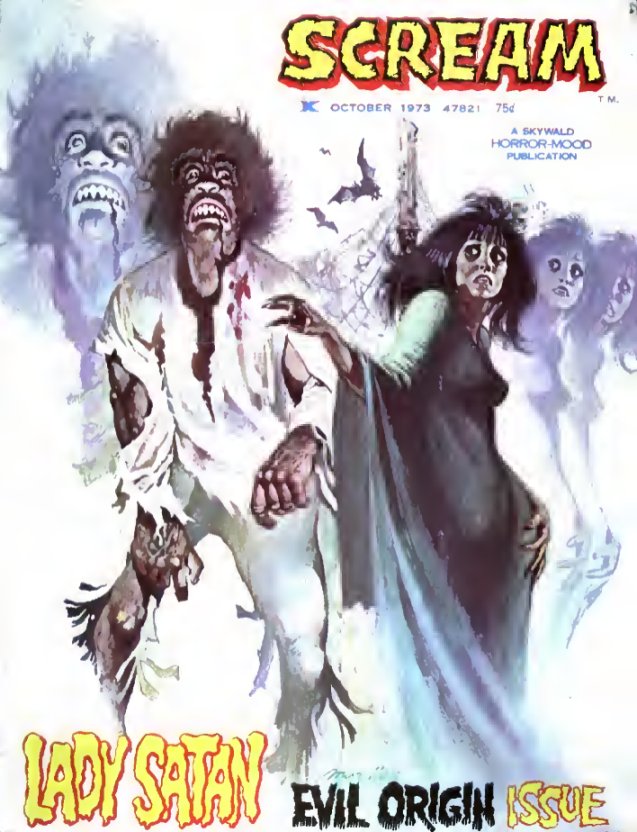
Scream #2

Jose Miralles provides the cover for this issue of Scream, featuring the character Lady Satan. It is cover dated October 1973.

First is Lady Satan in "The Macabre Beginning" by Al Hewetson (story) and Ricardo Villamonte (art). A young woman, Anne Jason, is brought by friends to a tourist attraction in Salem, but is then grabbed by some Satanists, who claim she's the Black Queen of Salem Witches, returned from the dead. Anne shocks them by revealing that she is in possessed by her. The Satanists reveal it was all an act, but she considers things real and calls forth for Satan, to marry him. Around this time Anne is able to repossess her body and not wanting to be married to Satan, flees and jumps off a cliff to her death. This is a bit of a confusing origin story, and VIllamonte's art is rather mediocre

Next is "I Was a Vampire for Hire" by Al Hewetson (story) and Felipe Dela Rosa (art). A man named Watson comes across an advertisement for Stanley, a pretend vampire for hire! Watson hires him to dress up as a vampire and smash through a window at an upcoming party he is holding. Stanley does as he was hired, but it has horrendous results as people freak out and Watson's father in law dies of a heart attack! Stanley finds out that it was all a plot schemed by Watson though, as he is set to inherit money due to his father in law's death. Stanley decides to get revenge, putting on a mask of the father in law and pretending to be him at the funeral, then reveals himself to be alive during it. This causes Watson to blab out that this was all a scheme both he and his father in law cooked up to enable them to easily transfer some holdings. Watson and the others demand to know where the father in law is, as he was only unconscious. Stanley reveals that he hid him in a frozen body compartment in the morgue, and he's now dead for real. Some pretty good twists in this story, A rare Skywald story that ends up not having any actual supernatural element to it.

"I Was a Vampire for Hire"
Next is "Gothic Fairy Tales: The Thing in the Black Dress" by Al Hewetson (story) and Jesus Suso Rego (art). This may be the first in a series, perhaps modeled after EC Comic's Grim Fairy Tales? We get another brief feature in this series at the end of the issue. In this story, an aging woman, angry that she can no longer compete with younger women decides to move to the village of Garg in Transylvania, hoping there she can regain a powerful position in society. She gets a bit of attention, but not as much as another, far younger and more attractive woman. Our protagonist decides she wants to get rid of her and starts telling everyone her rival is a vampire, including showing everyone a dead body with bite marks. A mob forms, and grabs the rival, then pulls her outside, where our protagonist is shocked to find the rival is in fact a vampire and is killed due to exposure to sunlight. Upon her death she calls out our protagonist as a witch. The mob quickly changes their focus, believing it, and our protagonist ends the story bound in a public stock in the middle of town. How volatile the mob was in this story was pretty ridiculous, but Suso's art is quite strong.

Fourth is an Edgar Allen Poe adaption, "The Pit and the Pendulum" with adaption by Al Hewetson and art by Ricardo Villamonte. This classic Poe story features a man who is sentenced to death and is jailed in a cell which contains a large pit in the middle. He avoids the pit, but drinks a drugged cup and later awakens bound on a board, with a pendulum swinging above him and slowly lowering. Our protagonist is able to escape by rubbing food on the ropes binding him, causing rats to bite at them until he is loose. Our protagonist is once again faced with the pit, but now the walls are moving in, forcing him closer and closer to it. But suddenly he hears voices and is freed by a friend. This is a fairly decent story, but I'll admit that Villamonte can't really hold a candle to Jose Ortiz, who also drew an adaption of this story for Warren.

A "Gothic Fairy Tale"
Fifth is "The Phantom of the Opera", a two page feature from Al Hewetson (story) and Maro Nava (art). The first page of this features us seeing how Lon Chaney put on his makeup for the titular role. The second page features a short scene from the movie, of his unmasking. Makes me wonder if this was originally intended for the "Scream Scene" feature we recently saw in some other Skywald issues.

Next is the one page "The Vampire Hunters" by Al Hewetson (story) and Domingo Gomez (art). It features, what else, but some vampire hunters, who come across a crypt with 8 open coffins and stake all the bodies within.

Seventh is "The Vampire Letters" by Al Hewetson (story) and Emilio Bernardo (art). An editor as a newspaper (Howie Anderson, a pseudonym for Al Hewetson, for whom the character is modeled after) publishes a classified ad from a vampiress wanting to meet up with a male vampire. Some bizarre vampire photos start coming into the paper and after he publishes them some actual vampire killings start occurring. Howie investigates and finds the source of the ad, and meets up with the vampiress, the beautiful Anne, who claims it was all a joke. As they embrace and start to kiss he realizes he really is a vampire though. Anne is in love with Howie for real, but he leaves. She chases after him, outside, and the sunlight starts immediately decaying her body. Howie changes his mind, turns around, bites her on the neck and changes into a vampire himself... then instantly dies as well. A somewhat decent story, its always fun to see Hewetson involved in the story in some fashion. Bernardo's art is just okay, but he at least provides a rather gruesome final page.

Another one pager is next, "The Thing That Left No Fingerprints" by Al Hewetson (story) and Ferran Sostres (art). This story features a rabid dog that was shot by its owner come back to life and kill him!

Ninth is "The Fetid Belle of the Mississippi" by Al Hewetson (story) and Jesus Suso Rego (art). This story is told in interesting fashion; the caption show lines from a screenplay while the word balloons include narration. A steamboat, the Robert E. Lee travels down the Mississippi river in Tennessee. Things are initially calm, but then chaos ensues. The body of a woman is found in the wheel of the boat. Then another boat, occupied by corpses bears down on the Robert E. Lee, crashing into it. Then a giant Loch Ness Monster type beats rises from the sea and attacks! It is here where the captain of the Robert E. Lee loses it, shouting out that the script is all wrong. He beats the monster into submission, then grabs an ax and starts chopping away at the captions and says he will rewrite the screenplay. Another one of those crazy, break the fourth wall Skywald stories, which helps what may have otherwise been a rather dull story.

"The Vampire Letters"
Tenth is another entry in the Nosferatu series, "The Name is Sinner Cane... And the Name Means Evil!" by Al Hewetson (story) and Zesar Lopez (art). Similar in fashion to the prior story in this series, the titular Nosferatu has summoned various hooded fiends to eat dinner with him. He calls upon one of them, Sinner Cane, who was a voodoo priest in Haiti. We flash back to his conflict with a man named Papa General, and how he would curse him with unexplained pain. The general starts having Cane's followers murdered, but Cane rises them up as zombies and comes to the General's home. The general is revealed to be holding a doll through which he is able to control Cane's actions, and causes him to burn and mutilate his own body. Cane eventually jumps out of a window and the general causes him to shoot himself in the head. We return to the present and Cane removes his hood, revealing his mutilated corpse body. Zesar's art and atmosphere is quite strong, helping hold up an only slightly better than average story.

The issue concludes with the one page "A Gothic Fairy Tale: A Tale of 2 Macabre Snakes" by Al Hewetson (story) and Felipe Dela Rosa (art). Despite being credited to Dela Rosa, this doesn't really look like his artwork. This is a very simple feature, two snakes attack and eat each other.

Saturday, November 23, 2019

Scream #1

Today we see the premiere of Scream, Skywald's third horror magazine. With this issue Al Hewetson announces the start of phase 3 of the Horror Mood, focusing on the types of stories that the readership has claimed it wants. The cover is by Vicente Segrelles and it is dated August 1973. Overall this is a fairly strong issue to kick off this title.

First is "I, Slime" by Al Hewetson (story) and Jose Gual (art). An old man whose legs were shot off in the war works as a mailman, delivering mail to various places in the town including the local lunatic asylum. One day when he heads there he finds the woman who usually tends to him hanging upside down from the ceiling, with her throat ripped out. The lunatics have taken over and they grab a hold of him. They bring him to the top of a tower in the Asylum and drop him, and he splatters on the ground, dead. His remains are gathered and buried. But soon his remains, now just slime, make their way up out of the ground and to the Asylum, sealing the doors until the lunatics starve to death. This was a pretty good story including some real life photos used in the artwork. Although there is an easy work around for the ending, they could have simply knocked the doors down.

Second is "Weird Count, Black Vampire Bats and Lunatic Horrors" by Al Hewetson (story). Richard Arndt's "Horror Comics in Black and White" claims this story is drawn by Felipe Dela Rosa, but it looks much more like Fernando Rubio to me. This isn't a traditional story, but rather gets into superstitions, myths and realities about vampires, getting into facts about Transylvania, Vlad the Impaler and other matters.

Craziness in the premiere of the "Nosferatu" series
Third is "This Archaic Breeding Ground..." by Al Hewetson (story) and Jose Gual (art). This story appears to be part of the Shoggoths series, although again appears to be more of a self-contained story rather than including characters from the prior stories. This story features a crew of men on a boat who head to Antarctica, using the book Necronomicon as a guide, and find an abandoned city. Continuing further on, they find a space craft and the beastly Shoggoths, as well as many human women with whom they have bred with. The captain of the group is horrified to find the Shoggoths have killed all his men and he flees back to his ship where the Shoggoths wait for him. Hewetson does a really effective job here writing an original story that really comes off like a Lovecraft story. Not just the plot itself, but the prose is very much like that you'd get from Lovecraft. Great job.

Fourth is "...Hickory Dickory Dock..." by Al Hewetson (story) and Ferran Sostres (art). Anthony Capelli is a young man who has lived in a mental institution since stabbing his Satan worshiping mother as a young boy. The day has finally come for the doctors to let him go. Anthony eventually comes across a screening of Dracula starring Bela Lugosi and becomes enraptured upon seeing a scene where Dracula proclaims himself unable to be harmed by fire. Incidentally enough the movie theater burns down, but Anthony makes it out okay. He makes his way to a costume shop and dresses up as Dracula, then bites the neck of the woman tending to him! He flees, making his way to a funeral home and continuing to think he is Dracula, lies down in a coffin. But the coffin is for a man slated to be cremated. As the story ends we can clearly see that Anthony is not Dracula as he is burned alive! This was a pretty good story with some good art and a hilarious ending. It is clear that the doctors never should have let him out of the asylum!

Next is the two page "Dracula" by Al Hewetson (story) and Domingo Gomez (art). This appears to be another part of the Scream Scene series and is a brief scene from Dracula.

"The Comics Macabre"
Fifth is the premiere of the Nosferatu series with "Where Lunatics Live" by Al Hewetson (story) and Zesar Lopez (art). The titular Nosferatu summons various evil men to his castle, all of whom wear masks of various animals. Eventually one comes before them without a mask, Dracula himself. We go back in time to see Dracula's story and hear of how he was killed and his body beheaded. Followers of him are able to find his body and it resurrects, without a head! They then seek out his head and are able to find it, hidden away by the church. But it is soon revealed that they have been tricked and it is an ape's head! From there the narrative returns to Nosferatu and the group and the story ends. This is a pretty macabre story with some great art by Zesar. I wonder if this series will be more anthology in nature with each of the attendees telling their story.

Sixth is "The Tale of the Perfect Crime" by Al Hewetson (story). Again, Richard Arndt credits in his book appear off this as he has this being drawn by Fernando Rubio but it is clearly Felipe Dela Rosa (perhaps he mistakenly swapped stories in his book). A man plots to kill his annoying wife. One night he grabs her and forces her to consume poison until she dies. He then puts her in his bathtub and pours acid over her until her body dissolves. He laughs maniacally as the story ends and the narrator tells us someone has pulled the plug on his brain. An example of a story without much of a plot but is rather focused more so on concept and mood.

The one page "Scream" closer
Seventh is "The Comics Macabre" by Al Hewetson (story) and Maelo Cintron (art). Frederick Werthem, writer of Seduction of the Innocent, which contributed to the Comics Code authority, along with authority president Leonard Darvin have come to the offices of Skywald. They are quite angry at the fact that their attempts to destroy horror comics, which was effective for so many years, is now being worked around by Skywald with its horror magazines. They meet with Hewetson himself, who refuses to stop making horror magazines, so they kill him with an ax. Just then, all sorts of monsters, including Dracula, a werewolf, Frankenstein's monster and original Skywald monsters like the Slither Slime Man and The Heap come out of the comics and attack the two men, killing them. This story is quite fun to read and includes several self-references to Skywald stories in this issue like "I, Slime" and "The Strange Painting of Jay Crumb", as well as a classic EC horror story, "Indisposed". In addition to the characters listed above it also features cameos from artist Maelo Cintron, Skywald publisher Herschel Waldman and writer Jane Lynch.

Eight is "The Strange Painting of Jay Crumb" by Al Hewetson (story) and Zesar Lopez (art). A group of critics decide upon the award for Best Illustrator. One such man is hesitant to give it to Jay Crumb, the one favored by the others and leaves. On the way back home he actually stops by Crumb's home and calling him a phony, decides to head inside. There he finds many horrific and monstrous paintings from Crumb, who start coming to life! As the story ends Crumb shows off his new painting, featuring said events. This story features references to artist Dela Rosa and well as Josep Toutain (called Jerry here), the head of Seleccionnes Illustrada.

The issue concludes with the one page "Scream" as drawn by Zesar Lopez and features what else, but a woman screaming.

Thursday, November 14, 2019

Psycho #13

Today I'm covering Psycho issue 13, cover dated July 1973 and painted by Vicente Segrelles. The cover features the story "The 13 Dead Things", yet that story doesn't appear within! It will appear a couple of issues later in Psycho 15. Is it worth the wait? You'll have to wait until then to find out...

This issue's frontispiece is "Prologue to Horror" by Al Hewetson (story) and Domingo Gomez (art).

First up is "The Day That Satan Died" by Al Hewetson (story) and Felipe Dela Rosa (art). On a small plane traveling towards Calcutta, captain Jack Boivon goes back to speak to his passengers, the large Bob, photographer Herbert and a young woman named Patti who is quickly revealed to be a radical communist and hijacks the plane. When Jack's co-pilot refuses to purposely crash the plane like she demands, she shoots him in the head and the plane promptly crashes into a mountain. Amazingly enough, all four survive. Patti reveals that she made a deal with Satan for her youth and beauty to last hundreds of years in exchange for her soul, but she's running low on time until the deal is up and needs someone else to give up their soul to retain it. She figures her fellow passengers have no choice but to agree to it or freeze to death. But this soon blows up in her face as Bob reveals he's the abominable snowman, Herbert reveals he's a vampire, and Jack reveals he's Satan himself! Patti's body immediately rots away, but Bob and Herbert, angry at having to live as monsters promptly stomp and tear Satan to shreds! I love this story, in fact may consider it my favorite Skywald story so far. Its the perfect representation of Skywald's drastically different style from Warren, where Hewetson is willing to go so over the top, enough so that one doesn't mind at all that the ending is spoiled by the title. Dela Rosa's characters often come off as quite ugly looking but that is in service to a story filled with monsters and villains like this one. The character Herbert makes a reference to working for Pilote magazine, a real magazine based out of France which would feature work from Selecciones Illustrada artists like Luis Garcia.

"The Day That Satan Died"
Second is "Monster, Monster, in the Grave!" by Augustine "Funnell (story) and Pablo Marcos (art). This story is a sequel to "Monster Monster on the Wall!" from Nightmare #12. Our protagonist, a bullied boy who is now grown up, and a werewolf, has killed a few bullies that had attacked him. He next returns to one of his childhood homes where a couple of more men wait. He breaks through and slaughters them. Afterwards he flees, running into the woods and finds a pistol, which he loads with a bullet and shoots himself in the head! I did not expect that ending at all! I figure that's got to spell the end to this series, right?

Third is "Let's All Drink to the Death of a Clown" by Doug Moench (story) and Fernando Rubio (art). A man, Mr. Cade, is pursued by a knife wielding... clown! Flashbacks reveal Cade, owner of a circus, pursuing one of his employees, a young woman named Beth, who is engaged to the clown, Bob. Bob punches out Cade when he continues to go after her, but thinks he and Beth have a secure spot in the circus and Cade won't get rid of them. Cade eventually does kill Bob, then fires all the other clowns in the circus as well. As we return to the present, he continues to flee, pursued by the killer clown, and is eventually confronted by many of them and is stabbed to death... or is he? We find as the story ends that it was actually a novelty knife, so I'm assuming he died of fright? Clowns were always scary to me as a kid, so they fit being used in a horror story such as this.

A werewolf... killing himself?
Fourth is The Heap in "When Dies a Lunatic... Dies a Heap" by Al Hewetson (story) and Xavier Villanova (art). The Heap continues to go on a rampage in the subway, as we had seen at the conclusion of the previous story including killing a little girl. The Heap wanders off but is shot with some serum-infused shotgun shells which cause him to weaken and he is captured and transported via airplane. The Heap is able to break free of his bonds and jumps from the plane, landing coincidentally enough in the farm of his parents! They bring him in and the story concludes with The Heap at a dinner table with the two of them. And that, believe it or not, is the conclusion of The Heap series. Quite the odd and unexpected ending, that is for sure. I've read that Al Hewetson hated The Heap and wanted to get rid of him, which I assume led to these final two stories which were drastically different than those stories that had come before. The Heap was a recurring character that started up before Hewetson had even joined Skywald and didn't really fit the style of the magazines by this point, so I can get him ending it, although I wish he had done so in a manner that fit better with the stories that made up most of the series. The Heap ended up being largely a mindless monster towards the end, which simply wasn't interesting on a long term basis.

Fifth is the two page "A Taste of Human Flesh..." by Ed Fedory (story) and Ferran Sostres (art). Three men are lost at sea and start getting extremely hungry. They soon arrive at an island, only to discover it is full of cannibals! Two of the men are promptly cooked, but the last manages to escape, killing a native on his canoe and paddling away. Soon the hunger returns. When the man is eventually found, he has become a cannibal himself!

Sixth is "The Horror Within and Without" by Rich Buckler/Chuck McNaughton (story) and Mike Kaluta (art). This story was originally intended for the sci-fi magazine that Skywald cancelled, explaining why we're seeing a few collaborators we haven't seen in a Skywald magazine in a while. A man named J-1001011 (I'll just call him J the rest of the way) awakens in space, ordered to take part in an upcoming attack. J communicates with his ship's computer, which is ordering him to attack a city on a nearby planet. J also questions if there's any news of his parents but doesn't receive any response. J takes part of the attack and is able to successfully destroy the city as ordered, killing its inhabitants. When J returns he is told that his parents were killed in his attack! As the story ends his memory is wiped and he returns to sleep. A rather depressing tale, and I kinda knew from early on what the big twist would be.
The conclusion to "The Heap"

Seventh is the two page feature "The Raven" by Al Hewetson (story, credited to Jessica Vogel) and Manuel (art). Even Richard Arndt's Horror Comics in Black and White book doesn't fully identify who "Manuel" is and if that's his first name or last name. This brief story features a man who comes across a raven on a tree branch who can speak! The raven asks him to kiss him and that it is a beautiful woman, transformed by a witch. Once he does so, she actually transforms into a beautiful woman, but he reveals he is a vampire and bites her! She has one last twist though, she has rabies, causing him to die from being unable to breathe. Yet another story in this issue that hammers home twist after twist, this was a pretty good, short feature.

Eighth is "The Taste of Carrion" by Ed Fedory (story) and Pablo Marcos (art). At a funeral, a man bemoans the death of his daughter, Greta, and blames some nearby demons for her death, and the death of other children. When another body is found, a mob gathers, convinced that they will find the monster responsible if they check the local mausoleum and castle. Upon going inside the mausoleum they find millions of flies, which are revealed to be the monster. The townsfolk are soon all killed by them. This story didn't make the most sense to me (It is really hard to follow at times) and also drags on a bit too much towards the end.

We wrap up with "Scream Screen Scene: The Mummy" by Al Hewetson (story) and Maelo Cintron (art). This is the start of a recurring feature in Skywald where they show a brief scene from a famous horror movie, but due to copyright don't exactly adapt the scene but rather use a similar one. In this case its the Mummy and features some archaeologists excavating a mummy, which immediately comes alive and attacks them.