Showing posts with label gomez. Show all posts

Friday, March 27, 2020

Psycho #24

Today I'm covering Psycho issue 24, cover dated March 1975. The cover is provided by Sebastia Boada. This is both the final issue of Psycho and the final issue of Skywald overall! The end has finally come. Gene Day provides the one page frontispiece.

We start with "A Fragment in the Life of Dracula: Within the Walls of Castle Dracula!" by Al Hewetson (story) and Jose Martin Sauri (art). This story continues the storyline started up in Scream #10. Vlad the Impaler is a werewolf, but has not become a vampire yet, with this story telling how. He goes to where he has many prisoners locked up and speaks to one, a gardener, Rathskeller, whose son fled rather than provide him service. Vlad decides to free the man during the full moon, telling him he can go free if he can escape him. Ratskeller flees through the dark woods and eventually is come upon by a number of vampire bats. Vlad consumes not only Rathskeller's body, but that of the bats as well. He returns to his castle, having become a vampire. As usual, really strong art from Sauri here, although he once again appears to be taking clear inspiration from Esteban Maroto's "A Most Private Terror" from Creepy #52.

Second is the return of the series, "Monster, Monster" after a long absence with "Visions of Bloody Death". While Augustine Funnell still provides the story, Ricardo Villamonte has been replaced as artist by Paul Puigagut. Our protagonist, currently living in New York under the name Vincent Crayne continues to turn to a werewolf at the full moon. The woman with the amulet whom he is seeking decides to send a demon after him, while also fearing for her son, his roommate. The demon attacks Crayne and she also transforms the landlady into a demon as well to fight him. Crayne comes out on top and turns back into a human, but his roommate is dead. He realizes the woman is going to England and decides to pursue her there. This series continues to be meandering and rather pointless to me. Puigagut's art is very impressive though and a big upgrade from Villamonte. The downside is it can be somewhat confusing at times to figure out what is going on.

Third is "Daughter of Darkness" by Joan Cintron (story) and Maelo Cintron (art). A rare Cintron story that is not part of the Human Gargoyles series. It is his wife providing the story. The story claims this is her first work for Skywald, but she also had contributed to a short story by him early in his Skywald career. A prince's wife is giving birth, but she passes away due to it, making him quite upset at the child, especially when he realizes it is a girl. Two decades pass and the girl is now grown up, asking the midwife about her mother. She is forbidden from leaving, nor from ever loving anyone. That night a vampire appears, flying down to her room and bites her neck. She goes down to see her father later, asking permission to be married, but he refuses and says she is forbid an heir. Suddenly the vampire appears and along with her, bites her father's neck, and she claims there is no need to worry about an heir as he will now live forever. A pretty decent story, and it was good to see Cintron do something outside of the Gargoyles series.

Next is the two page "The Book of the Dead!" by Al Hewetson (story) and Domingo Gomez (art). This brief feature is about H.P. Lovecraft's Necronomicon, and features various monsters and best. It also features an old woman for whom I've seen drawn by at least 3 other Selecciones Illustrada artists, what must be from a very popular photo reference.

Next is "From Hell to Eternity!" by Ed Fedory (story) and Jose Cardona (art). Two men and their assistant Carlos have come to the Pacific island of Zacatecas, with a map on human skin that they believe will lead to riches. They are seeking the tomb of Moran-Kula, ruler of the Toltecs, whom upon his death was bound up in the tomb, his mouth sewn shut. Eventually waters rose and covered their entire city and the tomb. After diving underwater, they find the tomb, and riches within. Thinking there are jewels in Moran-Kula's mouth, they cut open his sewn lips, but flesh eating beetles come out of his mouth and devour them. Meanwhile, Carlos celebrates above water, returning to shore with a giant chest they brought up, but the beetles are inside it as well and consume him too!

Next is "The City of the White Wolf" by Dave Sim (story) and Luis Collado (art). The hunter William Ashton Perry has brought a group to hunt in the winter wilderness. He decides to use himself as bait, putting himself in a fake bear trap. A white wolf approaches him, but then turns, getting William upset as he thinks he can make a thousand dollars from its pelt. William heads out on his own at night and finds the wolf, shooting at it and successfully killing it. In short order however he finds himself surrounded by a pack of wolves. The next morning William's body is found, with much of it having been eaten by the wolves. A unique type of story in that it has no supernatural element to it at all. Sim does a good job in his one and only Skywald story, as does the artist Collado.

The following story is "..If I Should Die Before I Wake..." by Al Hewetson (story) and Jose Cardona (art). A vampire grows nervous about what may happen if his body is found in the graveyard where he makes his home, knowing that even children could kill him during the daytime. He decides to move to some other place the next day. Unfortunately for him, that very day men come to destroy the mausoleum he sleeps in and put his coffin outside, unopened. The coffin is brought to the morgue where his body is discovered and believed to be that of a dead man. As a result, his body is frozen. The vampire dies as he feared, but not in the way he thought! This story's ending is very similar to "I Was a Vampire for Hire" from Scream #2.

Our final story is a second story in "The Fiend of Changsha" series, with "Dead by Day, Fiend by Night" by Al Hewetson (story) and Sanho Kim (art). Our protagonist Chan Hai returns to life after a thief takes the blade that is sticking out of his body. He finds himself unable to step outside in the sunlight due to his being a vampire. Meanwhile the police chief visits the scholar Man Lao, who recognizes Hai to be a vampire. They find Hai, who was a former student of Lao. Hai agrees to go with Lao who can teach him about being a vampire and what he can do about it. The police chief leads him into an ambush though. Hai slays him by drinking his blood, then turns into a bat and flies away. Lao worries the curse he has put upon China by spreading vampirism. A pretty good story to wrap up this issue of Psycho, and Skywald as a whole. Too bad the series has to stop here partway through!

And with that, my coverage of Skywald's individual issues comes to an end. It has been a fun ride to finally experience their works, which while not at the level of Warren, was still a pretty memorable journey. I do plan on making a few more posts about Skywald now that I have finished, focusing in particular on matters such as my favorite stories, features on some of the artists, a discussion of the series used and some other things.

Thursday, March 19, 2020

Nightmare #22

This issue of Nightmare has a cover by Salvador Fabia and carries a date of December 1974. It features a werewolf bursting through panels from several old Skylwald stories.

This issue's contents consist of what was supposed to be the first issue of The Tomb of Horror, which would have been Skywald's fourth horror magazine. Its theme was to have a host for each story, often the artist or writer for that story. Alas, that magazine never came to see the light of day and was included as part of this issue of Nightmare instead. The inside front cover features drawings of many Skywald contributors by Maelo Cintron.

We start with a "Tomb of Horror Introduction" by Al Hewetson (story) and Domingo Gomez (art). This two page feature is introduced by Gomez, who also stars in it, as he shows us various monsters such as Dracula, Phantom of the Opera, Frankenstein's monster and others.

"Mercy, Mercy, Cries the Monster"
First story is "The Tales of the Vulture: The Bat - Mercy, Mercy Cries the Monster" by Al Hewetson (story) and Jesus Martin Sauri (art). A vulture hosts this story, claiming he will use his feature as an opportunity to introduce various new characters that the reader has the ability to request more stories of. Brock Stans is a professor and archaeologist from Manhattan, yet while in the jungles of Central America he is attacked by a swarm of vampire bats. He makes it back to Manhattan, but finds himself transforming into some sort of man-bat. After attacking and killing a woman he justifies it to himself thinking he is somebody now, having been a meek cripple before his transformation. Traveling to a graveyard he comes across a man who believes himself to be a vampire and they argue, with Brock trying to convince him he is not really one, but a dull nobody. The cops come upon him and the "vampire" claims he was being attacked, leading to Brock being arrested as he turns back to human. As the story ends we see him returned to his man-bat form, but locked in a padded cell, hoping to get out. Sauri's art continues to be quite the highlight, and this story comes off in part as a more macabre take on Batman.

"When I Was a Boy I Watched the Blood-Wolves"
Second is "When I Was a Boy I Watched the Blood-Wolves!" by Augustine Funnel (story) and Jose Cardona (art). The story is hosted by Funnell. Our protagonist is a boy who hates all other humans and instead finds friendship with wolves, who share some of their food with him. When his parents punish him without dinner he doesn't care. Eventually he grows up and becomes a  killer, slaying a couple and getting arrested. The two officers holding him talk of how he considers himself a werewolf. However we soon find out that one of the officers is a werewolf instead, slaying his partner and freeing our protagonist. After all, they are like family. Some pretty good art by Cardona here and the way the story ends I could see a sequel.

Third is "Kill, Kill, Kill, and Kill Again" by Al Hewetson (story) and Ferran Sostres (art). This story is hosted by Ferran Sostres. Satan orders his archangels to cause havoc. We focus on one in particular, Simon Ingels who causes a man to murder his wife then promptly departs him to decry what he has done. We see Ingels cause various other horrible situations such as a cop striking a hippie, a milkman breaking into a house and other assorted things. We then learn of Ingels' life and how he was practically perfect. Heaven rejected him for being inhuman (due to being so perfect) so he became a servant of Satan and continues to cause havoc as the story ends. This was a very different type of story for Skywald, lacking a more traditional narrative but rather focusing on Ingels in his role as minion of Satan and the things he is causing to happen. Some well done art by Sostres as is typical for him. Also a great title!

"Kill, Kill, Kill and Kill Again"
Fourth is "The War of the Hell-Damned" by Al Hewetson (story) and Jesus Duran (art). This story is hosted by Jesus Duran. Professor Peter Cushman tells his students the tale of a skeleton that he owns. As a young man he was part of an occult group that would spend time in caves and search for monsters such as vampires. Spotting some tracks in the cave they go to see the local professor (also Peter's father), who doesn't believe in vampires or werewolves, offering up real life explanations for what they were inspired by. Peter and his friends later return to the cave where the professor is waiting, claiming he believes one of them, Rolf, to be a werewolf. Rolf confirms his suspicions and turns into a werewolf, but claims the professor to be a vampire! He pulls out a stake and mallet and tries to kill the professor, but Peter jumps him, revealing himself to be a vampire too and slays Rolf. The professor dies of his injuries though, and Peter carries on with his father's legacy. As we return to the present, he explains that he is a vampire, and he had killed all his fellow students that night. Duran's art here is quite strong (the page with Rolf the werewolf trying to stake the vampire professor is in particular a great one). Modern day Peter is modeled off of actor Peter Cushing (and obviously his name is based on him too).

"The War of the Hell-Damned"
Fifth is "The Cox-sackie-Axe Murder" by Ed Fedory (story) and John Agras (art). Ed Fedory hosts this story. Our story initially focuses on two lovers, however the woman's father, Silas Lowell does not want them together. Once the two of them depart, Silas has the man seized and slays him with an ax, but not before he proclaims a curse on Lowell and all that shall follow him. He rises from the grave as a monster, slaying Lowell. Lowell's daughter, Patience, hangs herself in grief. Years go by and every Lowell male dies before his 30th birthday. We turn to the present and focus on Ned Lowell, who is about to turn 30. The monster comes to slay him but upon hearing the name of Ned's daughter, Patience, thinks back to his lover, goes to her grave and dissolves. A pretty good story by Fedory, although some only so-so fart by Agras. Also the failure to name our protagonist is frustrating.

Sixth is "The Mummy Khafre: The Funeral" by Al Hewetson (story) and Cesar Lopez (art). This story is hosted by Al Hewetson. The titular Khafre is wife of the Pharoah Nefercheres, but her madness and mistreatment of her subjects causes her to be put ot death. She is mummified alive! We then head to the modern day where professor Peter Flinders and his assistant Tom find her tomb. Tom hopes to bring the still living Khafre to T.P. Barnum's circus and slays Peter in order to do so. He smuggles her out of Egypt, keeping her handcuffed and eventually finds Barnum, who doesn't buy her outright but pays him to stay with the circus using her as one of the attractions. Khafre is able to convince Tom that he is the reincarnation of Nefercheres and has him unwrap her head, revealing her to be as beautiful as she was when she was mummified. She then reveals her deception, strangles him and leaves. It looks like this will be the start of a new series starring Khafre.

Friday, January 31, 2020

Psycho #19

Sebastia Boada provides the cover for this issue of Psycho, cover dated July 1974.

The frontispiece is "Old Horrors" by Al Hewetson (story) and Domingo Gomez (art). It features a young woman being pursued from a man coming out of a coffin.

First story is Lady Satan in "The Son of Lord Lucifer" by Al Hewetson (story, credited to Edward Farthing) and Pablo Marcos (art). Marcos makes his first appearance for a new story in a while. Lady Satan is now with Satan's child. She knows that once Anne retakes control of her body, she will try to destroy it and has herself bound to a bed. Anne wakes back up and knows that the only way to kill Satan's child is to kill herself. Later Anne awakens again while not bound and tries to kill herself, first by jumping off a cliff, then stabbing herself to no luck. She is able to throw herself into a fire, horrifically burning herself and killing the baby. This part of the series ends here, and this would end up being the final part, either dropped by Skywald or perhaps a victim of the entire line's cancellation that happens later. I never particularly cared for this series, with the same gimmick of Lady Satan and Anne taking control of the same body getting old a long time ago.

"Old Horrors"
Next is "Like a Bat Outta Hell" by Al Hewetson (story, credited to Howie Anderson) and Ricardo Villamonte (story). Our protagonist is an older man who has always been interested in inventing things. Unfortunately for him, his devices often stop working or malfunction in key moments, causing him to be shunned. He decides to move to Europe, buy a castle and turn it into an amusement park. One of his inventions though, a giant mechanical bird runs amok and kills a girl. The townsfolk gather, wanting to kill him and take revenge. Upon coming to the castle much of his devices such as robot alligators and knights also run amok, killing many. They finally come up on him and our protagonist says he's had enough. He chops up his own body with an ax, revealing he was a robot! A crazy ending to a rather crazy story!

Third is "The Yeti" by Al Hewetson (story) and Alphonso Font (art). A town in Switzerland is ravaged by the titular Yeti, who is quite strong but not intelligent. It kills person after person, all those standing in its way. A man covered in shadows claims he is the only one who can stop it. He heads into the town and successfully strangles the Yeti, then leaves. The man returns to his home where we discover he's Frankenstein's monster! A rather simple story with a funny and unexpected ending.

"Ligeia"
Fourth is "Ligeia", an adaption of the Edgar Allen Poe story by Al Hewetson, with art by Jesus Duran. This is a fairly basic story, plot-wise. The protagonist falls in love with the tall brunette Ligeia, but she dies of an illness. He drowns in his sorrows by taking opium, but eventually marries another woman, the blonde haired Rowena, whom he does not love. Then she falls sick and dies too. While at her side all he can think of is Ligeia. Rowena's body rises, but removing its veil reveals it is the corpse of Ligeia instead. He kisses her then rots away himself. The ending is somewhat changed from the original story; while Ligeia is resurrected my recollection was it was not as a corpse, nor does the protagonist rot away himself.

Fifth is "Hell is on Earth!" the second story in the Revenge of Dracula series by Al Hewetson (story) and Emilio Bernardo (art). When we last left this storyline, Vlad had fakes his own death but now finds he must hide out. He finds a shack where he rests, and there lives an old woman who worships Lucifer. She tells him she seeks to give great power and embraces him. We find she is a vampire and she bites him, turning him into the first male vampire. He then heads out, turning into a bat and comes before some people, revealing he has power over them, including convincing a woman to stab herself. Bernardo turns in a really strong first page of artwork here, after that it reverts to his usual level of work.

"And in this Land... A Monster"
We wrap up with the Monster, Monster series with "And in this Land... A Monster" by Augustine Funnell (story) and Ricardo Villamonte (art). Our werewolf protagonist, in his human form, has come to America, under the name Vincent Crayne, seeking to find the American woman who took the amulet in the prior stories. While walking down an alley, he is mugged, but changes into a werewolf and slaughters his muggers. He realizes someone saw him and chases him, only to discover another werewolf! He knocks the other werewolf out, lets a hippie who saw it go, and then turns back into human. Realizing what he's done, he brings him to the room he is staying in, waiting for him to wake up. The setting for this series changes and this is at least a little more interesting than the last few parts, but I'd much rather see this series put to rest so we could get something new.

Friday, January 3, 2020

Scream #5

Fernando Fernandez provides a particularly scary looking cover for this issue of Scream, cover dated April 1974.

First is the second chapter in "The Autobiography of a Vampire", by Al Hewetson (story) and Ricardo Villamonte (art). Our titular vampire (called Judas in the prior story) continues his tale. Now a young man, he travels to Barcelona where he meets many women, but falls for one, Maria, he finds swimming in a nearby river. Unfortunately when Judas tells Maria's father he has no money or prospects, he throws him out. Judas asks Maria to elope but she too rejects him, so he bites her neck and kills her. These many years later he still regrets it. This is another one of those stories where Villamonte's art is quite inconsistent. On some pages it is really strong, at the quality of someone like Esteban Maroto, while in other pages it looks quite rushed.

Next is another story in the Darkkos Manse story, "Get Up and Die Again" by Al Hewetson (story,credited to Howie Anderson) and Alphonso Font (art). A man who bears a resemblance to Frankenstein's monster is seized and hung. A Dr. Ingels wants his body, but the sheriff will only provide it to him if he agrees to murder his wife for him. Ingels does it; poisoning her. He takes the man's body and is able to successfully resurrect it, a real life Frankenstein's monster. The monster is horrified at being brought to life and demands Ingels create him a mate, so he raises the sheriff's wife back to life. But she knows it is he who murdered her. The monster kills her, then turns on Ingels and kills him, then heads to the swamp. Font did very little work for Warren (only one story if I remember correctly) but will get several stories here at Skywald, with this being his debut. He does quite a good job and I look forward to seeing more from him. A fairly decent story too. Ingels' name has got to be a reference to EC's Ghastly Graham Ingels.
"The Autobiography of a Vampire"


Third is "The Cask of Amontillado" an adaption of the Edgar Allen Poe story, with adaption by Al Hewetson and art by Maro Nava. This classic Poe tale tells the story of a man who seeks to end the life of a colleague named Fortunato who is a wine connoisseur. Our protagonist claims he has a bottle of the wine Amontillado and Fortunato comes with him down to a vault where he is chained to the wall and then walled up behind some bricks. The overall plot of this story is fairly simple (and this is at least the fourth comics adaption I've read of this story). Nava's artwork this time bears some resemblance to Rafael Auraleon.

Fourth is "The Black Orchids and the Tale of Anne" by Al Hewetson (story) and Jose Cardona (art). A young woman named Anne is cared for in an asylum. When she is let outside to look at some orchids she grows angry and destroys them. One of the doctors tells Anne's history. She had caught her husband walking with another woman and murdered them both. Further flashbacks shows that the woman was Anne's sister! Anne was quite beautiful while her sister Mary was not. Once Anne married her husband, he spent some time with Mary, who grew in love with him and he cared for her inner beauty. Anne caught them together and killed them. It is explained that Anne hates beautiful things and they can't let her see herself or she'd try to destroy herself. Unfortunately she isn't guarded very well, walks past a mirror and reacts by swinging an axe into her face! This is a fairly strong story, with a good ending and Cardona does a very good job on the art. His style is very reminiscent of Jose Gonzalez at many points in the story.

"The Black Orchids and the Tale of Anne"
Fifth is "The Conqueror Worm and the Haunted Palace" another Poe adaption, by Al Hewetson, with art by Domingo Gomez. This two page feature combines the two Poe poems, The Conqueror Worm and The Haunted Palace. Gomez's art as usual is quite good.

Sixth is "Are You Dead Yet?" by Al Hewetson (story) and Ricardo Villamonte (art). A man named Simon Toubin tells of how a group of four individuals come to visit his asylum. He initially shows them a few patients, but soon they find one of them dead and that there is a killer on the loose. Chaos ensues, more people die and we find that Simon has let many of the inmates run wild! Eventually it is revealed that one of the guests is the killer and he is thrown in an asylum himself. This story is rather confusing with it hard to tell characters apart at times (and part of me wonders if some pages are out of order). Ultimately results in an overall weak effort.

Seventh is "Shift: Vampire" by Augustine Funnell (art) and Emilio Bernardo (art). As with many Skyald stories this one is a bit hard to comprehend. It identifies two vampires, one in 1973 and another in 2073 (at least I think that is the case, when I first read it I thought they were the same character) who have a time machine that can send them back in time or forward in time by 100 years. Both end up getting pursued by people, so they jump in the time machine. Because they both do so at the same time though, they get trapped in some sort of eternal shift and get stuck in time as a result. At least that's the way I interpret how this rather confusing story ends.

"The Picture of Dorian Gray"
We conclude with an adaption of Oscar Wilde's "The Picture of Dorian Gray", with adaption by Al Hewetson and art by Zesar Lopez. The beautiful young man Dorian Gray acts as model for a portrait by his friend Basil. When the art purchaser Henry Wotton arrives to look at it, he becomes fascinated with Dorian's face. Dorian states that he wishes he could stay young and attractive like he does now forever and that the painting would age in his place. Through the influence of Henry, Dorian starts living a life of hedonism, constantly partying, drinking and sleeping with various women. He notices a change in the painting, with a grimace appearing on his face and decides to hide it in the attic. As time goes by the painting continues to change, with the painting looking meaner, uglier and more decrepit while in reality Dorian remains exactly the way he is. Dorian becomes quite disgusted with the painting, which is showing his true self. Over 30 years goes by and he is visited by Basil, who is shocked to see Dorian still looks the same and grows quite angry when he sees the horrifying state the painting is in. He attacks Dorian, who ends up stabbing him with a sword. Dorian, disgusted by his actions attacks the painting with the sword. His servants find the scene later, with Basil dead, Dorian also dead, now aged and quite horrifying looking and the painting has returned to its original state. Having read the original book I can say that this adaption is quite abbreviated, but does a good job hitting at the high points of what is a pretty well known tale. Zesar's art is quite strong as usual and he is effective at the contrast between Dorian's face and the painting.

Tuesday, December 24, 2019

Psycho #17

Salvador Faba provides the cover for this issue of Psycho, cover dated March 1974.

We begin with "The Death Pit", a one page frontispiece by Al Hewetson (story) and Domingo Gomez (art). Featuring a band of the dead, this reminds me of the story "Phantom of the Rock Era" all the way back in Nightmare #4.

The first full length story is "The Black Sculpture of the Pharaohs" by Al Hewetson (story) and Ricardo Villamonte (art). A pharaoh obsesses over a cat statue he claims took him 20 years to find. He gets into an argument with his queen and stabs her to death, claiming it was an accident. She is buried in a tomb as a mummy, but soon after the pharaoh realizes the cat statue is gone, as is his wife's mummy! It is shown that this is a plot of his high priest, who seized the statue and the mummy to make it look like the dead queen did it. However the dead queen's mummy is indeed alive and kills the priest, then tosses his body where the pharaoh and others can see it. The pharaoh now knows the high priest was behind things and orders his men to search for his henchmen for the statue. He doesn't realize that the statue is in the tomb with the mummy of his dead queen. A rather weak start to the issue, with all that trouble about a statue and some weak art from Villamonte.
"The Death Pit"

Next is "This is Your Life, Sam Hammer, This is Your Death!" by Al Hewetson (story) and Jose Cardona (art). Police officer Sam Hammer is criticized by his boss for not making enough arrests and to catch some criminals in the act. Through information from a bum, Sam and his partner confront a crew of criminals making fake license plates. While trying to arrest them Sam is forced to kill one of them and his partner is killed in a machine. Suddenly, crazy things start happening. His sandwich is alive! He finds a corpse in the bathroom. The time clock punches him. And so on. He eventually wakes up at his own funeral! He is told that he is on a TV show, This is Your Life, This is Your Death. His partner and everyone else was in on it. They get prizes for their participation, while Sam gets punished by being killed! Quite a ridiculous story, and its a good thing they revealed the big action from the license plate criminals as being an act, as multiple people dying over fake license plates is considerably absurd.

"This is Your Life< Sam Hammer, This is Your Death!"
Third is "This is the Vault of the Living Dead!" by Al Hewetson (story, credited to Harvey Lazarus) and Maro Nava (art). A group of drunks in a bar attack a group of mysterious, peaceful hippies that come in and sleep during the day, and go out at night. The drunks try to push them around with no luck, then suspect they are vampires and bring them out in the daylight, but nothing happens to them. The drunks then go even further, murdering all the hippies. The drunks leave, but then the hippies get up and go find them, attacking them. It turns out they are indeed vampires, and that brief exposure to sunlight doesn't kill them after all. They are generally peaceful but the behavior of the drunks have caused them to satiate their hunger and attack them, sucking their blood. A rather weak story with some really over the top action by the characters and some particularly dreadful art by Nava.

Fourth is "These Are the Things That Are Dead" by Al Hewetson (story, credited to Howie Anderson) and Felipe Dela Rosa (art). A group of guys in Manhattan decide to steal a subway train. They jump inside, knock out the conductors and cause a big crash, jumping out of it mere seconds in advance. They then grab a car and go on a driving spree, hitting a parked car. When the policy arrive and find the car empty, we realize that the three of them have been dead all this time. Some okay art from Dela Rosa here, but the ending to this story I could see from miles away.

"The Narrative of Skut"
Fifth is "The Crime in Satan's Crypt!" by Ed Fedory (story) and Antonio Borrell (art). A man takes out a contract hit on a young woman in an alley. Dressed in robes, he hides from the police then finds his hiding place leads to a tom, which he heads into, finding solid gold and a casket with a dead body in it that makes him think it is alive. Soon a group of robed men, led by a naked woman show up, commanding the body, Lothodeus to rise and help guide them for the coming of Satan. The killer tries to flee, with the gold but is seen and chased. As he makes his way out the ceiling of the tomb starts collapsing. He makes it out just in time, only for a statue in the graveyard to fall on and kill him. A rather lame ending, but some good art from Borrell at least.

Next is "The Lunatic Class of '64" by Jane Lynch (story) and Emilio Bernardo (art). Walter Lyman says goodbye to his wife and kids, planning on going to his high school reunion. As he heads there we flashback to Walter being a loser in high school. The girl he liked rejected him due to his pimples. No one would sign his yearbook, he even has a girl who refuses to cheat from his notes when he offers. Walter arrives but surprisingly is treated well by his old classmates. Thinking everyone is in on a secret plot to make fun of him, he knocks over some candles, causing the entire place to burn down. In our final panel we see a classroom filled with skeletons! Lynch does a decent job in her Skywald debut, although I'm not really sure where she was going with the final panel.

Seventh is "The Narrative of Skut" by Al Hewetson (story) and Luis Collado (art). Some mobsters arrive at a local boarding house and shoot up the old lady who runs it. The small sized Skut runs errands for the mobsters including dragging out the body, getting them food and other errands. He decides to rat out the mobsters, revealing their location to another mob who shoot them up. Not wanting to be seen with the bodies, Skut brings them to the basement where the old woman appears, alive, despite the bullets already in her and the more Skut fires into her. She grabs a hold of him and drags him into the grave he dug, trapping him there until he starves to death. Collado's art is very strong here, including a number of very detailed, highly realistic looking panels.

We conclude with "Monster, Monster, Heed Death's Call" by Augustine Funnell (story) and Ricardo Villamonte (art). Our werewolf protagonist, now back to a human, the gypsy Kirsten and her daughter Nola travel, fleeing from the group of gypsies after them seeking an amulet Kirsten has. Kirsten decides to leave the werewolf behind but then the other gypsies arrive and attack her. the werewolf, now back in said form, goes on a rampage, slaughtering all of them except a veiled woman who has stayed back and at story's end removes her veil and swears the amulets will be hers. This series continues to be rather mediocre, with a rather dull, repeated plot and often inconsistent or poor art from Villamonte.

Sunday, December 22, 2019

Scream #4

Xavier Villanova provides the cover for this issue of Scream, cover dated February 1974.

First is the latest Lady Satan story in "Satan Wants a Child" by Al Hewetson (story, credited to Howie Anderson) and Ricardo Villamonte (art). Lady Satan is brought before a demon who reveals that Satan has not yet forgiven her and seeks something else from her, a child. She is to wait in a bed for him, but awakens with Anne back in control of her body. She departs, heading back to the town of Salem and figures the only way to stop things from happening is to stab herself. It fails to kill her however and Lady Satan returns to having control of her body. She travels to be with Satan, they embrace and when Anne resumes control of her body she learns to her horror she is with Satan's child. This series continues to be rather lackluster for me, and the act of Anne and Lady Satan exchanging control of Anne's body is getting old.

"The Skull of the Ghoul"
Next is an adaption of Edgar Allen Poe's "The Oblong Box" with adaption by Al Hewetson and art by Maro Nava. This story tells of how our protagonist, traveling on a boat at sea sees his friend Wyatt also come on board with several servants, his wife and a large oblong box that he believes includes a painting. Wyatt's wife is quite vulgar and grotesque and Wyatt seems fit to rage and pass out. Eventually a large storm hits the ship and as it is destroyed, Wyatt chains himself to the box and sinks into the depths of the ocean. As the story concludes the captain reveals all. Wyatt's wife was in fact his servant, his real wife was dead, included in the box which was filled with salt. Our protagonist considers with horror what must have been going on with Wyatt and the box in his room at night. A pretty good Poe story; Nava's aping of Jerry Grandenetti continues including an extremely obvious swipe of a character from the story "The Adventure of the German Student" from Creepy #15.

Third is "The Skull of the Ghoul" by Al Hewetson (story) and Ferran Sostres (art). Traveling in a carriage across Barcelona is a carriage manned by a guard who is keeping a hold of a woman prisoner. When the driver of the carriage collapses dead, the woman takes the opportunity to break from her bonds and kill her guard. Feigning that she needs help, she travels into the town and is greeted by a Countess Sostres to brings her to her manse. There the countess shows our protagonist around, including showing her the skull of Dracula. Our protagonist plans to steal it and flee yet that night as she is about to do so she hears talking. It is the countess, talking to the skull! Our protagonist is taken a hold by Sostres' servants and she reveals she is a vampiress; she killed the driver of the carriage and will now drink her blood as well. Rather standard vampire fare, but Sostres' art is quite strong. For some odd reason this story is split into two parts, although the first part is a mere three pages long.
"The Lunatic Mummy"

Fourth is "The Legend of the Cannibal Werewolf" by Ed Fedory (story) and Ricardo Villamonte (art). A hunter named Sir Percy shows off the stuffed werewolf he hunted in Africa. He is asked to describe how he hunted it and we see him traveling through the jungle, and being attacked by the werewolf. Returning to the present, he reveals that the werewolf wasn't seeking to kill him, but find a mate and he transforms into a werewolf himself, along with his mate slaying everyone there. We will see another werewolves in love type story a bit later on which I consider quite a bit better than this rather "eh" story.

Fifth is "The Lunatic Mummy" by Al Hewetson (story, credited to Howie Anderson) and Cesar Lopez (art). This story is Lopez's Skywald debut. A man named Emmanuel Humphrey travels through the desert, stopping to rest at an oasis. While sleeping a group of religious fanatics capture him, planning on sacrificing him. They bury him up to his head, about to let a snake kill him, but then change their mind, dig him back up and mummify his body, then bury him again. The authorities arrive and kill all the fanatics, but upon digging up Emmanual find that his body completely deteriorates. The plot of this story makes me wonder if it inspired a sequence from the first Creepshow movie where people are buried in sand up to their heads. Stephen King was reportedly a Skywald fan, so it is a possibility.

Sixth is "The Vampire Kingdom" by Al Hewetson (story) and Domingo Gomez (art). A pair of newspaper reporters search Peru, finding a half buried city, occupied by the man-bats, half man, half vampire creatures. The design of the man bats seem quite similar to a one page feature of them done all the way back in Nightmare #11.

"When the Dusk Falls... So Does Death"
The issue concludes with the latest in the Nosferatu series, "When the Dusk Falls... So Does Death" by Al Hewetson (story) and Zesar Lopez (art). Nosferatu ask another of his dinner guests to tell his tale, this time one with a werewolf mask. The man removes his mask, only to reveal another, iron mask underneath. The man says his name was Fernando Doma and he lived in Madrid. An eligible bachelor, he pursued a woman, Anastasia Rubio, causing her to break up with her current suitor. At the first full moon we discover that Anastasia is in fact a werewolf and upon biting Fernando turns him into one too. They pursue many victims but eventually Anastasia is killed by a cross dropped by her former suitor. Fernando transforms into a werewolf and kills him, but is taken in by the authorities who put him in an asylum and strap an iron mask around his head such that when he transforms into a werewolf, the growth of his head will crush it. As we return to the present, Fernando removes his mask revealing his mutilated crushed head. As often is the case, the Nosferatu story is the peak of the issue, with great art from Zesar. I must say though Anastasia just isn't that beautiful with her short hair, and most notably very dark circles around her eyes.

Friday, December 20, 2019

Nightmare #17

Sebastian Boada provides the cover for this issue of Nightmare, cover dated February 1974. Vampires dominate this issue, with 4 out of the 6 full length stories including them.

First is "The End of All Vampires" by Al Hewetson (story, credited as Howie Anderson) and Jesus Suso Rego (art). When a college professor outlines to his class plans to kill all vampires, he brings the hunchback Dean of the University, Grieves in to speak with the class. Grieves speaks of how a female student at the university, named Sancho is in fact a vampire. Many men she has come in contact with have died anemia shortly afterwards. When Sancho is followed she is witnessed embracing a vampire in a graveyard and they are both taken into custody. Examination shows the man to be decomposing and Sancho to be in her 80s despite looking the age of a college student. When Grieves confronts Sancho and convinces her to talk, she reveals how she was born 100 years before and her gypsy parents showed her around as a vampire as a child. When a real vampire came across them he bit her, turning her into one. Despite revealing all, Grieves stakes her in the heart, killing her. The class over, Grieves returns, alone to a lair in the basement where we find that he is not a hunchback but has been hiding his wings and is in fact a true vampire himself, seeking to kill all human vampires. The highlight of this story is the art, Suso providing arguably his best performance yet. Sancho appears modeled after Carol de Haro, who modeled for many of the Selecciones Illustrada artists such as Luis Garcia and Jose Gonzalez. We have a fairly strong story here as well.

"The End of All Vampires"
Next is "The Vampire out of Hell" by Al Hewetson (story, credited as Edward Farthing) and Ricardo Villamonte (art). Photographer Tony Jones speaks of Sonia Greene, a colleague of his who insists they go on an expedition in South America. He and several other men follow her. When their guides tell them they have approached a forbidden city and can't go any further, Sonia insists continuing, even if the natives flee. As they approach the city several vampire bats arrive as well as a gorilla-like beast and bring Tony and another man into the forbidden city where Sonia is sat on a throne as their new queen. Tony's colleague David is killed, his blood drunk by her new subjects. Tony demands she speak to this act yet she says not a word and he curses her as he is killed as well. As the story concludes we find that Sonia has not spoken because her new "subjects" have removed her tongue. While this story has a decent ending to it, we never get an explanation for why Sonia was so insistent they head to the forbidden city in the first place. The quality of Villamonte's art wildly fluctuates throughout this story, at times reminding me of Esteban Maroto's work, but in other panels looking rather sloppy.

Third is "The Night in the Horror-Hotel" by Al Hewetson (story) and Jesus Duran (art). Reed and Anne, newlyweds traveling through a storm the night of their wedding are forced to stop at a hotel staffed entirely by freaks. After the freaks perform for them, Reed and Anne start getting freaked out, causing the freaks to tell them their sad story of how they purchased this hotel, hoping to do something other than work for a circus, yet any guest has the same horrified reaction. That night, Anne discovers Reed not in their bed but with the freaks and demands they leave. Reed states that this is in fact his home and he is a freak as well, revealing a third eye on her forehead. Anne reveals that she has a third eye herself though, realizing they were meant for each other. That night we get one final twist however, Anne is not human but an alien and contacts her superiors and is told she can stay with and mate with him as part of her mission. An overall strong story and Duran provides some good art as usual.

"The Night in the Horror-Hotel"
Fourth is "The Psycho" by Al Hewetson (story) and Ruben Sosa (art). Our protagonist, a reporter named Ralph tells us his story and how he came across a photo of a girl with two pin holes in her neck, believed to be a bite from a vampire by one of his colleagues. Ralph doesn't believe it but while walking outside at night sees the vampire attacking a woman. His boss wants him to go out and track down the vampire, so Ralph arms himself with silver bullets. Eventually he comes across the vampire again and threatens him. The vampire provides him a proposition however and Ralph takes him up on it, becoming a vampire himself. This is a so-so story, whose end twist is repeated two stories later in this same issue. I thought silver bullets were for werewolves, not vampires!

Fifth is "The Inquisition" by Al Hewetson (story, credited to Joe Dentyn) and Lombardia (art). In Salem an old woman is tortured by several hooded men, who declare her to be a witch. She says no to all their questions. Eventually they tell her that if she reveals she is a witch they will have mercy on her. Lying, she says she is a witch and they chop her head off. The men then take off their masks and we find that they are newspaper reporters who are doing heinous acts like this so they will have something good to report on. Lombardia's art is fairly strong here as is the twist at the end of the story, something that seems less and less unusual in the age of "fake news" that we live in now.

"The Inquisition"
Sixth is "The Auto-biography of a Vampire, Chapter 1" by Al Hewetson (story) and Ricardo Villamonte (art). Our titular vampire tells his story, calling himself Judas. He speaks of how he grew up in Spain in the 17th century in a rural town. One day a vampire comes by, strikes down his father and drinks the blood from both his parents. Seeing Judas cry, the vampire decides to take him with him and burns down his home. Yet when the vampire, named Prince Rodion Zosimov, a Russian noble, arrives at his castle he wonders why he even brought Judas with him and casts him out. An old silversmith takes Judas in. When Judas grows up he confronts Rodion, shooting him in the head, only for Rodion's head to come back together; as a vampire he can't die this way. He offers Judas the opportunity to become a vampire and he accepts, then immediately backstabs Rodion by staking him in the chest. We return to the present, where Judas tells us of how he regrets his decision all these years later due to having to live as a vampire. Here the story ends, but the Chapter 1 designation makes me wonder if this will be a continuing series. This story contains several instances of real life photographs being used for certain panels.

The back cover features the one page "The Lunatic Creations of Edgar Allen Poe" by Al Hewetson (story) and Domingo Gomez (art). This provides some brief highlights of Poe stories like The Pit and the Pendulum, Murders in the Rue Morgue, Descent into the Maelstrom and The Tell-Tale Heart.

Monday, December 16, 2019

Psycho #16

Domingo Gomez provides the cover for this issue of Psycho, cover dated January 1974.

First is "The Old Vampire Lady" by Al Hewetson (story) and Jesus Duran (art). A young photographer comes to interview the wretched old vampire lady. She tells him of her past, starting from her childhood and how her headmistress was a vampire. At 10 years old she was bitten and changed into a vampire herself and she would bite classmates and boys. Eventually a man named Baron Meinster who is a vampire comes to see them and they live with him, and our protagonist, now grown up, turns on the headmaster along with Meinster. She and him kill many victims but Meinster is eventually found and killed. Returning home, she finds her mother has died, of a broken heart after finding what came of her daughter. She eventually finds a man who falls in love with and marries her, but upon finding out she is a vampire, his strong religious beliefs cause him to commit suicide by stabbing himself. We return to the present, finding out that the old vampire lady is 175 years old and she brings the photographer to a tomb where she still posses the now rotted body of her husband. Some excellent, macabre art by Duran here and it was a fairly interesting story too, telling us the various events of the titular character's life rather than being focused on just one plot.

"The Old Vampire Lady"
Next is "Monster, Monster Rise from Thy Crypt" by Augustine Funnell (story) and Ricardo Villamonte (art). Where we last left this series, our protagonist, a werewolf had shot himself in the head. But it seems like he hasn't died, as it was not a silver bullet. The bullet is still lodged in his head however. An old gypsy woman, Kirsten, finds him and wondering if he is her son brings him out with her while he is unconscious. Soon her daughter Nola approaches, being chased by a man named Dominik. She demands Dominik leave and she, Nola and our protagonist, now in his human form, travel in a wagon to the gypsy village where Dominik declares (without her consent) that Nola is marrying him. Back in his werewolf form, our protagonist attacks Dominik, but the bullet lodged in his head weakens him and he, Kirsten and Nola flee when a plank is thrown at him (quite lame, I know) and Dominik swears revenge as the story ends. This series had an interesting enough start, but now its starting to get dragged out (and now involving gypsies after seeming to be a urban story earlier is odd).

Third is "They Lived in Darkkos Manse!", the latest in the Darkkos Manse series, by Al Hewetson (story, credited to Joe Dentyn) and Maro Nava (art). A fugitive named Paul Muni flees from the authorities into the swamp and comes across Darkkos mansion. He climbs to the top of it as his pursuers arrive and sees a humanoid monster who kills his pursuers and dogs, but then climbs the mansion towards him! Paul jumps off, but into the quicksand, which he sinks into. The monster pulls him out and he is now another monster guarding the swamp. Nava's style comes off a bit cartoonish here, but it overall works for this story.

"The Thing With the Red Ribbon in its Hair"
Fourth is "The Thing with the Red Ribbon in Its Hair", a one page feature by Al Hewetson (story) and Domingo Gomez (art). Tom marries a woman named Clarice for her money then kills her, revealing to her that he is in it for the money. But she either returns from the dead or doesn't die at all (the narrative is rather confusing) and forces him to live out his life with her. Some okay art by Gomez but a rather confusing story.

Fifth is "The Thing in the Box" by Al Hewetson (story, credited to Harvy Lazarus) and Fernando Rubio (art). A rather odd approach in this story in that only the final panel has any dialogue in it. An old man's wife falls asleep while they are on the porch, and he takes the opportunity to kiss another old woman who stops by. His wife wakes up, sees it and goes to the shed where she grabs a box. She leaves it at her rival's front door, who opens it and some tentacles come out and she dies. The old woman then puts it back in the shed. That's about it, a pretty simple story.

Sixth is "Hunger of the Slaughter-Sludge Beasts!" by Doug Moench (story) and Jesus Suso Rego (art). Detectives Harry and Frank investigate some weird occurrences where bodies are found, reduced to mere skeletons in areas with water or drains such as a bathtub or swimming pool. Meanwhile the wealthy Clinton owns a company that dumps chemicals into the river. Naturally, these chemicals have led to some sludge like creature forming and it is soon revealed that it can take the form of inanimate objects. It turns into a garbage can and then kills a homeless man that goes through it. We then see it traveling through drains and killing various people in their homes and a woman at a laundromat. Harry and Frank discover what is happening when they see the sludge at the lake, but it ends up killing them by taking the form of their car. At the end of the story we see that it even can take the form of a plane and a human being as a man returns home to his wife, who is actually the sludge. A pretty good story here, both horrifying and funny at times and Suso provides his usually strong art performance.

"Hunger of the Slaughter Sludge Beasts"
Seventh is "A Tale in Old Egypt: The Premature Burial" by Al Hewetson (story) and Felipe Dela Rosa (art). This brief two-page feature displays via hieroglyphics someone being mummified, waking up in a tomb and trying to get out but finding themselves locked in.

The issue concludes with "Greed" by Al Hewetson (story, credited to Edward Farthing) and Ricardo Villamonte (art). A little girl's parents don't believe her when she tells them of a fish monster. We see that the monster, who is humanoid in form is real and he kidnaps her, telling her he will kill her before their eyes to teach humanity a lesson. He brings her to a cliff and prepares to throw her off in front of the large crowd that gathers to rescue her. The father is able to climb up the cliff and knock the monster off, but in its last moments he shows mercy and tosses the girl onto a cliff so she doesn't die with him. But unfortunately no one sees or hears her, so she dies. Quite a depressing ending here!

Tuesday, December 3, 2019

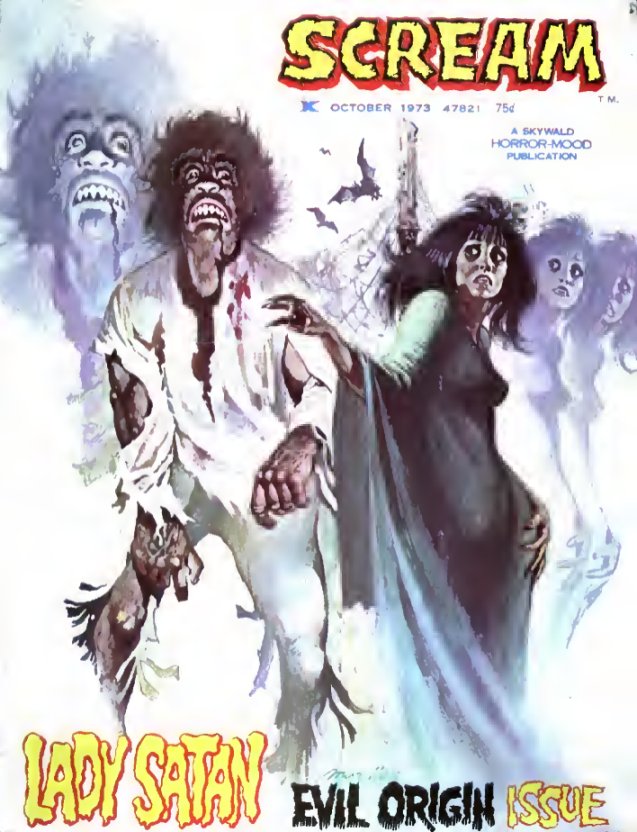
Scream #2

Jose Miralles provides the cover for this issue of Scream, featuring the character Lady Satan. It is cover dated October 1973.

First is Lady Satan in "The Macabre Beginning" by Al Hewetson (story) and Ricardo Villamonte (art). A young woman, Anne Jason, is brought by friends to a tourist attraction in Salem, but is then grabbed by some Satanists, who claim she's the Black Queen of Salem Witches, returned from the dead. Anne shocks them by revealing that she is in possessed by her. The Satanists reveal it was all an act, but she considers things real and calls forth for Satan, to marry him. Around this time Anne is able to repossess her body and not wanting to be married to Satan, flees and jumps off a cliff to her death. This is a bit of a confusing origin story, and VIllamonte's art is rather mediocre

Next is "I Was a Vampire for Hire" by Al Hewetson (story) and Felipe Dela Rosa (art). A man named Watson comes across an advertisement for Stanley, a pretend vampire for hire! Watson hires him to dress up as a vampire and smash through a window at an upcoming party he is holding. Stanley does as he was hired, but it has horrendous results as people freak out and Watson's father in law dies of a heart attack! Stanley finds out that it was all a plot schemed by Watson though, as he is set to inherit money due to his father in law's death. Stanley decides to get revenge, putting on a mask of the father in law and pretending to be him at the funeral, then reveals himself to be alive during it. This causes Watson to blab out that this was all a scheme both he and his father in law cooked up to enable them to easily transfer some holdings. Watson and the others demand to know where the father in law is, as he was only unconscious. Stanley reveals that he hid him in a frozen body compartment in the morgue, and he's now dead for real. Some pretty good twists in this story, A rare Skywald story that ends up not having any actual supernatural element to it.

"I Was a Vampire for Hire"
Next is "Gothic Fairy Tales: The Thing in the Black Dress" by Al Hewetson (story) and Jesus Suso Rego (art). This may be the first in a series, perhaps modeled after EC Comic's Grim Fairy Tales? We get another brief feature in this series at the end of the issue. In this story, an aging woman, angry that she can no longer compete with younger women decides to move to the village of Garg in Transylvania, hoping there she can regain a powerful position in society. She gets a bit of attention, but not as much as another, far younger and more attractive woman. Our protagonist decides she wants to get rid of her and starts telling everyone her rival is a vampire, including showing everyone a dead body with bite marks. A mob forms, and grabs the rival, then pulls her outside, where our protagonist is shocked to find the rival is in fact a vampire and is killed due to exposure to sunlight. Upon her death she calls out our protagonist as a witch. The mob quickly changes their focus, believing it, and our protagonist ends the story bound in a public stock in the middle of town. How volatile the mob was in this story was pretty ridiculous, but Suso's art is quite strong.

Fourth is an Edgar Allen Poe adaption, "The Pit and the Pendulum" with adaption by Al Hewetson and art by Ricardo Villamonte. This classic Poe story features a man who is sentenced to death and is jailed in a cell which contains a large pit in the middle. He avoids the pit, but drinks a drugged cup and later awakens bound on a board, with a pendulum swinging above him and slowly lowering. Our protagonist is able to escape by rubbing food on the ropes binding him, causing rats to bite at them until he is loose. Our protagonist is once again faced with the pit, but now the walls are moving in, forcing him closer and closer to it. But suddenly he hears voices and is freed by a friend. This is a fairly decent story, but I'll admit that Villamonte can't really hold a candle to Jose Ortiz, who also drew an adaption of this story for Warren.

A "Gothic Fairy Tale"
Fifth is "The Phantom of the Opera", a two page feature from Al Hewetson (story) and Maro Nava (art). The first page of this features us seeing how Lon Chaney put on his makeup for the titular role. The second page features a short scene from the movie, of his unmasking. Makes me wonder if this was originally intended for the "Scream Scene" feature we recently saw in some other Skywald issues.

Next is the one page "The Vampire Hunters" by Al Hewetson (story) and Domingo Gomez (art). It features, what else, but some vampire hunters, who come across a crypt with 8 open coffins and stake all the bodies within.

Seventh is "The Vampire Letters" by Al Hewetson (story) and Emilio Bernardo (art). An editor as a newspaper (Howie Anderson, a pseudonym for Al Hewetson, for whom the character is modeled after) publishes a classified ad from a vampiress wanting to meet up with a male vampire. Some bizarre vampire photos start coming into the paper and after he publishes them some actual vampire killings start occurring. Howie investigates and finds the source of the ad, and meets up with the vampiress, the beautiful Anne, who claims it was all a joke. As they embrace and start to kiss he realizes he really is a vampire though. Anne is in love with Howie for real, but he leaves. She chases after him, outside, and the sunlight starts immediately decaying her body. Howie changes his mind, turns around, bites her on the neck and changes into a vampire himself... then instantly dies as well. A somewhat decent story, its always fun to see Hewetson involved in the story in some fashion. Bernardo's art is just okay, but he at least provides a rather gruesome final page.

Another one pager is next, "The Thing That Left No Fingerprints" by Al Hewetson (story) and Ferran Sostres (art). This story features a rabid dog that was shot by its owner come back to life and kill him!

Ninth is "The Fetid Belle of the Mississippi" by Al Hewetson (story) and Jesus Suso Rego (art). This story is told in interesting fashion; the caption show lines from a screenplay while the word balloons include narration. A steamboat, the Robert E. Lee travels down the Mississippi river in Tennessee. Things are initially calm, but then chaos ensues. The body of a woman is found in the wheel of the boat. Then another boat, occupied by corpses bears down on the Robert E. Lee, crashing into it. Then a giant Loch Ness Monster type beats rises from the sea and attacks! It is here where the captain of the Robert E. Lee loses it, shouting out that the script is all wrong. He beats the monster into submission, then grabs an ax and starts chopping away at the captions and says he will rewrite the screenplay. Another one of those crazy, break the fourth wall Skywald stories, which helps what may have otherwise been a rather dull story.

"The Vampire Letters"
Tenth is another entry in the Nosferatu series, "The Name is Sinner Cane... And the Name Means Evil!" by Al Hewetson (story) and Zesar Lopez (art). Similar in fashion to the prior story in this series, the titular Nosferatu has summoned various hooded fiends to eat dinner with him. He calls upon one of them, Sinner Cane, who was a voodoo priest in Haiti. We flash back to his conflict with a man named Papa General, and how he would curse him with unexplained pain. The general starts having Cane's followers murdered, but Cane rises them up as zombies and comes to the General's home. The general is revealed to be holding a doll through which he is able to control Cane's actions, and causes him to burn and mutilate his own body. Cane eventually jumps out of a window and the general causes him to shoot himself in the head. We return to the present and Cane removes his hood, revealing his mutilated corpse body. Zesar's art and atmosphere is quite strong, helping hold up an only slightly better than average story.

The issue concludes with the one page "A Gothic Fairy Tale: A Tale of 2 Macabre Snakes" by Al Hewetson (story) and Felipe Dela Rosa (art). Despite being credited to Dela Rosa, this doesn't really look like his artwork. This is a very simple feature, two snakes attack and eat each other.

Friday, November 29, 2019

Nightmare #15

Happy black Friday, everyone! We've got another Ken Kelly cover for this issue of Nightmare, cover dated October 1973.

The frontispiece for this issue is "How They Killed the Chicago Vampiress" by Ed Fedory (story) and Emilio Bernardo (art). It features a dead young woman having her body burned due to feat of her being a vampire. In what may have been a production error, an image from the story "15 Dead Things" which was originally intended for Psycho #15 appears on the table of contents page, rather than an actual story from this issue. That story will finally appear soon in Psycho #15.

First story is "Dracula Did Not Die!" by Al Hewetson (story) and Antonio Borrell (art). The first few pages of this story act as a historical account for the real life Dracula, Vlad the impaler. It was thought he was dead, but when his coffin is dug up only a horse's skeleton is found inside. Vlad/Dracula laughs at being able to fake his own death, but does regret that he'll have to hide himself and not be able to take advantage of his wealth, influence and power. Dracula explains how he was able to fake his death and killed any witnesses. He heads towards his castle, finding it on fire and swears those doing so will pay. The story suddenly stops here, implying that his will be the start of a multi-part series. Some pretty good art from Borrell here, although this is much more of just an introduction than a full story.

"Dracula Did Not Die!"
Next is "The Gargoyle Who Went to War", a two page feature from Al Hewetson (story) and Fernando Rubio (art). This brief story takes place in Paris France where some people gather to look at the gargoyle statue on the Cathedral of Notre Dame. Natzis arrive and take over the city, lining up people to be shot. Then suddenly, the gargoyle comes to life and kills the soldiers. This story is unrelated to the long running Gargoyles series.

Third is another two pager, "The Truth Behind the Myths About Bats... Particularly Vampire Bats" by Al Hewetson (story) and Domingo Gomez (art). Rather than being a typical story, this is rather a two page feature providing factual information about different types of bats.

Following this is "The Kid and the Killer and the Bum Rap" by Al Hewetson (story) and Francisco Cueto (art). A man named Miller is brought to jail, claiming he's been framed. He is put in a cell with a man named Eddie, who claims that he was beat up by him when he was a kid. Miller admits to being a killer, but claims he didn't commit the murder they claimed he did. Eddie and Miller start talking about things that Miller did when he was younger, including some murder he actually committed. Eddie tells Miller that he is in here for killing his wife, and his brother, his father, his landlord, a gay neighbor, many cops, doctors, etc... and says now he's going to kill Miller. We hear the guards laughing as the story ends. A rather abrupt ending to this, and we gotta presume Miller died, although why the guards would be in on it I'm not sure. Cueto's art is at least a little better than usual here.

"THe Kid and the Killer Bum Rap"
Fifth is "Tapestry of Blood" by Ed Fedory (story) and Fernando Rubio (art). A man finds himself shipwrecked on an island in the south Pacific. To his horror, he soon sees a fellow man killed by a giant snail! He beats the snail to its death but it is too late to save the man. Suddenly another man wearing an overcoat, hat and sunglasses appears. Calling himself a doctor, he leads our protagonist into the woods and to his camp. There he tells our protagonist of how his wife lies in the waters beyond the reef and he can never leave. Our protagonist later follows him, and the doctor explains how he died and was resurrected, and how our protagonist killed "Grayson" who is revealed to be the snail he attacked earlier. The doctor removes his sunglasses, revealing himself to be a snail like creature and bites into our protagonist! Quite a fun ending to this story, which I enjoyed.

Snail man!
Sixth is another in the Shoggoths series with "The Grotesque Green Earth" by Al Hewetson (story) and Zesar Lopez (art). Hewetson and Zesar are actually characters in this story! They receive a letter from a Howard Hay in Arkham, Massachusetts. Upon arriving he tells them of manuscripts he's found from a woman from approximately a century ago who lived by the river. We then flashback to see the woman as she writes. At her husband's grave she finds a hole that leads her down into a lengthy pit. This eventually leads to a large cavern where she finds an underground city. Inside she finds a library filled with zombies,, writing of man's doom. Suddenly some Shoggoths arrive. They chase her back up to the surface and even after she makes her way there they make it through. Hay, Hewetson and Lopez head to where the papers were found and it leads to an underground tunnel where they find her skeleton, where she's written that they will come to the Earth, in 1973! This story's style is much like the previous Shoggoths story in Scream #1 and reads as if it was a Lovecraft story itself. Zesar's art is strong as well, making this a pretty high quality story.

The Shoggoths return!
Next is "Ravings of the Damned" by Ed Fedory (story) and Juez Xirinius (art). A pair of archaeologists in a temple find a desecrated corpse of one of their men in front of a large statue. One of the men thinks a monstrous snake did it, while the other thinks it is Quontotaz, an Indian legend. Later that night, one of the men hears the other screaming. It is the statue, come to life and crushing him in its arms. Months later another expedition arrives. The remaining man is now worshiping Quontotaz, and is in a beast like form. Just there, the stories stops rather abruptly. A quick ending to an average at best story.

We wrap up with another story in the Gargoyles series, "Once Upon a Time in Alabama: A Horror" by Al Hewetson (story) and Maelo Cintron (art). Edward and Mina, with their child Andrew hitchhike their way to Birmingham, Alabama. Edward is able to get a job on a construction work site and saves a man falling from above. Just then, another, evil gargoyle arrives. He demands Edward fight him, or his wife and child will be killed by being shot by a madman at a riot (how a gargoyle can be killed by mere bullets eludes me...). Edward has had enough, decides to fight the enemy gargoyle and kills him. He then finds Mina and Andrew, safe and sound at a rally. This is standard fare for the Gargoyles series, pretty good art, but a rather uninteresting story. Gargoyles face some discrimination. Edward fights some sort of monster. Rince and repeat.